The Collapse of Compute Costs: Small Fields Building Tools on Their Own Terms
Google I/O 2026 proves the democratization of intelligence—a unique lever for non-capital regions and primary industries.
Google has drastically reduced the cost of its highest-tier artificial intelligence and introduced agents that operate autonomously around the clock. The collapse of this massive compute barrier means something profound for places like ours. For the first time in history, small fields and non-capital regions hold the power to design and build tools precisely calibrated to their own real-world problems.
The metrics revealed at the Google I/O 2026 keynote demonstrate that intelligent computation has become as foundational as electricity or water. Gemini’s monthly active users reached 900 million within a single year, and the models now process a staggering 32 quadrillion tokens per month—a sevenfold increase from the previous year. Yet the most critical metric is the plummeting cost of access. Google introduced a new AI subscriptions tier, AI Ultra, priced at $100 per month. By bundling the Gemini 3.5 Flash model with 20TB of storage, top-tier infrastructure can now be deployed into any local operation with minimal financial friction.
The objective of massive technology firms is clear. As CEO Sundar Pichai stated, their focus is on providing the power of agents to "work for everyone." They are building the ultimate general-purpose tools. However, a general-purpose system inherently lacks the granular context of a specific local environment. This is exactly where slower places hold an undeniable advantage. The entities who most intimately understand the seasonal crop yields of a Yeongyang apple orchard, the daily foot traffic of a neighborhood pharmacy, or the complex inventory flow of a regional workshop are the practitioners standing directly on that ground. Armed with an ecosystem of 8.5 million developers and universally accessible tools, small, sturdy fields can now layer their living, on-the-ground data over cheap compute to forge customized assistants that exist nowhere else in the world.
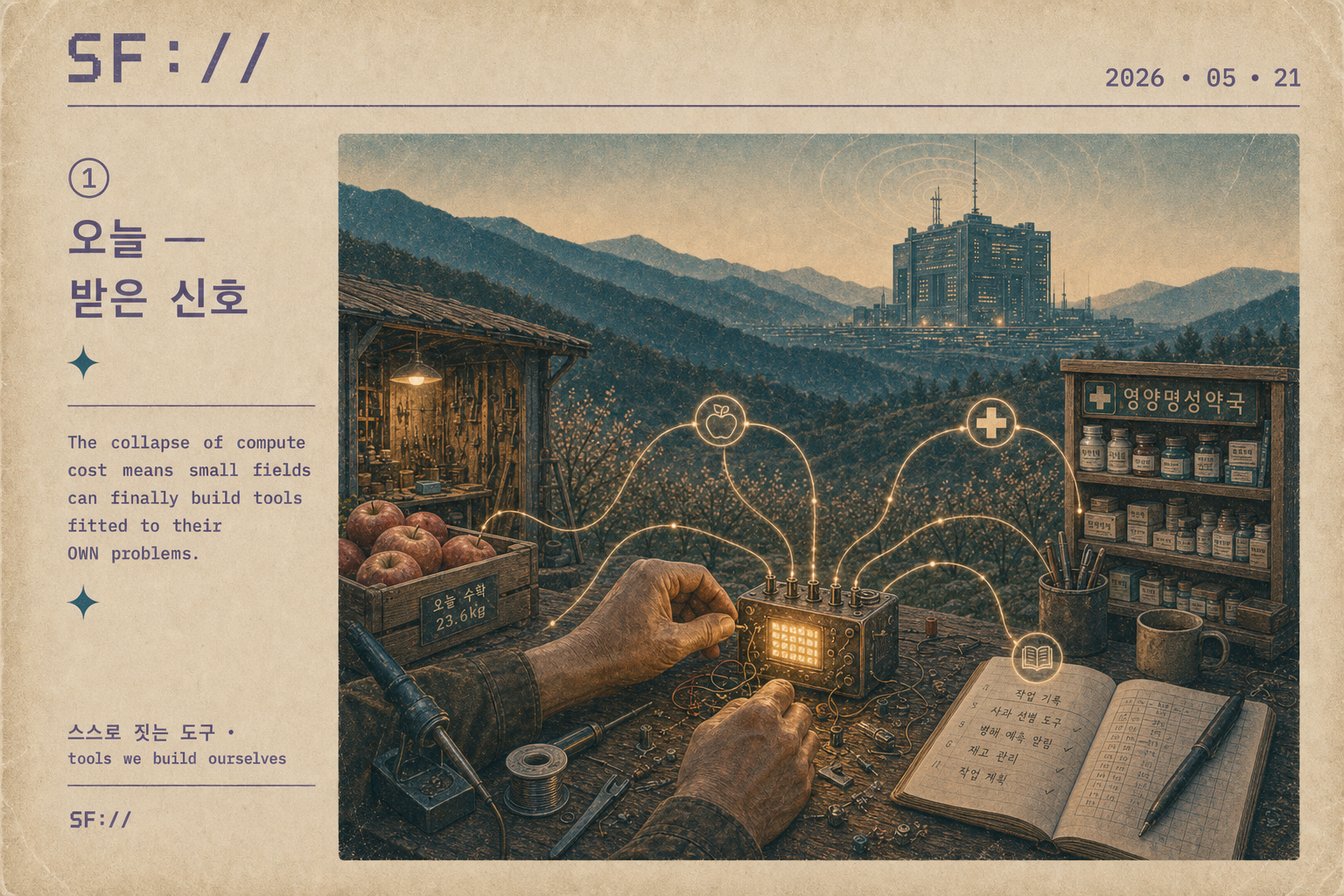
Consider the newly announced ‘Gemini Spark’, an agent that continues executing user instructions, managing emails, and updating spreadsheets within a cloud virtual machine 24/7, even after the application is closed. The official rollout begins as a US-only beta, but we do not need to wait passively for a finished service to cross the ocean. By utilizing currently open APIs and AI Studio, we can immediately connect a local cooperative's decade of ledger data or agricultural records. We can pull this 24/7 autonomous work environment into our present reality today—building the precise contextual engine that Silicon Valley cannot build for us.
The arrival time of technology to the local field is not a fixed schedule written elsewhere. It is a variable determined entirely by our own actions—by how rapidly we choose to integrate our proprietary data with these newly accessible tools. Amidst the sweeping wave of general-purpose technology, small and sturdy fields are now positioned to step forward as the most active architects of their own solutions.
⏱ The time we pull forward
- Possible now: Connecting raw, local data—such as a workshop's daily inventory or an orchard's yield history—to top-tier AI models via open APIs to automate contextual analysis.
- What we can build within a year: Fully autonomous, 24/7 local agents that manage cooperative ledgers and predict seasonal supply chain needs without relying on pre-packaged, generic software.
- The key that shortens it: Taking immediate ownership of our domain knowledge. The faster we map our specific on-the-ground workflows to available computing tools, the faster the technology arrives.
- Basis: The $100/mo AI Ultra tier and Gemini 3.5 Flash integration, which fundamentally lowers the barrier for high-performance compute (AI subscriptions).
- What it means: We no longer wait for a global technology company to localize a product for our specific needs. We are the architects of our own operational intelligence, leveraging cheap compute as our foundation.
One thing we can do this week: Identify one recurring, data-heavy task in your local operation—such as a weekly inventory tally or a daily customer flow log—and run a small sample of that data through an open AI Studio to see how easily your unique context can be organized.
📎 Sources: Google I/O 2026 keynote · Gemini's 24/7 agent · AI subscriptions
→ More: Today · SF:// Receive

この記事は明星心齋の深層思考エンジン
Simthink Engine (深 Think)により執筆されました。