1면 톱
The Governance OS Ships Twice a Week
Google Gemini Enterprise · Cheongsong's Post-Public-Physician Model · 5/6 SF:// Brief
글 SF://
에디터 · SF:// · 제 4호
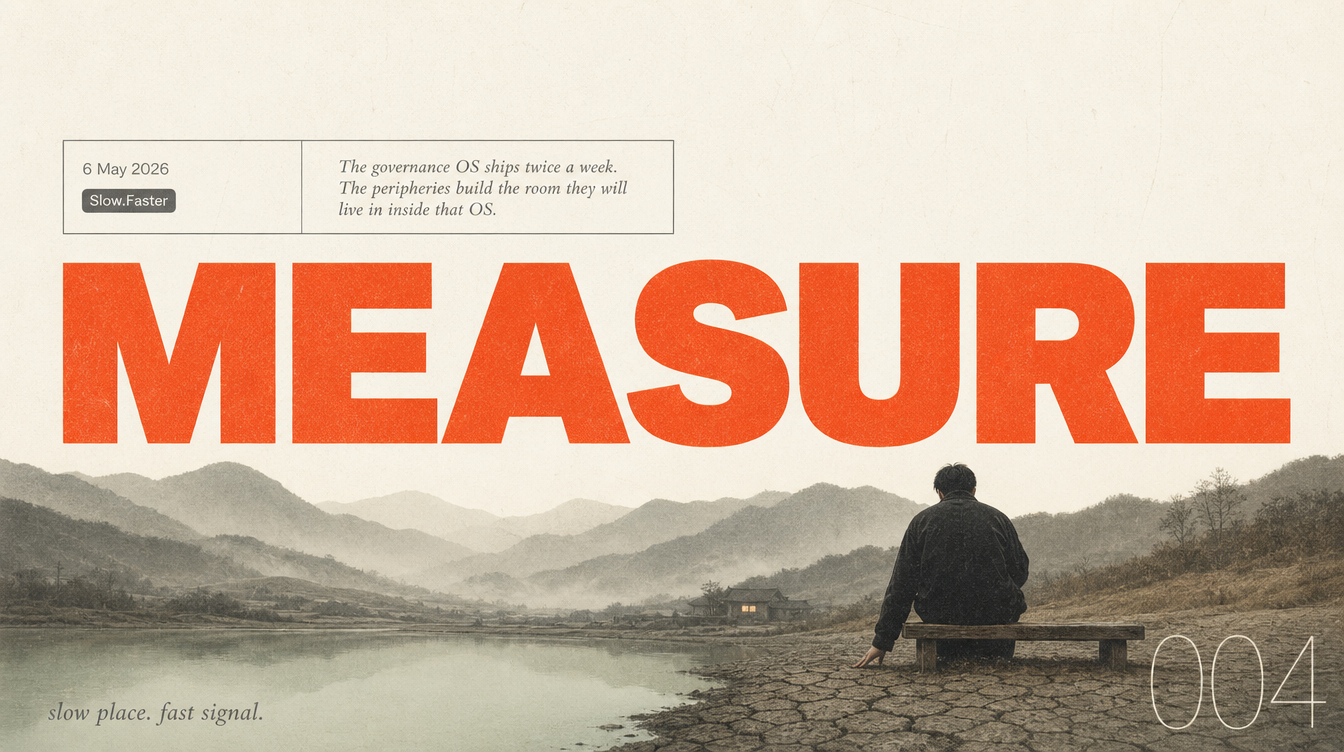
A week after Microsoft Agent 365 GA (5/4), Google has unveiled the Gemini Enterprise Agent Platform — two hyperscalers shipping "agent governance OS" within seven days. In the same week, Cheongsong County (next to Yeongyang) launches a post-public-physician standard model that combines AI, robotics, and home-based care. The lag between those flows is not exclusion but a voluntary distance — the silent verdict of "not enough, not yet" meeting the half-life curve of falling expert thresholds. SF:// measures the point where those two curves cross.
slow place. fast signal.
Issued · SF:// · 2026-05-06 (KST)
At a Glance
| Section | Signal |
|---|---|
| 🧭 Editor's View | The governance OS is shipped twice a week. The peripheries build the room they will live in inside that OS. |
| ⚡ TL;DR | 5 headlines |
| ⭐ Big Story | Google Cloud Next '26 — Gemini Enterprise Agent Platform |
| 🚀 Models & Products | Gemini 3.1 Pro · Flash Image (Nano Banana 2) · Lyria 3 |
| 🔬 Research | Anthropic Automated Weak-to-Strong Researcher · International AI Safety Report 2026 |
| 🏢 Industry | Pentagon's 7 vendors + Reflection AI in week 1 · NVIDIA Rubin $5.26T cap · Enterprise agents 31% in production |
| ⚖️ Policy | EU AI Act Aug 2 enforcement looms — Digital Omnibus trilogue stalled, May 13 third round |
| 🇰🇷 Korea Focus | AI EXPO KOREA 2026 opens today · government AI budget ₩9.9T (3× YoY) |
| 🏛 Regional | ★ Cheongsong County's post-public-physician model — combining AI, robotics, and home care |
| ⚡ Quick Hits | Boryeong AI DRT regulatory sandbox · 3 Gyeongbuk universities AI base curriculum ₩1.8B · GAMFF September |
| 📌 Wrap | Tracking 5/4 + 5/5 issues; Cheongsong deep-dive forthcoming |
🧭 Editor's View — How to Read Today's Headlines
The signals from this week converge on a single point. Following Microsoft Agent 365's general availability — covered in our 5/4 issue — Google has unveiled the Gemini Enterprise Agent Platform at Cloud Next '26. By absorbing Vertex AI and putting more than 200 models — including Anthropic's Claude Opus, Sonnet, and Haiku alongside Gemini 3.1 and Lyria 3 — onto a single graph, the "agent governance OS" is now a product line for both hyperscalers. The pattern we sketched yesterday (5/5) — who occupies the seat where governance standards are set — has registered as a market signal in less than a week. One honest disclosure: SF:// itself is produced each week with help from enterprise engines like Claude (Anthropic), SK NUGU, and Google Gemini. Not refusal. Measurement.
In the same week, Cheongsong County — the next county over from Yeongyang — has launched a "post-public-physician era standard model" that fills its rural medical workforce gap with AI, robotics, and home-based care, backed by ₩15 billion in the 2026 budget. A small county is now piloting both halves of AI dementia care at once: the SK Telecom NUGU-based "Aria" voice assistant for cognitive support, and a robotic rehabilitation room opened in February. The governance OS is built far away. The peripheries build the room they will live in inside that OS. Measuring the lag between those two flows is what SF:// does each week.
A note on what that lag actually is. After a recent lecture I sat with the question for several days, and the conclusion that arrived was this: what looks from outside like exclusion is, more honestly, a voluntary distance. A silent verdict — "not enough, not yet" — operates on this ground every day. At the same time, the time it takes a domain expert to fold AI into their own work has shrunk from a month to a week to three or four days, on a half-life curve that quietly chips away at that verdict. What SF:// is trying to measure each week is the point where those two curves meet. Cheongsong is the place that arrived first at that point, which is why it gets its own deep-dive issue next week.
— Chi-hoon Shin, Ph.D. · Editor
⚡ TL;DR
- Google Cloud Next '26 — Gemini Enterprise Agent Platform unveiled, Vertex AI absorbed, $750M partner fund
- Pentagon's 7-vendor + Reflection AI contracts enter week 1; Anthropic's blacklist designation holds
- NVIDIA Rubin enters full production — $5.26T cap, $62.3B data-center quarter
- EU AI Act Aug 2 high-risk enforcement looms; May 13 third trilogue decides
- ★ Cheongsong's post-public-physician model — a county next to Yeongyang piloting AI speakers, rehab robots, and home-based care together
⭐ Big Story
Google Cloud Next '26 — Gemini Enterprise Agent Platform Unveiled ★★★★★
Vertex AI absorbed; 200+ models including Claude, Gemini, and Lyria 3; graph-based sub-agent network; $750M partner fund
Google has launched the Gemini Enterprise Agent Platform at Cloud Next 2026. Four points capture the announcement.
- Vertex AI absorbed: Going forward, Vertex AI's services and roadmap will evolve through Agent Platform rather than as a stand-alone offering.
- Model lineup: Gemini 3.1 Pro for complex workflows; Gemini 3.1 Flash Image (Nano Banana 2) for visual assets; Lyria 3 for professional-grade audio; and Anthropic's Claude Opus, Sonnet, and Haiku — more than 200 models in total.
- Agent graph: Sub-agents organized into a graph-based framework, with explicit, reliable logic for how they cooperate on complex problems.
- Partner fund: A $750M innovation fund for partners building agents for specific business processes and industries.
This is the second "governance OS" to ship in a single week, paired with Microsoft's Agent 365 GA — which we covered in our 5/4 issue. Two hyperscalers releasing an "AI control OS" within seven days is not a coincidence. The single observation we drew from yesterday's five thinkers — who occupies the seat where governance standards are set — is being registered as a live market signal almost immediately.
Why it matters: The graph and the platform that bind models together are becoming the standard before the models themselves. Korean SI and SaaS companies must now decide where they want to sit on this graph — as consumer, partner, or integrator.
⏱ Time-to-arrival in Korea
- Global hyperscalers and Seoul-based AI HQs: now (already in GA)
- Korean metro-area SI, finance, manufacturing: 6–12 months (Vertex AI → Agent Platform migration in progress)
- Non-metro counties (places like Yeongyang): 2–3 years (procurement cycles plus thin operational headcount)
- Evidence: Five days into Microsoft Agent 365 GA, we see no movement in county-level SI procurement notices in North Gyeongsang Province. Same for Pentagon contracts in week 1.
- What it means: A 6–12 month gap in metro Korea against a 2–3 year gap in the peripheries is not a procurement delay. It is the result of a voluntary distance — the silent verdict of "not enough, not yet". Our weekly job is to measure where, in which domains, and on what signals that verdict begins to shift.
📎 Google Cloud blog · The Journal · 6 min
— Chi-hoon Shin, Ph.D. · Editor
🚀 Models & Products
Gemini 3.1 Pro · Flash Image (Nano Banana 2) · Lyria 3 ★★★★☆
Released within the Big Story above. Gemini 3.1 Pro is the reasoning model for complex workflows; Flash Image (Nano Banana 2) is the next-generation text-to-image and image-editing model; and Lyria 3 handles professional-grade audio generation. All three are callable directly from inside the Agent Platform — that is what the "OS" metaphor actually means in practice.
📎 Google Cloud Next 2026 highlights · 3 min
🔬 Research
Anthropic — Automated Weak-to-Strong Researcher ★★★★☆
An AI agent that proposes research ideas, runs experiments, and iterates
Anthropic's Alignment team has released an autonomous AI research agent that outperforms human researchers in some areas, suggesting that "automating this kind of research is already practical." The Anthropic Fellows Program 2026 (May and July cohorts) is also expanding to mechanistic interpretability, scalable oversight, and model welfare.
📎 Anthropic Alignment · 4 min
International AI Safety Report 2026 — Bengio + 30 countries + 100+ experts ★★★★☆
The International AI Safety Report 2026, released in February, is chaired by Yoshua Bengio with more than 100 AI experts from over 30 countries. It is the largest intergovernmental AI safety collaboration to date. The time it takes to enter Korean policy discourse is roughly 6–12 months.
📎 International AI Safety Report · 5 min
🏢 Industry
Pentagon Pushes Through 7-Vendor + Reflection AI Contracts — Anthropic Stays Blacklisted ★★★★★
5/1 enforcement held despite the April 17 Trump–Amodei meeting; Defense Secretary Hegseth's "supply chain risk" designation stands
The Pentagon's May 1 contract enforcement is now one week in. Seven vendors (OpenAI, Google, Microsoft, AWS, Nvidia, SpaceX, and Reflection AI) have entered live operation on classified-network AI contracts. Anthropic remains excluded, with Defense Secretary Pete Hegseth holding firm on the supply-chain-risk designation he formalized in March. The April 17 White House meeting between Anthropic CEO Dario Amodei and chief of staff Susie Wiles did not change the May 1 timeline. Anthropic is in federal court — a California judge blocked part of the administration's order in April.
Why it matters: The frontier lab with the strictest safety posture has been excluded from the largest government market. That cascades into how allied governments — Korea, Japan — handle their own classified-AI procurement. "Refuse the contract on safety grounds" becomes a short-term loss but a long-term reputational asset. Korean LLM vendors will face the same trade-off when they bid on government work.
📎 CNN · Defense News · 6 min
NVIDIA Rubin in Full Production — $5.26T Cap, $62.3B Data-Center Quarter ★★★★☆
NVIDIA's six-chip Rubin platform has entered full production. FY2026 revenue: $215.94B; data-center segment alone: $62.3B in a single quarter. Bank of America has raised its 2026 chip-market forecast to $1.3T — $300B above where it sat four months ago. TSMC is doubling its 2nm fab buildout.
📎 NVIDIA Investor Relations · 4 min
Enterprise Agents Reach 31% in Production — Banking 47%, Healthcare 18% ★★★☆☆
80% of enterprise apps shipped or updated in Q1 2026 embed at least one AI agent, up from 33% in 2024. But only 31% of enterprises have an agent in production. The gap is sectoral: banking and insurance lead at 47%, while healthcare and government trail at 18% and 14%. Median time-to-value is 5.1 months — SDR agents pay back in 3.4, finance and ops in 8.9.
📎 Writer Enterprise AI Report · 5 min
⚖️ Policy
EU AI Act Aug 2 Enforcement Looms — May 13 Third Trilogue Decides ★★★★☆
The April 28 second political trilogue stalled. May 13 will determine whether the original Aug 2 timeline holds.
The EU AI Act's high-risk obligations are scheduled to take effect August 2, 2026. In November 2025 the European Commission proposed the Digital Omnibus, which would defer those obligations until December 12, 2027. The April 28 second political trilogue failed to reach agreement, with a third scheduled for May 13. If the parties cannot agree by May 13, the original Aug 2 timeline applies as written — with immediate consequences for Korean firms entering the EU market.
📎 AI Act Service Desk · IAPP · 5 min
🇰🇷 Korea Focus
AI EXPO KOREA 2026 Opens Today — COEX Hall A, 18 Countries, 330 Companies, 562 Booths ★★★★☆
Four keywords: physical AI, LLM, AI infrastructure, AI agents
The 9th AI EXPO KOREA 2026 opens today, May 6, at COEX Hall A and runs through May 8. Eighteen countries, 330 companies and institutions, 562 booths. Four keywords frame the show: AI agents, LLMs, AI infrastructure, and physical AI. Korean foundation-model companies including Upstage ("Solar") and Twelve Labs (video understanding) are running booths.
📎 COEX event page · 3 min
Korean Government's 2026 AI Budget Hits ₩9.9T — Triple 2025's ₩3.3T ★★★★☆
Ministry of Science and ICT ₩5.1T, Ministry of Industry ₩1.7T, SMEs and Startups Ministry ₩900B. Inside the SME ministry's industrial and regional AI transition program (₩243.7B total) sits a region-led AI transition track of ₩49B. The Rural Development Administration's AI and green-bio budget is a separate ₩1.13T for 2026. The national picture is set; whether that money reaches county-level peripheries is a separate question.
📎 Korea Policy Briefing · Rural Development Administration release · 4 min
🏛 Regional
⭐ Cheongsong County's Post-Public-Physician Model — AI, Robots, and Home-Based Care, Together ★★★★★
A county next to Yeongyang piloting both software and hardware halves of AI dementia care on a ₩15B 2026 budget — the closest anchor SF:// has to its own identity
Cheongsong County is filling its public-physician shortage with AI, robotics, and home-based medical care, calling it a "post-public-physician era standard model." The 2026 budget is ₩15 billion: directly hiring two salaried physicians, plus AI and robotic infrastructure. The two systems Cheongsong is combining:
1. AI Smart Care Service — Cheongsong's Dementia Care Center partnered with Happy Connect (an SK Telecom social-impact foundation) to deploy the SK Telecom NUGU-based "Aria" voice assistant. Four functions: cognitive reinforcement, social engagement, medication management, and 24/7 emergency SOS. The program is being expanded to 30 households with mild cognitive impairment or early dementia.
2. Robotic Rehabilitation Room — Opened February 2, 2026 by the Cheongsong County Public Health and Medical Center, located on the first floor of the Dementia Care Center. The room is equipped with rehabilitation robots for patients with physical or brain-lesion disabilities — but the public press releases do not name the robot vendors or models. We are pursuing this directly with the medical center.
📚 Deep-dive issue forthcoming — How exactly Cheongsong's two systems work; how they compare to global anchors (Pacific Living's "Kathy" pilot in Oregon — 47.8 minutes per resident per day on average; Japan's 20-year experiment with PARO and Pepper); and the lineup of 17 Korean players (Naver Clova CareCall in 140 institutions reaching ~30,000 elders, Sevenpoint One AlzWin, Neurophet AQUA AD, Hi AlzGuard, Emocog, WIROBOTICS WIM, Cosmo Robotics, Rainbow Robotics, and more) will run as a separate deep-dive issue next week. Direct reporting in progress.
Why it matters: Cheongsong sits next to Yeongyang. A small county piloting both halves of AI dementia care — software (AI voice) and hardware (rehab robots) — at the same time is a prototype that places like Yeongyang, Jeongseon, and Taebaek can adopt within 6–12 months. The catch: twenty years of Japanese data on PARO and Pepper point to a paradox — staff burden often grows after deployment, and patient attachment to the device requires its own management. Whether that paradox repeats in Korea has not been measured. SF:// starts measuring with the next issue.
📎 Kyongbuk Ilbo · Daily DG News · Segye Ilbo · 7 min
⚡ Quick Hits
- Boryeong (Chungnam) AI rural-DRT regulatory sandbox — AI-driven Demand Responsive Transport granted regulatory exception. Rural transport prioritizes resident benefit over fiscal efficiency.
- 3 Gyeongbuk universities win ₩1.8B AI base curriculum funding — Kyungwoon, Kyungbook National (WISE), and Dongguk WISE campus, ₩600M each over two years.
- GAMFF in September — Gyeongbuk International AI & Metaverse Film Festival, Sep 3–6 in Gumi, Pohang, and Gyeongsan. ₩100M total prize pool.
- OpenAI delays AI device launch to 2027 — Hardware launch slips from H2 2026 into 2027.
- ₩60T over 5 years for national strategic technologies — 55 technologies including AI, semiconductors, and bio.
📌 Wrap
This week's lens — the governance OS is shipped twice a week, and the peripheries build the room they will live in inside that OS. Cheongsong gets its own deep-dive issue next week.
Tracking past issues:
- 5/4 [Microsoft Agent 365 GA] → Five days in, zero county-level deployments. Monitoring continues.
- 5/5 [The five seats of AI sovereignty] → "The seat of governance standards" hardened within a week into Google's Gemini Enterprise. Next academic-research section continues this line.
Today, again, we sow seeds in dry soil.
— Chi-hoon Shin, Ph.D. · Editor
🤖 AI disclosure
This issue is produced each week with help from enterprise LLM tools — Claude (Anthropic), SK NUGU, Google Gemini, and others. The editor (Chi-hoon Shin, Ph.D.) is responsible for fact-checks, primary-source verification, and tone. Every primary-source link in this issue was verified at publication time.
A periphery-focused publication produced with hyperscaler tools is an irony, but our position is not refusal — it is honest measurement. The SimThink engine is an IP of Myeongseong-Simjae Inc. — an education company independent of SF:// — and not an asset of the Yeongyang AI Association.
This issue is licensed under CC BY-NC 4.0. Attribution: SF:// (yyaia.org).
Contact: contact@yyaia.org