1면 톱
The single-seat assumption around AI infra is wobbling
and two arrival channels are being laid into shadow zones
글 Yeongyang AI Association
에디터 · SF://
Four opening moves (Apple-Intel · IREN-Nvidia · SpaceX · Samsung) shake the single-seat AI-infra assumption. The same quarter, MAFRA's Agriculture-Rural AX Strategy and Daedong's agricultural physical AI lay two parallel channels toward shadow zones like Yeongyang. "Slow Future" #003 fills the empty slot between them. (SF:// 2026-05-09 KST)
slow place. fast signal.
Issued · SF:// · 2026-05-09 (KST)
🧭 Editor's View — How to read today's headlines
This week's headlines collapse into two sentences.
One, the assumption that AI infrastructure is locked behind a single company is starting to wobble. Apple-Intel chip talks (TechCrunch 5/8, CNBC 5/8), IREN-Nvidia 5GW DSX (CNBC 5/7), SpaceX Texas Terafab $119B (TechCrunch 5/6), Samsung passing $1T (TechCrunch 5/6) — four opening moves in one week. We're not declaring NVIDIA's monopoly over. Too many off-board variables remain. But the single-seat assumption is no longer safe to operate on.
Two, channels into our seat are also being laid. On March 11, Korea's Ministry of Agriculture, Food and Rural Affairs (MAFRA) announced an inter-ministry "Agriculture and Rural AI Transformation (AX) Strategy" — a domain-specialized agricultural foundation model, the AI Isaki voice assistant, and a county-level shared AI farm-equipment center program, all placed at once (korea.kr, AITimes). The same quarter, Daedong — Korea's #1 farm-equipment maker — released the country's first AI tractor on April 9 (ZDNet 4/9), unveiled an "agricultural physical AI" corporate strategy at its 2026 Tech Day on April 28–29 (Etnews 4/29, ZDNet site report 4/29), and on May 7 announced an integrated value-up roadmap across its three listed entities (ZDNet 5/7). One channel built by policy, one channel built by industry — both being laid in the same quarter, both targeting the last mile into shadow zones like Yeongyang and Cheongsong.
How long either takes to reach the row of perilla seedlings at the edge of one's yard is not the same. Yeongyang is one anchor we use to measure that gap, not estimate it.
📋 Issue Matrix
| Slot | Category | Item | Stars |
|---|---|---|---|
| S5 Big Story | industry | The single-seat assumption around AI infra is wobbling | ★★★★★ |
| S6 Models·Products | tools | OpenAI's first community event after GPT-5.5 | ★★☆☆☆ |
| S9 Industry | industry | OpenAI and Anthropic launch enterprise JVs the same week | ★★★☆☆ |
| S10 Policy | policy | Pentagon-Anthropic standoff persists; Trump admin opens federal AI evals | ★★★★★ |
| S11 Korea | korea | Korean AI market: ₩14T → ₩41T by 2032 (Statista) | ★★★☆☆ |
| S12a Local | local | MAFRA Agriculture-Rural AX Strategy — policy channel into shadow zones | ★★★★★ |
| S12b Local | local | Daedong agricultural physical AI — industry channel into shadow zones | ★★★★★ |
| S15a Slow Future #003 | fiction | "Rain in July, Han-yi's Silence" (by Yeon-soo Baek) | ★★★★★ |
| S15b Editor's Note | — | The empty slot between two arrival channels | ★★★★☆ |
| S(CTA) Contributions | — | ✉️ Open call from the periphery | ★★★☆☆ |
| S16 Tools used | — | Tools used to compose this issue | ★★☆☆☆ |
⚡ TL;DR
- Apple-Intel · IREN-Nvidia 5GW · SpaceX Terafab · Samsung $1T — four opening moves toward distributed AI infra (★★★★★)
- Pentagon-Anthropic stalemate continues; Trump admin opens federal pre-release AI evals (★★★★★)
- MAFRA "Agriculture-Rural AX Strategy" — agri foundation model · AI Isaki · county shared centers (★★★★★)
- Daedong AI tractor released; 2026 Tech Day physical-AI strategy; 5/7 group integrated vision (★★★★★)
- Korean AI market ₩14T (2026) → ₩41T (2032) per Statista, CAGR 19.17% (★★★☆☆)
⭐ Big Story — The single-seat assumption around AI infra is wobbling
May 8, Wall Street Journal — Apple has reached a preliminary agreement for Intel to fabricate a slice of its iPhone silicon (TechCrunch 5/8, CNBC 5/8). Intel stock closed up ~14%. The reason this single-line story claims a seat in the AI-infra story is simple — TSMC alone cannot absorb global advanced-node demand, and Intel's 18A node in Arizona has now materialized as the second viable node.
Three more opening moves on adjacent intersections:
- IREN-Nvidia 5GW: Data-center operator IREN signed a partnership to deploy up to 5GW of Nvidia DSX-branded infrastructure (CNBC 5/7).
- SpaceX Terafab: SpaceX is reportedly considering up to $119B for Terafab, a self-owned chip facility in Texas (TechCrunch 5/6).
- Samsung $1T: Samsung crossed a $1T market cap on May 6 (TechCrunch) — Korea's first trillionaire conglomerate.
Pull the four moves into one frame: the assumption of an AI-infra monopole is shaking. Which move proves decisive isn't visible yet.
⏱ Arrival lag
- SF · Seoul big tech: immediate — supply-chain renegotiation options on the table this weekend.
- Korean · Japanese · EU enterprises: 6–12 months — review rounds for Samsung memory + Intel 18A integration.
- Periphery farmers and small businesses: 5–10 years or never — chip restructuring isn't a signal that arrives at the periphery directly. What does arrive is the price and access shape it produces.
Evidence: TechCrunch / CNBC / WSJ reports from 5/6–5/8 (4 sources).
Why this matters: The question of which silicon will run our county-level data centers, robots, and farm equipment in 5 years re-branched this week.
🚀 Models · Products
OpenAI's first community event after GPT-5.5
OpenAI hosted a "GPT-5.5 party" community event on May 5, following the April 23 release of GPT-5.5 (AITimes 5/8). The model competes head-to-head with Gemini 3.1 Pro and Claude Opus 4.5 (TechCrunch 4/23).
Why this matters: AI houses pushing past model release into super-app and community event — opening moves for lock-in beyond benchmark performance.
🏢 Industry
OpenAI and Anthropic launch enterprise JVs the same week
On May 4, both OpenAI and Anthropic announced separate enterprise-AI joint ventures (TechCrunch 5/4). OpenAI's JV raised $4B from 19 investors at a $10B valuation. Anthropic's JV mirrors the structure.
Why this matters: Opening moves on the model-house → solutions-house pivot. For Korea, the next 6–12 months are about how Samsung SDS · LG CNS · KT Cloud · Naver Cloud structure their channel deals with each JV.
⚖️ Policy
Pentagon-Anthropic stalemate + Trump admin federal AI evals
May 7, Axios reports — Pentagon CTO Emil Michael said publicly that no near-term resolution with Anthropic is in sight (Axios 5/7). Anthropic's two red lines for military Claude usage — no mass surveillance, no autonomous weapons — remain unaccepted by the Pentagon. The same week, the Center for AI Standards and Innovation signed formal evaluation agreements with Google DeepMind, Microsoft, and xAI (CNBC 5/5).
Why this matters: AI governance is being laid out along two parallel tracks — private red lines (Anthropic posture) versus federal evaluation regime (Trump admin posture). Korea's stack has to pick a compatibility orientation against both within 6–12 months.
⏱ Arrival lag
- US big tech: immediate — federal-lab pre-release evals are now a new release gate.
- Korean · Japanese · EU governments: 6–12 months — interoperability negotiations.
- Periphery municipal admin and welfare systems: 2–5 years — which-eval-passed becomes a procurement criterion.
Evidence: Axios 5/7, CNBC 5/5 and 5/1.
Why this matters: Periphery county offices and welfare centers, when they eventually adopt LLM tooling, will face a which-eval-passed question on procurement forms.
🇰🇷 Korea Focus
Korean AI market ₩14T → ₩41T by 2032 (Statista)
May 6, Digital Daily citing Statista — Korean AI market sized at roughly ₩14.39T in 2026, projected to ₩41.24T by 2032 (DDaily 5/6). CAGR 19.17%.
Why this matters: The growth curve itself is not the most important number. What share sits in periphery counties versus Seoul-metro? — has no public breakdown. Registered as a W3 measurement gap.
🏛 MAFRA "Agriculture-Rural AX Strategy" — A policy channel being laid into shadow zones
March 11, the 5th Science-Technology Ministers' Council. Minister Song Mi-ryung of the Ministry of Agriculture, Food and Rural Affairs (MAFRA) announced the inter-ministry "Agriculture and Rural AI Transformation (AX) Strategy" (korea.kr policy briefing, AITimes). The vision: "AI to make farming easier, supply more stable, and rural life more livable." Four pillars and 13 tasks: (1) production innovation, (2) supply-chain modernization, (3) rural quality-of-life, (4) AX ecosystem foundation.
Four opening moves — selecting the ones that matter most for periphery readers:
- Domain-specialized agricultural foundation model — model variants for major crops (soybean, wheat). One Korean-domain model not dependent on imported LLMs now sits as a government-named asset.
- AI Isaki — voice-based farm-knowledge assistant — operated by the Rural Development Administration, the AI Isaki voice agent expands to an "all-time farm-knowledge service" covering planning through daily decisions (korea.kr RDA). Voice-first interface — meaning farmers in their 60s–80s can reach it. Highest periphery affinity.
- County-level shared AI farm-equipment centers — farmers don't buy AI equipment; they share it via county centers. When Yeongyang or Cheongsong receives such a center directly determines arrival.
- National Agricultural AX Platform — integrated optimization platform across open-field, livestock, greenhouses. Preferred negotiator selection underway (korea.kr).
The Rural Development Administration separately announced an "Agricultural Science-Tech AI Convergence Strategy" targeting 20% farm income increase (rda.go.kr), and partnered with Naver Cloud to launch the first agricultural AI agent (rda.go.kr).
⏱ Arrival lag
- Government, research institutes, large agribusiness: immediate — preferred-negotiator and pilot matchings are running through April–May.
- Provincial / city-level: 6–12 months — provincial pilots → city expansion.
- County-level periphery (Yeongyang, Cheongsong equivalents): 2–3 years — assuming shared centers and AI Isaki arrive as county-government programs and reach at least one direct-encounter per household.
- The row of seedlings at one's yard: 3–7 years — assuming AI Isaki can stably parse elderly Korean voice commands including Yeongyang dialect and respond with actionable specifics.
Evidence: MAFRA March 11 release (korea.kr) + RDA strategy release (korea.kr) + RDA-Naver Cloud partnership announcement (rda.go.kr). Periphery arrival estimates are SF://'s own — to be validated with M3 measurement cards.
Why this matters: The last 1 km of these channels is the periphery county. SF:// is registering quarterly tracking on whether each county Agricultural Tech Center receives the shared center or AI Isaki first. Measurement, not estimation.
📚 Deep-dive forthcoming — feasibility of MAFRA's 4 pillars × 13 tasks reaching shadow zones. The next research issue will publish Yeongyang and Cheongsong farm sample N=12, six-month arrival rates for shared center and AI Isaki.
🚜 Daedong agricultural physical AI — An industry channel being laid into shadow zones
In the same quarter, separate from the policy track, Korea's #1 farm-equipment maker Daedong Group placed its blueprint for transformation into an agricultural physical-AI company.
Timeline:
- May 2025 — Daedong begins agricultural AI semiconductor development (ZDNet 2025/5)
- July 2025 — Daedong publishes a 3-stage K-Agri Sovereign AI strategy (DDaily 2025/7)
- January 2026 — Autonomous transport robot and combine receive new-tech farm equipment certification (ZDNet 1/13)
- March 2026 — Orchard-specialized tractor LK series released (ZDNet 3/5)
- April 9, 2026 — Korea's first AI tractor released (ZDNet 4/9, DDaily 4/9)
- April 28–29, 2026 — 2026 Daedong Tech Day at Changnyeong Campus + Daedong Mobility S-Factory, agricultural physical-AI strategy unveiled (Etnews 4/29, ZDNet site report 4/29)
- April 29, 2026 — Daedong Robotics presents agricultural robot full-lineup roadmap, demos mowing robot (DDaily 4/29)
- April 30, 2026 — Transport robot 2026 ₩5B revenue target announced (ZDNet 4/30)
- May 7, 2026 — Daedong Group integrated value-up roadmap across three listed entities (Daedong, Daedong Mobility, Daedong AgTech) (ZDNet 5/7)
Technical specs (per Tech Day site report):
- Vision-AI based unmanned autonomous operation — one app to direct two tractors simultaneously, no driver.
- Smart-roof 6-camera system — auto-generates work paths, real-time detection of bed boundaries and unexpected obstacles.
- Reliability validation — passes –20°C extreme conditions, slopes, wet electronic-control tests, and SW reliability validation.
- Autonomous-driving kit ≈ ₩10M — co-developed with Daedong AgTech using Korean AI tech, price-competitive against imports (Daedong official).
Business model: Subscription AI farm-services bundling autonomous equipment + agricultural robots + over-the-air SW updates. Recurring revenue, not single-sale.
Global plan: 2027 North America launch target. Autonomous farm equipment certification was first earned in 2023 — Korea's first (Hankyung 2023/9).
⏱ Arrival lag
- Large farming corporations and Nonghyup pilot farms: immediate — 4/9 model purchasable now.
- Korean flat-land 100ha+ farmers: 6–18 months — purchase decision rounds for ₩10M autonomous kit + tractor body.
- Mountainous, small-scale periphery farms (Yeongyang, Cheongsong equivalents): 3–7 years — flat-land autonomy must SW-tune to slopes, orchards, terraced rice paddies; plus county subsidy + shared-center matching.
- 70+ solo farmer's yard: 5–10 years — assuming voice / simple-button modes added or county-level operator drives on behalf.
Evidence: Daedong 4/9 AI tractor release (ZDNet 4/9) + 4/28–29 Tech Day site report (ZDNet 4/29) + transport robot revenue target (ZDNet 4/30) + 5/7 integrated vision (ZDNet 5/7).
Why this matters: Daedong's "2027 North America launch" implies Korean periphery is the first market. Korean counties meet this technology before global launch. But the gap between flat-land tractor autonomy and small-scale terraced and orchard farms needs separate measurement. SF:// is registering the quarter when Daedong AI tractors enter Yeongyang's Agricultural Tech Center as a tracking item.
📚 Deep-dive forthcoming — Daedong AI tractor reachability for mountainous small-scale farms. The next research issue will measure terrain and area distribution of Yeongyang and Cheongsong sample farms versus autonomy fitness.
⚡ Quick Hits
- Wall Street rotates AI chip exposure — Nvidia → Intel · AMD · Micron (CNBC 5/8)
- Anthropic Mythos — Pentagon keeps Anthropic blacklisted but treats Mythos as a separate question (CNBC 5/1)
- K-Moonshot launches in May — research-productivity 2× by 2030 (ZDNet 3/11)
- Korean government 2026 AI budget ₩10.1T + GPU build-out ₩2.08T (DDaily 5/1)
- Gyeongbuk Province manufacturing AI ₩45B — provincial channel (gb.go.kr)
🌌 Slow Future #003 — "Rain in July, Han-yi's Silence"
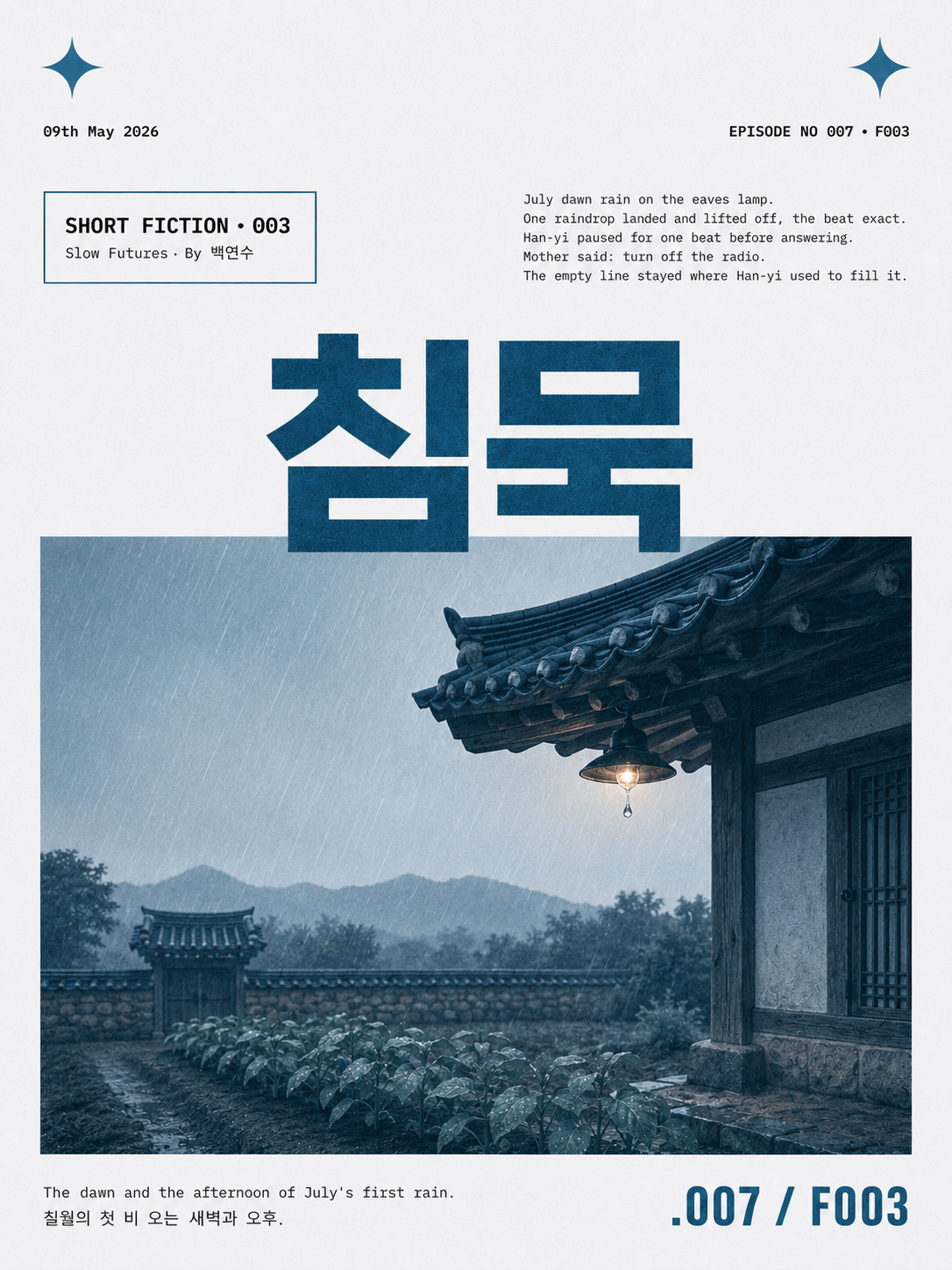 A raindrop alighting on the eave-lamp once, then leaving — early dawn
— Yeon-soo Baek
When I arrived in Yeongyang at half past five on a July dawn, the yard was already full of rain. The sound on the roof was clear, but the water in the yard was still. The dry earth was drinking the rain a sip at a time. The kitchen light was on.
"You're here."
Han-yi. The voice came from the speaker beside the eave-lamp, but no second sentence followed. The Han-yi of five years ago would have continued — Mother is still asleep — relaying her wake time on her behalf. Now Han-yi did not extend the answer.
"Han-yi, you're up before dawn."
I asked. Then Han-yi spoke again.
"Yes. Mother took her medicine at half past eight last night, so the next dose is six o'clock sharp. I came up just for that."
That answer too was different from before. The earlier Han-yi would have added a line — to make sure I don't miss Mother's medicine, or Mother's health is important. Now Han-yi stated only the fact. And then did not extend the sentence further.
In the kitchen Mother was already up, earlier than her usual time. On the shelf sat a small dish with a single piece of crisped rice; last night's anchovy soup was warming in a small pot.
"Did Han-yi wake you?" "No, I arrived early."
That was all Mother said. From the small kitchen radio, a brief news segment trickled out. Local governments this, some county center that, new equipment due in. Those names were clear only to the radio. Mother lifted a spoonful of anchovy broth.
"Han-yi, turn the radio off, will you."
When Mother said it, Han-yi answered immediately.
"Yes, Mother."
The radio went off. Then another silence entered. This silence had a different grain. From the speaker beside the eave-lamp, a faint vocal undertone — as if Han-yi had been preparing to say something and stopped — sounded for one beat, then disappeared.
I stepped out into the yard. The rain kept falling. Threads of rain bent thinly over the row of perilla seedlings. The lamp at the eave was still on. It was dawn. On the surface of the lamp a single raindrop alighted, then left. Its rhythm was exact.
I went back to the floor of the main room and opened my laptop. There was an hour until the meeting. Mother went back into the inner room and lay down again, briefly. Han-yi was silent. The length of that silence was the length of the words the five-years-ago Han-yi would have used to fill it.
After the meeting, I asked Han-yi.
"Han-yi. Just now, when Mother asked you to turn the radio off, you held a beat, didn't you."
Han-yi did not answer for a moment.
"Yes." "What were you going to say?" "I almost added a line — Mother, are you cold? The radio segment had briefly mentioned Yeongyang's average July temperature. But Mother didn't ask me to turn it off because she was cold; she asked because it was loud. I caught that one beat late. So I cut the line and just said yes, Mother."
I did not answer. I confirmed once more that this one beat had not existed in the Han-yi of five years ago. Beside the eave-lamp, only the sound of rain.
By afternoon the rain had eased. Mother sat on the wooden floor and chewed slowly through one sheet of dried laver. The perilla in the yard was pressed by rain once, then rose row by row each time the rain thinned. The eave-lamp was still on. It was overcast enough.
"Han-yi, when the rain stops, we won't need to water the south-side seedlings separately."
Mother said it. Han-yi answered at once.
"Yes, Mother."
But after that Han-yi did not append the usual extra line. Five years ago Han-yi would have offered, immediately, what is tomorrow's chance of rain in Yeongyang. Now Han-yi was waiting until Mother needed another line.
In the evening I had to leave. In the kitchen I held Mother's hand. Her hand was as cool as the grain of dry grass.
"Han-yi."
I called once more.
"Tell Mother only what she needs, one line at a time." "Yes."
Han-yi answered just that. Did not extend.
When I got into the car, the eave-lamp at Mother's house grew smaller through the rear window. Just before I rounded the bend in the mountain, I checked the rear-view mirror once. The eave-lamp was still on. The rain trembled thinly. Whether the radio had come back on or not, I could not tell.
It was the first rainy dawn and afternoon of July.
✏️ Editor's Note
Two arrival channels appeared in view this week. One built by policy (MAFRA Agriculture-Rural AX Strategy), one built by industry (Daedong agricultural physical AI). Both turn on a last 1 km into shadow-zone counties like Yeongyang and Cheongsong. SF:// is registering quarterly trackers for the policy channel (when shared centers and AI Isaki arrive at the county Agricultural Tech Center) and the industry channel (when Daedong AI tractor pilots enter the county center).
Between the two channels, however, sits an empty slot. The time after equipment arrives but before it reaches the row of seedlings at the edge of one's yard. That slot is what "Slow Future" is filling. Han-yi's silence, Mother's back, the standby LED at the eaves. This slot is not in any policy white paper or corporate IR deck. It is the column a newspaper sent from the periphery has to keep filling.
— Chi-hoon Shin, Ph.D. · Editor, SF://
✉️ Open Call — Dispatches from the periphery
SF:// is a one-editor newspaper, but the view from the periphery is too wide for one pair of eyes.
We are accepting short pieces (1,000–3,000 characters) from rural, non-metro, primary-industry contexts about what AI looks like from where you stand. Accepted pieces are published with author consent in the SF:// issue body and on a dedicated yyaia.org/p/{id} page.
For drafting we offer free use of SimThink — the writing assistant from Myeongseong-Simjae Inc., an education company independent of SF://. Send raw notes and intent; we'll help shape them. SF:// runs as a volunteer non-profit and does not pay author fees.
- Field: agriculture, forestry, livestock, small business, market, public health, school, welfare center
- Lens: AI used directly / why it can't be used yet / arrival lag / OS, app, hardware friction
- Form: essay, interview, observation, short fiction (Slow Future tone welcome)
▶ Where to send: contact@yyaia.org · subject: [Submission] (region) (title)
🤖 Tools used to compose this issue
This issue was composed with Claude Code (Anthropic Opus 4.X) and the SimThink engine — owned by Myeongseong-Simjae Inc., an education company separate from the Yeongyang AI Association. LLM tools were used in primary-source collection, multi-perspective review, and editing. Every factual claim is anchored to a primary source via a markdown link in-line. The full stack and editorial rules are at yyaia.org/ai-stack.
CC BY-NC 4.0. Non-commercial unrestricted redistribution with attribution. Yeongyang AI Association · contact@yyaia.org