
The day a single question becomes the organization's asset

In March 2026, a single document released by the president of Seoul National University quietly began to shift the landscape of the knowledge industry. The plan, named SHINE AI, contains 16 strategic tasks and 47 sub-tasks. Eight thousand AI-related courses. Two hundred AI applied research labs. Three thousand AI researchers. The numbers impress. But what makes this declaration matter is not the numbers.
Inside the plan sits a concept called question asset-ization. "Convert the questions students and faculty pose to AI in classrooms and personal devices into accumulable knowledge assets for the institution." On the surface it reads ordinary. Yet that single line redefines competitiveness in knowledge-based organizations from the foundation up.
Do you know which resource disappears fastest from any organization? It is not money, and it is not time. It is the tacit knowledge that walks out the door when a person leaves. When a lawyer with ten years of experience moves firms, the judgment patterns accumulated across hundreds of cases do not stay behind. When a doctor with thirty years of clinical practice retires from a hospital, the diagnostic feel in their fingertips is not transferred through documentation.
What Seoul National University announced as "question asset-ization" is the structural answer to this problem. Build a system in which every question a member poses to AI accumulates as institutional knowledge.
The wall between AI-native organizations and AI-using organizations
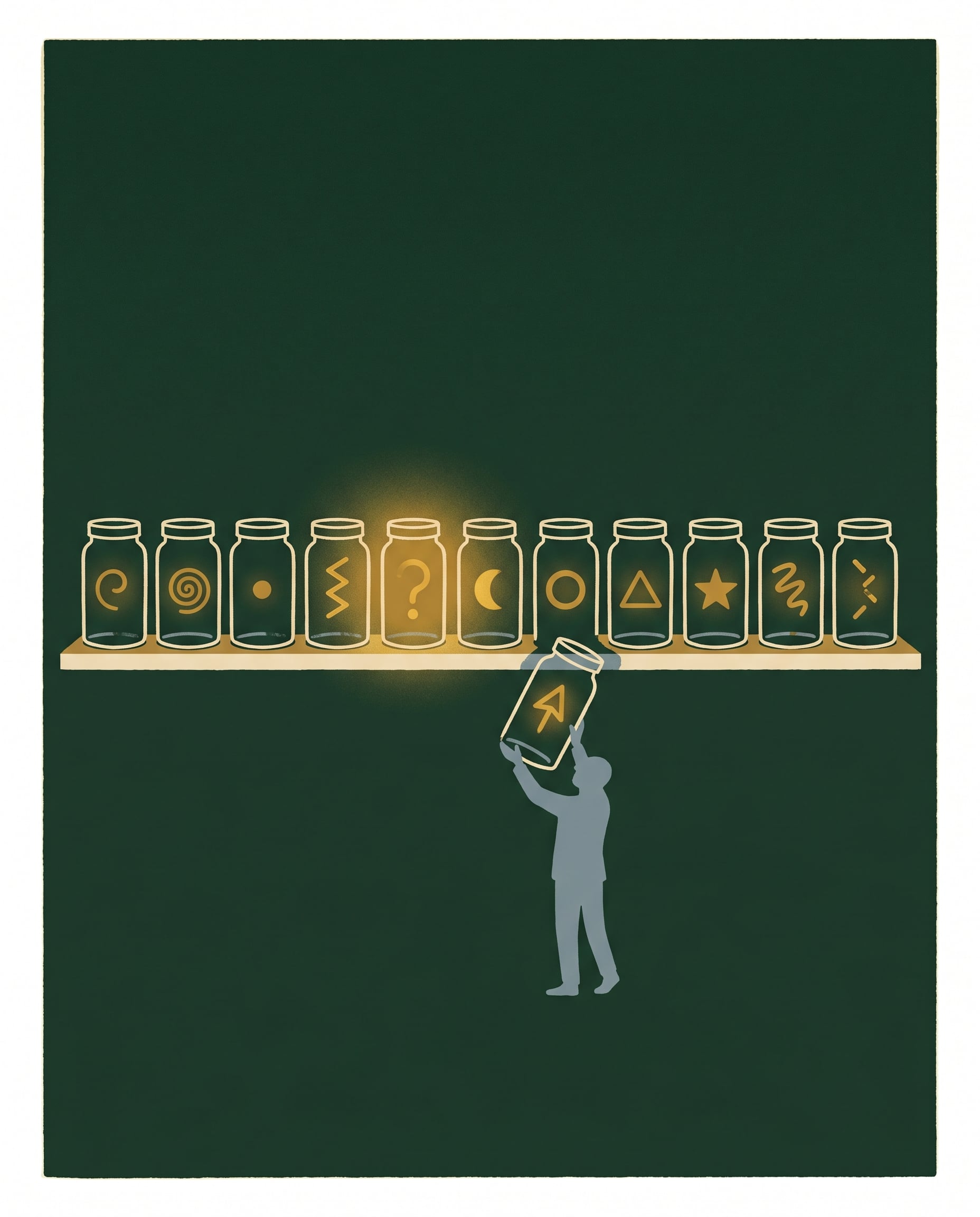
An organization that uses AI is not the same as an AI-native organization. Confuse the two and the strategy goes entirely sideways.
An AI-using organization adopts tools. They put ChatGPT into the workflow, hook up automation tools, hand certain repetitive tasks to AI. Efficiency rises. But the way the organization itself operates does not change.
An AI-native organization is different. The question is not how AI is used, but whether the structure by which the organization produces and circulates knowledge is itself designed around AI. When a new case appears, it converts immediately into learning data for the entire organization. A pattern one person discovers becomes the team's shared capability the next day.
MIT Sloan's 2025 research puts the difference into numbers. Knowledge-service organizations operating in AI-native mode showed, against AI-using peers: decision speed 3.2× faster, new-hire onboarding time cut by 67%, and knowledge reuse rate 4.8× higher. This is not simply faster. Because the learning architecture itself differs, the gap widens exponentially over time.
Where knowledge is the service, the gap is even larger
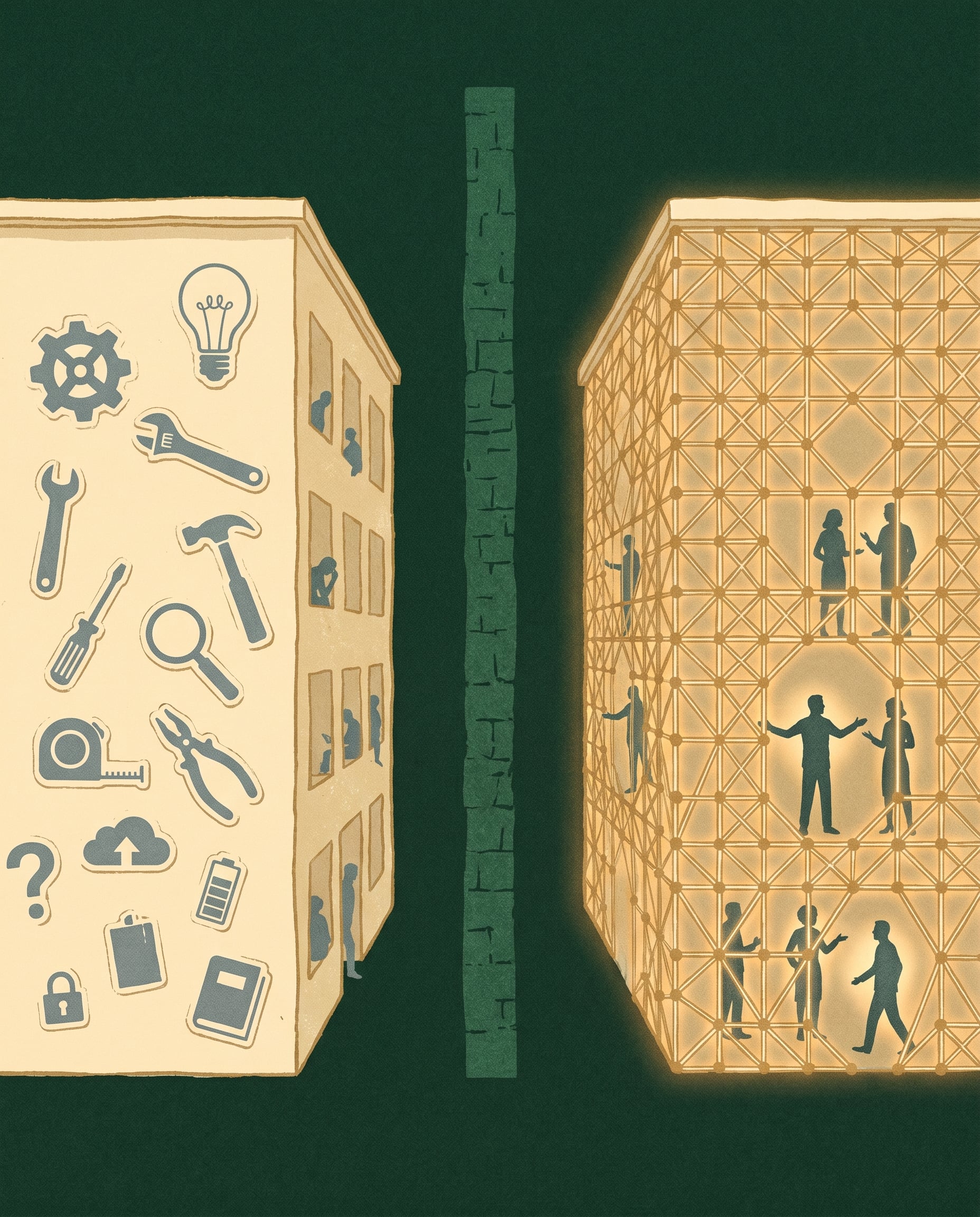
In manufacturing, AI mainly affects cost and speed. But in fields where knowledge itself is the service — law, medicine, education, research, financial consulting — the effect of AI-native transition operates on a different order.
Three structural reasons drive this gap.
First, the structuring of accumulated knowledge. The core competitive asset in a knowledge-based service is the long sediment of precedents, papers, cases, and know-how. In the past, that asset was scattered inside the heads of senior experts. AI-native organizations convert that knowledge into structured form, accessible to the whole organization. The judgment patterns of a decade-long veteran become the daily work guide of a first-year hire.
Second, decision speed in complex cases. A major Korean law firm that adopted an AI-native case-analysis system in 2025 cut the time to find similar precedents from three days to eight minutes. This is not merely a speed improvement. When three days becomes eight minutes, the range of work a lawyer can do changes. The number of cases reviewable in one day changes. The depth of analysis offered to a client changes.
Third, continuity of knowledge production. Does the organization's knowledge level hold when the person handling it changes? In medicine, the annual turnover rate of independent practitioners runs around 12%. In a conventional organization, that figure is loss. In an AI-native hospital, the clinical patterns of the doctor who retired remain inside the AI system, supporting the next doctor's diagnosis. The person leaves; the knowledge stays.
What Seoul National University actually declared

Read SNU's SHINE AI plan as "expanding AI education" and the core gets missed.
MIT, Stanford, and Carnegie Mellon began, as early as 2023, to move past using AI as a teaching tool and to redesign the methodology of producing new knowledge in collaboration with AI. The papers, the experimental design, the data analysis coming out of these universities' labs already differ from prior academic practice.
Seoul National University's announcement of an AI+X curriculum, an interdisciplinary program, and an 8,400㎡ AI Convergence Hall slated for 2031 completion is an effort to follow that current. The substantive meaning of the declaration is this: when graduates trained this way enter the field, the gap between organizations that work alongside them and those that do not is structurally set from the very first day.
The Harvard Business Review's 2025 analysis reports that startups carrying AI-native-trained personnel as founding members showed an average 2.7× difference in knowledge productivity within two years versus startups without them. The hiring market's logic is shifting underneath us.
For regions and small organizations, the reversal is real

Read this current as a story about Seoul National University and the conglomerates only — and that is the second misjudgment.
The smaller the workforce, the larger the relative effect of AI-native transition. The reason is simple. In a 50-person organization, AI replacing the knowledge productivity of three people produces a 6% impact. In a 5-person organization, the same shift produces a 60% impact.
A real case stands. A 5-person law office in Jeonju, North Jeolla, adopted an AI-native case-management system in 2025. Monthly handled cases increased by 40%. Fees went up; overtime came down. The competitor this office faces is no longer the small office in the next block. Its service quality is approaching that of major Seoul law firms.
The same applies to education. When a small rural training institute designs personalized curricula in AI-native mode, it can compete with the large metropolitan academies' personalization service. The era when geographic gap was a synonym for knowledge-service gap is ending.
This is why the Yeongyang County AI Association pursues this direction. Adoption of AI technology is not the goal. The goal is for regional organizations to transition AI-native and erase the regional gap in service quality itself.
What awaits organizations that do not transition

Imagine five years from now.
In knowledge-based fields, the gap between organizations that have completed AI-native transition and those that have not may be larger than today's gap between a 5-person practice and a 500-lawyer firm. Because structure, not size, decides competitiveness.
This gap does not widen gradually. Technology adoption commonly carries a tipping point. After a certain moment, the difference in service quality offered by non-transitioning organizations becomes clearly perceptible to clients. Past that moment, recovery is hard.
According to early-2026 reporting from McKinsey Global Institute, the share of organizations that have completed AI-native transition in knowledge-intensive service fields currently runs around 8% globally. But that 8% accounts for 71% of productivity growth in the corresponding fields. The structure is rapidly reshaping into one where a small minority captures the bulk of the gains.
What organizations starting now are building

The Seoul National University declaration is a signal. Korea's foremost knowledge-production institution officially committing itself to AI-native transition means that this transition is no longer a "future matter."
An AI-native organization is not a finished state. It is an organization that has begun the process by which every question, every judgment, every attempt of every member accumulates as institutional knowledge. Today's single question becomes next year's organizational capability. The gap between organizations that have begun this process and those that have not grows harder to close as time accumulates.
That an AI association was created in Yeongyang County, a small town of 17,000 residents, is because there are people here who read this signal early. Being small does not have to be a weakness. Moving fast. The transition's effect appearing immediately. Becoming a model case that influences other regions — these are the actual competitive strengths of an AI-native organization in a small regional town.
Seoul National University's declaration only formalized what was already known. The new power in the knowledge industry comes not from size but from structure. The organization that builds that structure first leads the next decade of knowledge production.
The Yeongyang County AI Association supports AI education and organizational transition based in Yeongyang County, North Gyeongsang. This piece is written based on Seoul National University's SHINE AI strategy announcement and field cases.

This article was produced with the deep-thinking engine
Simthink Engine (深 Think) of Myeongseong Simjae.