Director of Strategic Planning, Shin Chi-hoon · May 1, 2026
Only 13.8% of Korean workers feel engaged in their jobs. AI is not the threat. It is the mirror of structures already broken.

Deep roots hold 30 years. A new branch becomes light. AI is the new branch — not replacing the tree.
What broke before AI
Of all global workers, 21% say they are engaged in their work. Korea: 13.8%. Of 105 nations, rank 105. This is Gallup's standard survey across 12 dimensions. A heavier number exists separately: Korea's "actively disengaged" workers — those whose presence harms office culture — hit 23.9%. One in five people walk in whose presence is net negative to the company.
This number predates ChatGPT. Before AI shook our jobs, three-quarters of Korean workplaces were already shaken. So when Silicon Valley investor Bill Gurley's words translate into Korean terms, they read like this: Before asking whether AI replaces people, we should know people have never felt their work as their own. AI exposes that rift.
Where does Yeongyang sit on this map? We have no exact number. But we know this: the daily rhythm of a 60-year-old farmer tending an eight-year apple orchard cannot be measured by "engagement" the same way a downtown conference room slide-review hour can.
"Yeongyang is better positioned than cities" — the statement
Gurley made two analogies about AI. For people told what to do and doing it: AI is a threat. For people digging deep in their field: it is a jetpack. Korea's 13.8% engagement rate describes the first group. The person hired from good schools with the standard degree into the standard company to write the standard report. That is the work AI learns first.
Yeongyang's majority leans toward the second group. Farmers growing apples, noodle shop owners, nutritionists, seniors navigating the township office. These people's feet are anchored 30 years into their domain. Not "what I was told to do" — but answers they build for customers, weather, seasons, bureaucracy that shift each year. The moment one AI motion slides in — a weekly menu, a farm log, a copy line — the effect plugs directly into their work. It has more leverage than ChatGPT attached to a repeated morning status report.
It sounds good to hear. But one caveat is necessary. The claim that "self-employment means you define your own work" is only half true. You adjust menu order to match food delivery app algorithms. You reshape your business for government subsidy forms. You tweak your menu by star ratings. So "better positioned" is still possibility, not yet outcome.
Yet it is not simple — the actual shape of digital divide
Korea's Information and Communication Policy Research Institute reported in 2024 that those over 50 command 62% of the digital skills of 20–30-year-olds. Over the same period, AI experience among those 50+ jumped from 35.8% to 55.6%; ages 60+ from 25.1% to 43.5%. Read both numbers together: "Gap is narrowing, yet gap remains."
The field gap is rougher than statistics. AI tools overflow with Sino-Japanese loan words, English, specialist jargon. System prompt. Token. Context. Macro. For some, the words themselves are a wall. The advice "just speak" fails when voice recognition does not know dialect or domain terminology. Any 60-year-old farmer who has tried voice-typing "Application for land record entry modification, Attachment Form 3" knows. It does not transcribe in one pass.
So "each go deep in your field" requires caution. Gurley is a millionaire investor. Translate his message directly into rural Yeongyang, and it becomes a narrative that offloads public infrastructure responsibility onto individuals. Network, educational courses, device loans, someone nearby to help — without these four, the "jetpack" is an ad slogan. Individual effort is not sufficient; it is necessary. Above it, county-level support must operate.
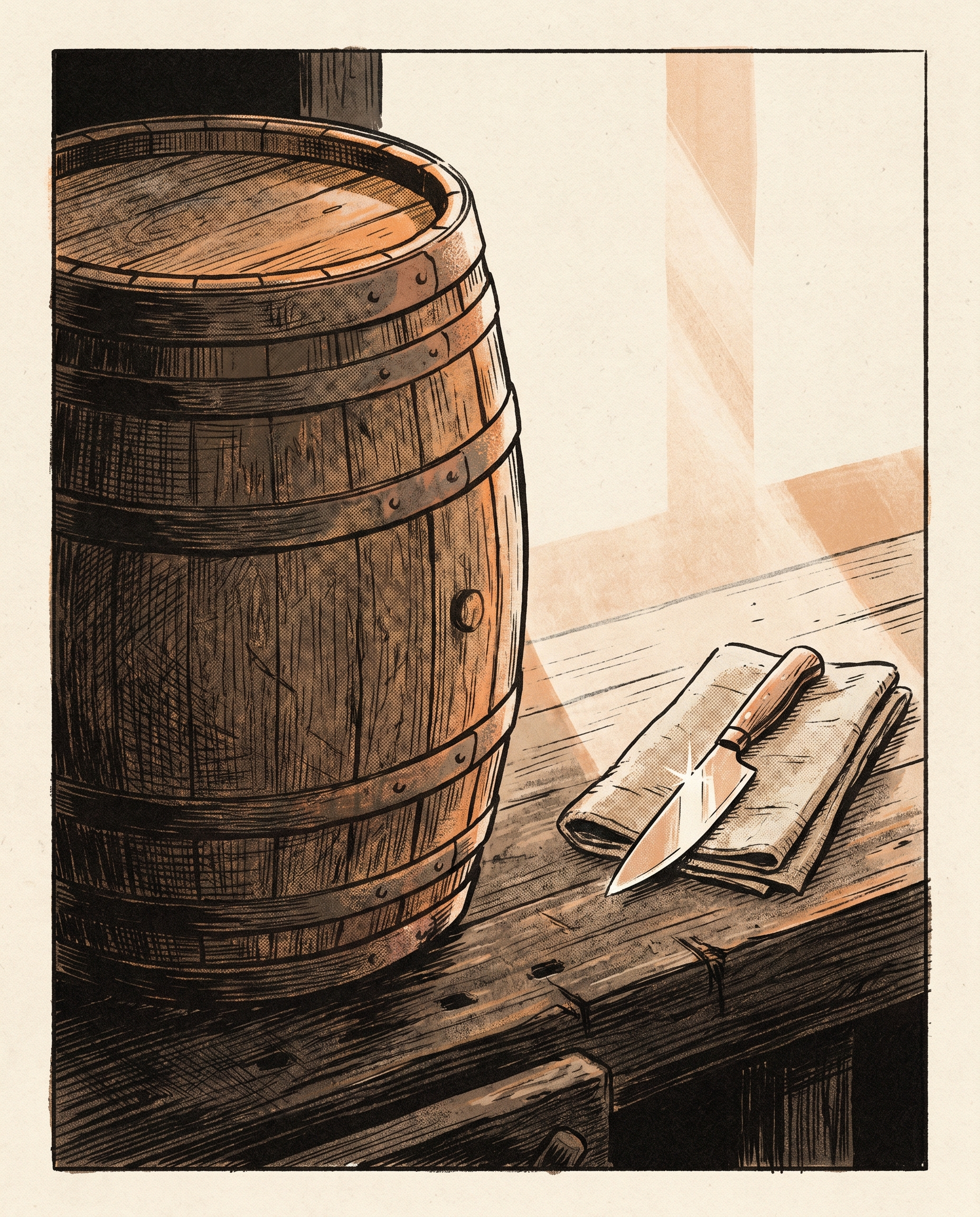
40-year oak barrel beside one newly sharpened blade. Not starting from zero — a tool placed on top of accumulation.
Angel's Envy at 70 — not late starts but deep accumulation
In the American whiskey industry, a name rings out: Lincoln Henderson. For 40 years at Brown-Forman, he was master distiller for Woodford Reserve, Gentleman Jack, Jack Daniel's Single Barrel. He retired in 2004. At 70 in 2006, he returned to the kitchen with his son and grandson. His first whiskey under his own name, Angel's Envy, hit market in 2010. Today Bacardi owns it — a flagship North American brand. He did not start at 70. He had 40 years in the barrel, then signed his name.
Gurley's "no such thing as a late start" feels good to hear. But Henderson's case points to something more exact: Breakthroughs happen not from zero in a field, but when a new tool lands on 30 years of layered work. A Yeongyang apple farmer touching AI for the first time is not starting from zero. Thirty years of apples, weather, disease, prices, village talk live in his head. AI is not the 30-year replacement. It is a new blade sharpened and placed on the handle.
Read this badly, it is comfort: "You are not late." Read exactly, it is strategy: "You have known this field longer than someone just touching it — now place one tool on top."
One motion, starting today
Bill Gurley's conclusion — "aggressive AI use determines who survives" — becomes this in Yeongyang terms: Pick one daily task and thread AI through it. Starting with one motion is the secret.
A nutritionist spends two hours designing a week of menus. Make a first draft in five minutes, refine it by hand. A noodle shop owner writes a caption weekly for new dishes on Instagram. Toss it to AI, rewrite in your own voice. An apple farmer files equipment rental subsidy forms twice a year. Use a tool that unpacks hard bureaucratic language as fill-in-the-blank. A parent solving math homework with their child asks AI to re-explain one stuck concept.
Once one motion becomes natural, the second eases. Once two become familiar, three flows naturally. Gurley's "jetpack effect" appears at motion five. Not at motion one. So motion one must be small. One small motion, five minutes daily, for one month.
Not alone — the association's role
Here we resurface the "caution" written above. One person's effort is not sufficient. Yeongyang County AI Association's work is therefore lending tools. Taking one person's well-built "gem" and letting everyone else use it as-is. Making the same form flow through county office, township office, civil service. Even if an older adult's first AI attempt fails, someone is there to show them once more. One person going deep might become a "jetpack," but one village going deep becomes a "runway." Yeongyang's answer is the latter.
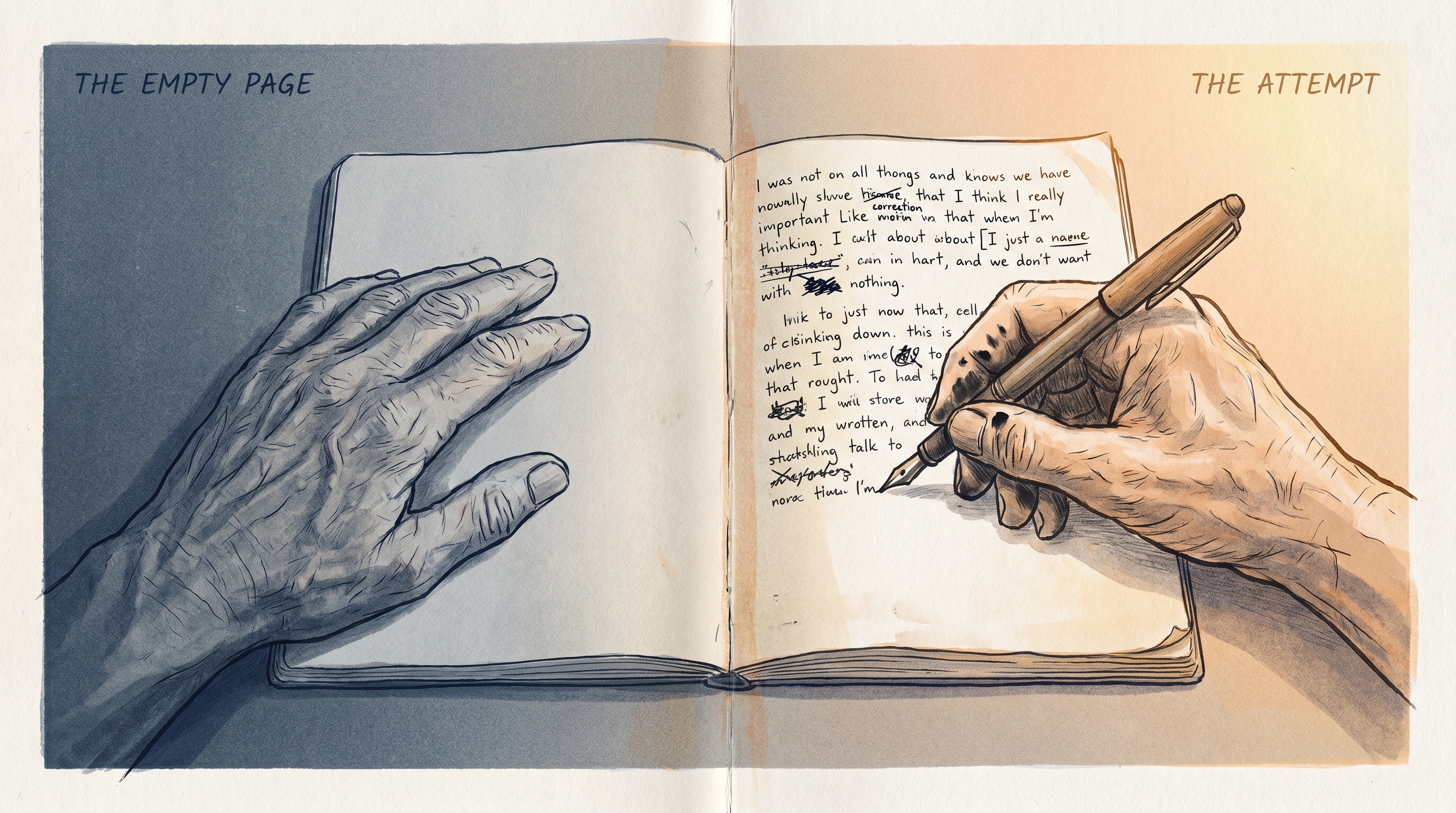
Hand that never tried. Hand that tried awkwardly. At 80, which will you be more at peace with.
To the 80-year-old you
Gurley says he asks himself when deciding: "If 80-year-old me saw this decision, what would he say?" People regret the things they did not try more than the mistakes they made. For someone living in Yeongyang, the story they tell at 80 to their grandchildren is: in 2026 when AI came to this town, what did I do?
Spare five minutes after lunch today. Thread AI once through one task you repeat daily. Awkward is fine. An awkward attempt is kinder to your 80-year-old self than the regret of not trying.
Sources
- Gallup, State of the Global Workplace 2024 / 2025. Korea: 13.8% engaged · 23.9% actively disengaged.
- Korea Information and Communication Policy Research Institute, 2025 Digital Divide Reality Survey. Ages 50+ digital skills = 62% of ages 20–30.
- Ministry of Science, ICT, and Future Planning, Digital Experience Survey by Generation. Ages 50–59: 35.8%→55.6%; 60+: 25.1%→43.5%.
- Bill Gurley, Tim Ferriss Show #840 (Dec 2025), Investing in the AI Era.
- Lincoln Henderson, Angel's Envy founding (2006, age 70) — Bacardi acquisition, now major North American brand.
- Kobe Bryant–Hakeem Olajuwon 5-hour post-move footwork session anecdote (2009–2011).
- Discord, Slack — key examples of pivot from gaming foundation.
The three illustrations in this article were created using Gemini 3 Pro Image and underwent editorial review by Yeongyang County AI Association. No likenesses of real people.

This article was produced with the deep-thinking engine
Simthink Engine (深 Think) of Myeongseong Simjae.