Three branches of the future — OS dilution · three-camp revival · agentic OS
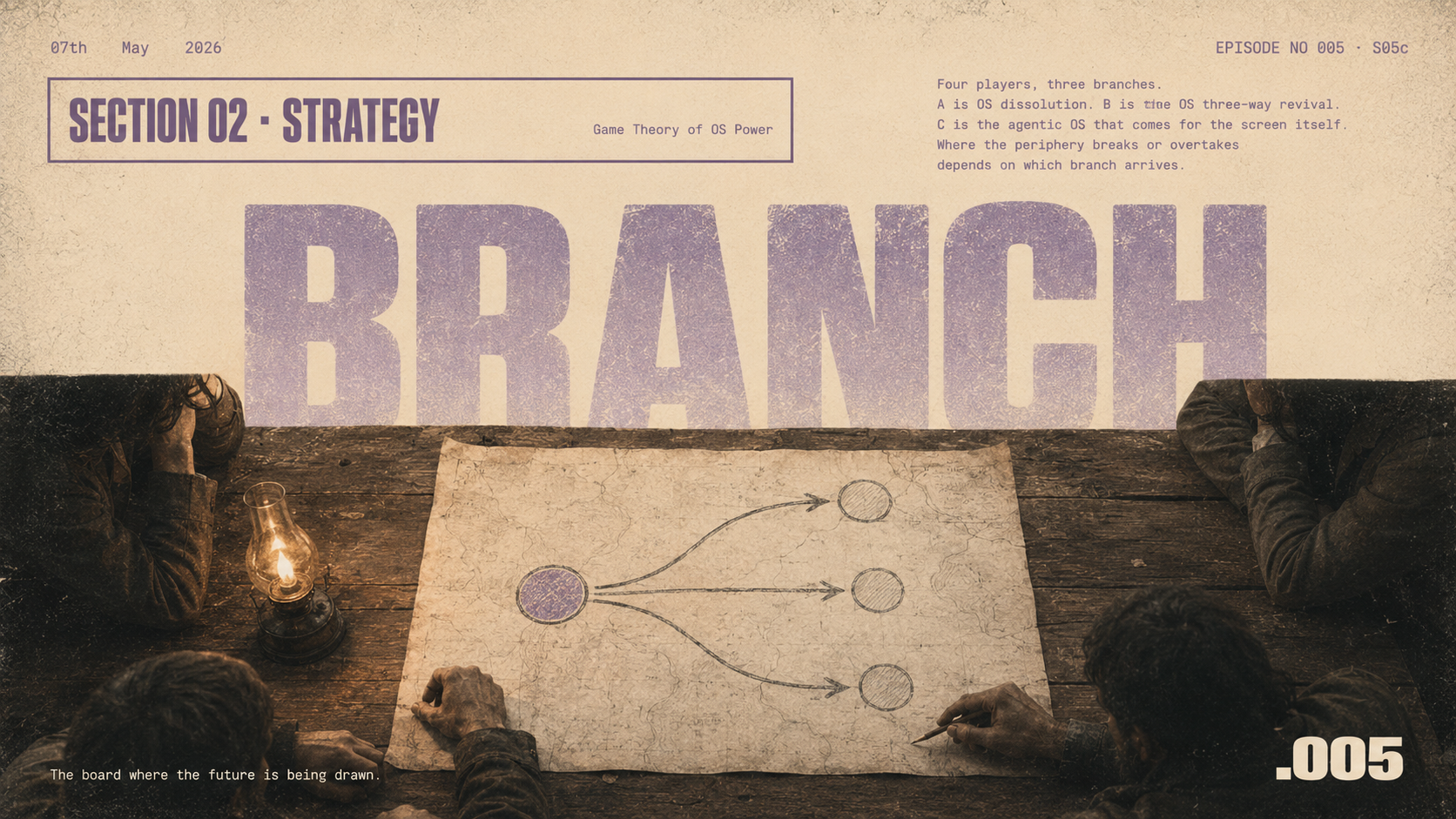 Four players gathered around one board — the three branches diverge.
What game theory is — an analytical method that models the possible outcomes when several actors decide while watching one another's moves on a single board. In this issue, Myeongseong-Simjae's SimThink engine puts four players (three big-tech firms and the AI model companies) on the single board called "OS primacy" and traces, with what likelihood, three branches of the future open up three years out. We treat the discussion between external sources and the editor's persona as a first-pass synthesis.
The four players on the board
| Player | Assets | Weakness |
|---|---|---|
| Microsoft | Windows 70%+ · Office · Azure · 41% stake in OpenAI | If an AI agent layer goes one storey on top of the OS, the meaning of the OS itself blurs |
| Android · Chrome browser · Gemini Enterprise | Has already failed once at desktop OS (Chrome OS) | |
| Apple | macOS · iOS · Apple Intelligence | Works only inside premium hardware — desktop OS share around 20% |
| AI three (Anthropic · OpenAI · xAI) | Models tied directly to cloud · already inside Office and email surfaces | No OS — eventually has to borrow the entry made by Microsoft or Google |
Variables that move the board
- As user intent gets handled directly in natural language, "app" and "OS" as nouns thin out
- As most services move to the cloud, deep dependence on the OS shrinks
- AI may close the old usability gap of desktop Linux (the hypothesis: Chrome OS's real cause of failure was "the era without AI")
- The Anthropic + Blackstone + Goldman joint venture is the first signal that capital intends to route the model business straight around the OS
Three branching futures
Starting from today's three simultaneous releases (Opus 4.7 · GPT-5.5 Instant · Gemini 3.1 Pro), SimThink tracks three branches three years out.
-
Branch A — OS dilution (high likelihood) AI agents (autonomous assistants that take user intent and operate the actual tools and data) settle one storey above the OS, and the user's sense of "using Windows" disappears. Microsoft and Apple keep their seats, but only the meaning of the OS thins out.
-
Branch B — three OS camps reborn (medium likelihood) Google and OpenAI revive Chrome OS / Atlas-style AI-OS and re-enter the market. If AI fills the old usability gap of Chrome OS, real revival is possible. The competition between Windows · Mac · AI-OS three camps starts again.
-
Branch C — agentic OS (low likelihood · 5–10 years) The screen UI itself migrates to voice and biometric interfaces. The smartphone is replaced by a wearable (glasses, watch — devices worn on the body) plus agent combination. The AI agent absorbs the role of the OS itself.
Per-branch payoff — for the peripheries (Yeongyang / Cheongsong scale)
| Branch | Gap change | Opening / risk |
|---|---|---|
| A. OS dilution 🔵 | 🟢 shrinks | Seniors no longer need to learn the Windows menu separately. They just deliver intent to the AI. If new infrastructure laid in the peripheries sits on data formats independent of any one OS, the periphery is safe down any branch |
| B. three OS camps reborn 🟡 | 🔴 widens | The city moves quickly to a new OS, and the periphery faces another learning load. The shrimp-back risk |
| C. agentic OS 🟠 | 🟢 possible overtaking (paradox) | If the periphery skips the screen-UI learning load entirely and walks directly into voice and biometric interfaces, its learning curve may be shorter than the city's |
Action recommendations from SimThink
- ❌ Do not accelerate "learn how to use the OS and apps" — this is an expensive bet that hedges only Branch B (three camps reborn)
- ✅ Accelerate "the ability to deliver intent to AI" — hedges both Branches A and C. Candidate core curriculum for free senior programs in Yeongyang
- ✅ Newly laid infrastructure in the peripheries (smart-farm, livestock, forestry, observation, welfare systems) should be designed on data formats not tied to a specific OS — JSON · CSV · OPC-UA, the kind of formats that are readable on any OS. They must read the same on Windows, on Linux, and on AI-OS. Whether actual projects in Yeongyang and Cheongsong adopt such formats requires separate verification.
📚 Forthcoming deep review — the conditions under which the "periphery overtaking" hypothesis in Branch C (agentic OS) can actually hold will be addressed formally in our Academic Research section. The asymmetry of interface cognitive load between city and countryside is the core.