1면 톱
Four Seats Locked in One Week
EU AI Act 16-Month Delay · Anthropic→Google $200B · DeepMind's Korea Campus · Upstage's Daum Acquisition · 5/8 SF:// Brief
글 SF://
에디터 · SF:// · 제 6호
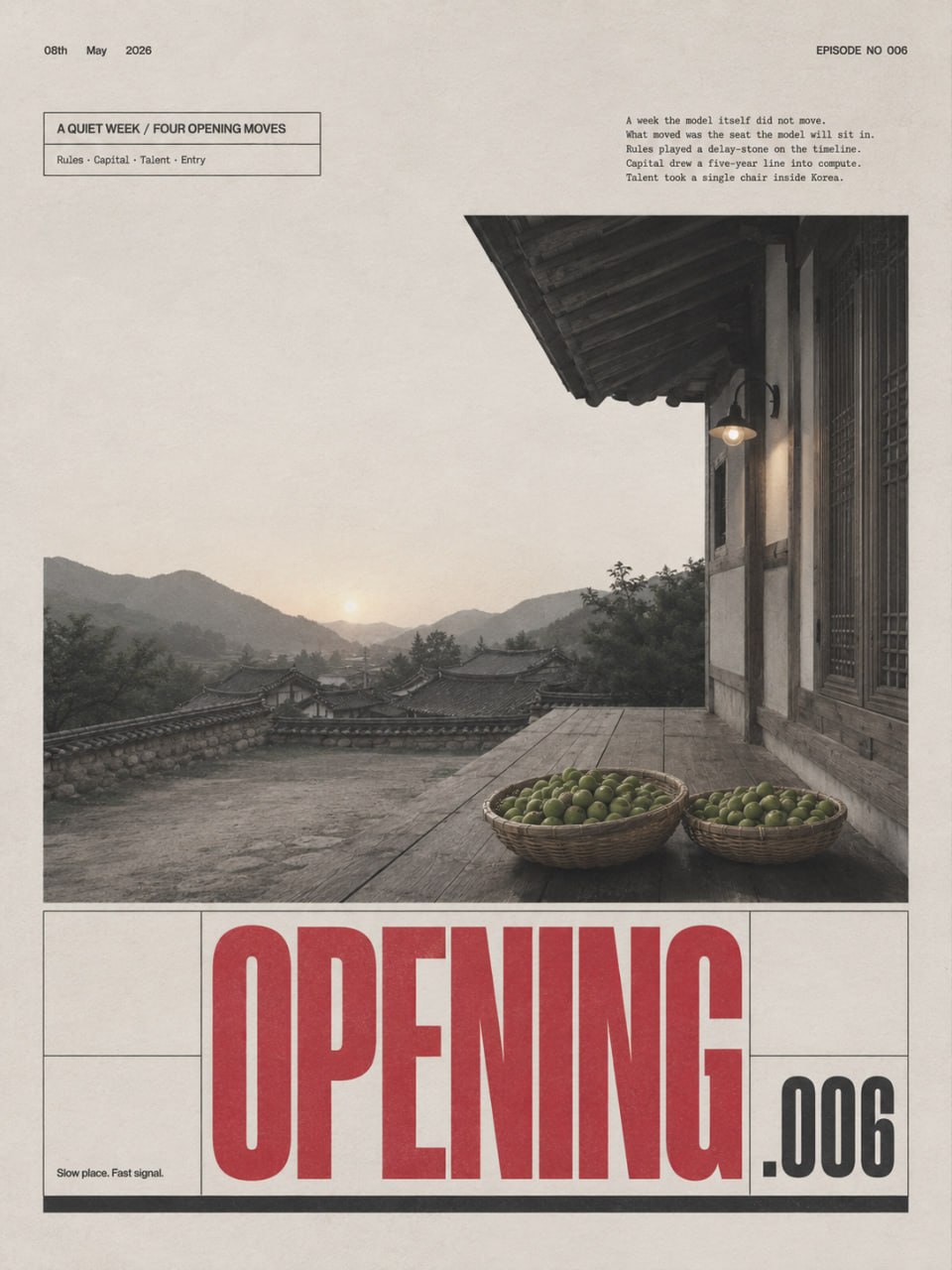
ON THIS ISSUE · 한 판에 보는 이번 호
2026-05-08 · ED. 006
오늘
도착한 신호EU AI Act Omnibus VII Deal — Rules Replay an Opening Move on the Timeline
On May 7, the EU Council and Parliament reached a provisional deal pushing high-risk AI obligations from 2026-08 to 2027-12, a 16-month delay. The new explicit prohibition on AI-generated non-consensual sexual content retracts on time but plants an additional stone on the prohibition axis.
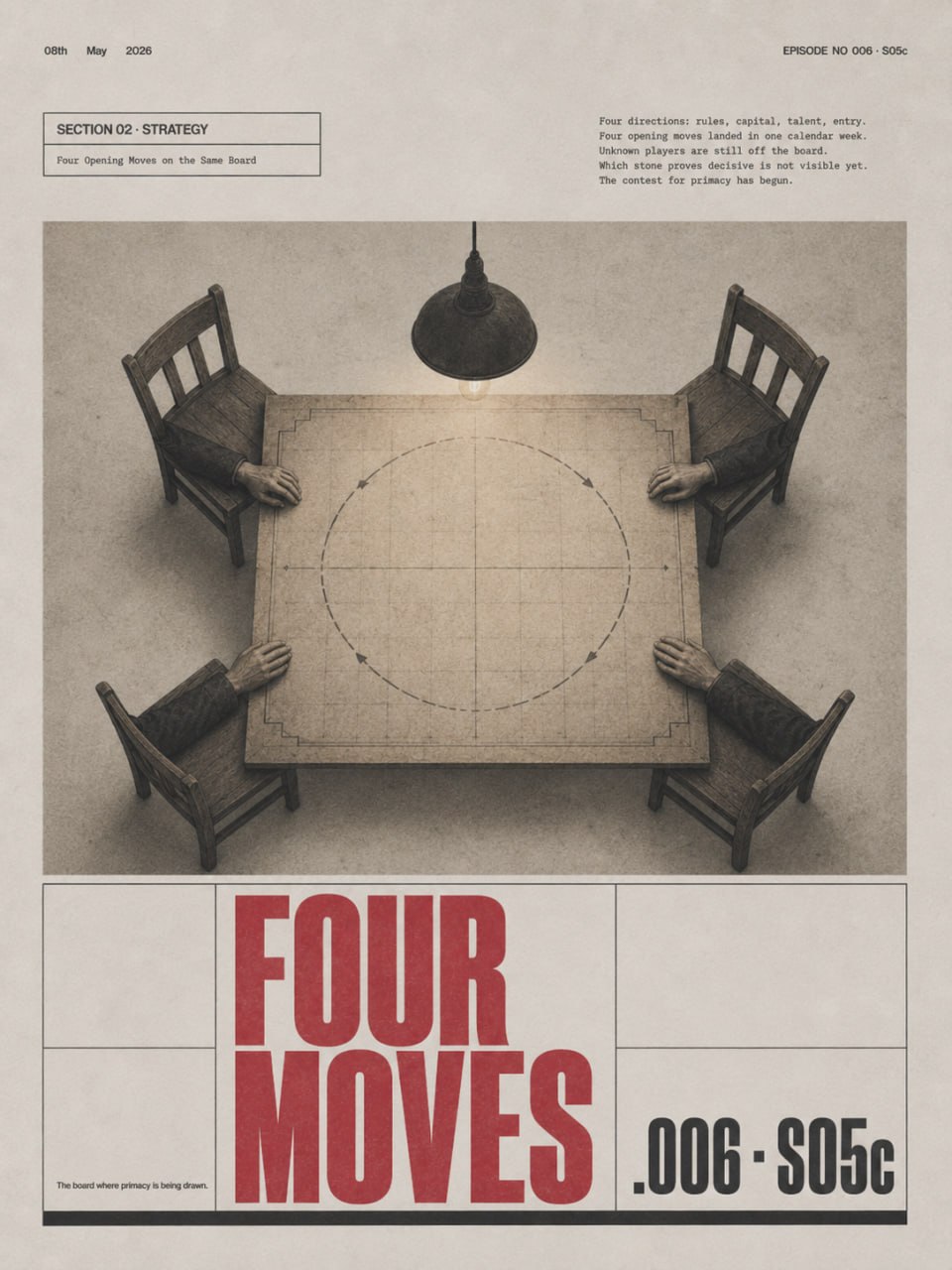
Four Opening Moves — Rules · Capital · Talent · Entry
In one week, four opening moves landed on the same board: EU 16-month delay, Anthropic→Google $200B, DeepMind Korea Campus, Upstage→Daum acquisition. Not a finished outcome — the current coordinates of an ongoing contest for primacy.
Anthropic → Google $200B compute opening move + DeepSeek $45B funding
Anthropic places a five-year $200B compute opening move with Google — about 40% of Alphabet's revenue backlog — alongside a $100B+ AWS commitment. DeepSeek's first funding round in talks at $45B led by China's National Big Fund.
DeepMind Korea AI Campus + Upstage → Daum + Acryl healthcare hub
Demis Hassabis signs MOU with the Korean government; Google's first overseas AI campus opens this year in Seoul Gangnam. Upstage finalizes its acquisition of the Daum portal, layering Solar LLM into search. Acryl selected as MSIT generative-AI healthcare hub.
EU Omnibus VII — explicit ban on AI-generated non-consensual sexual content
Parliament's late-stage addition. AI systems producing child sexual abuse material fall under the same clause. How Korea's AI Basic Act enforcement decree absorbs this is a separate tracking item.
우리
우리가 보낸 글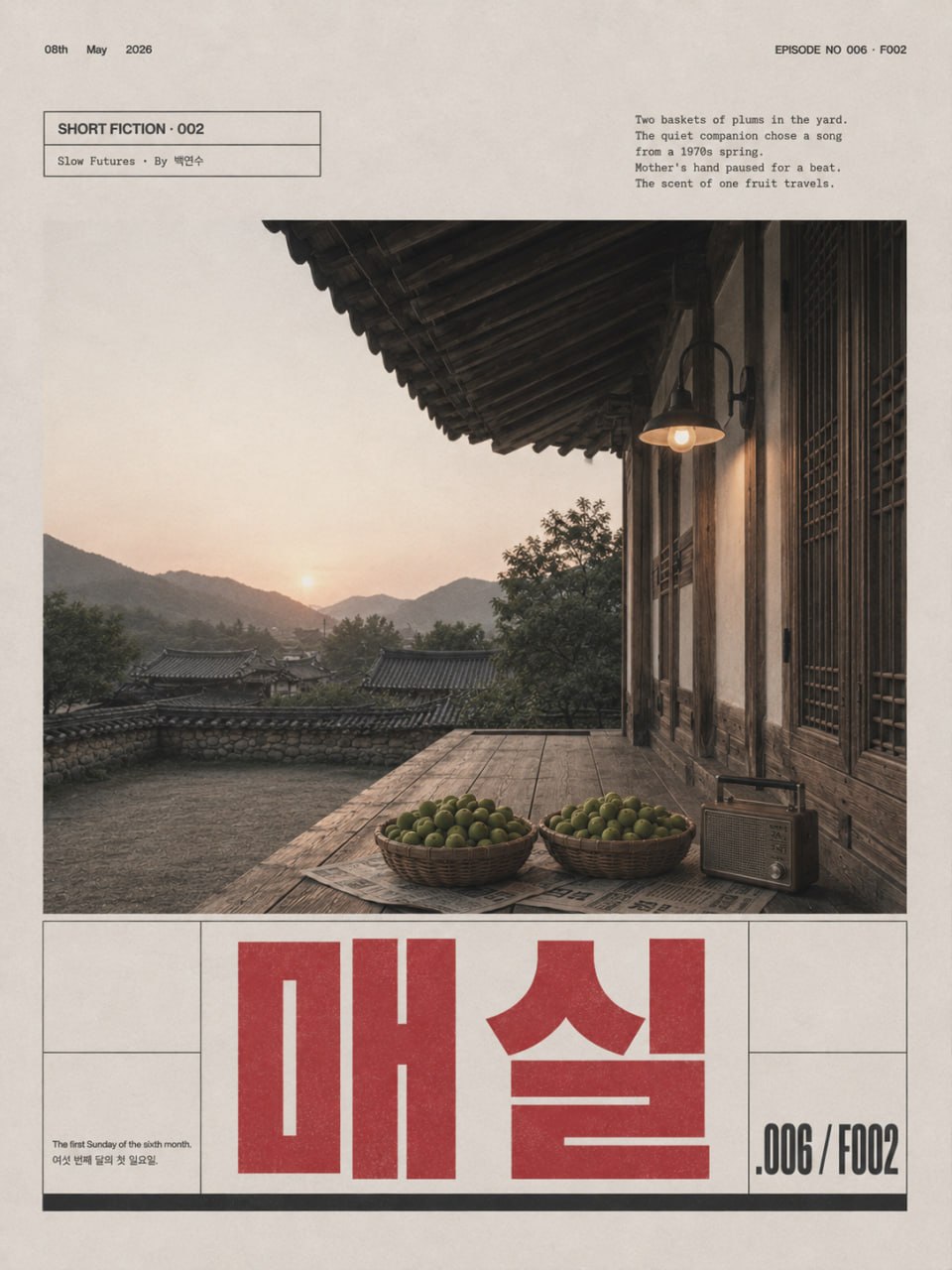
June Plums
The first Sunday morning of June. Two baskets of plums in the yard. Mother says only "Hani, put on some music," and Hani — having learned five years of Sunday silences — chooses one song. The scent of plums fills the yard once and settles. Yeon-soo Baek's second SF short.
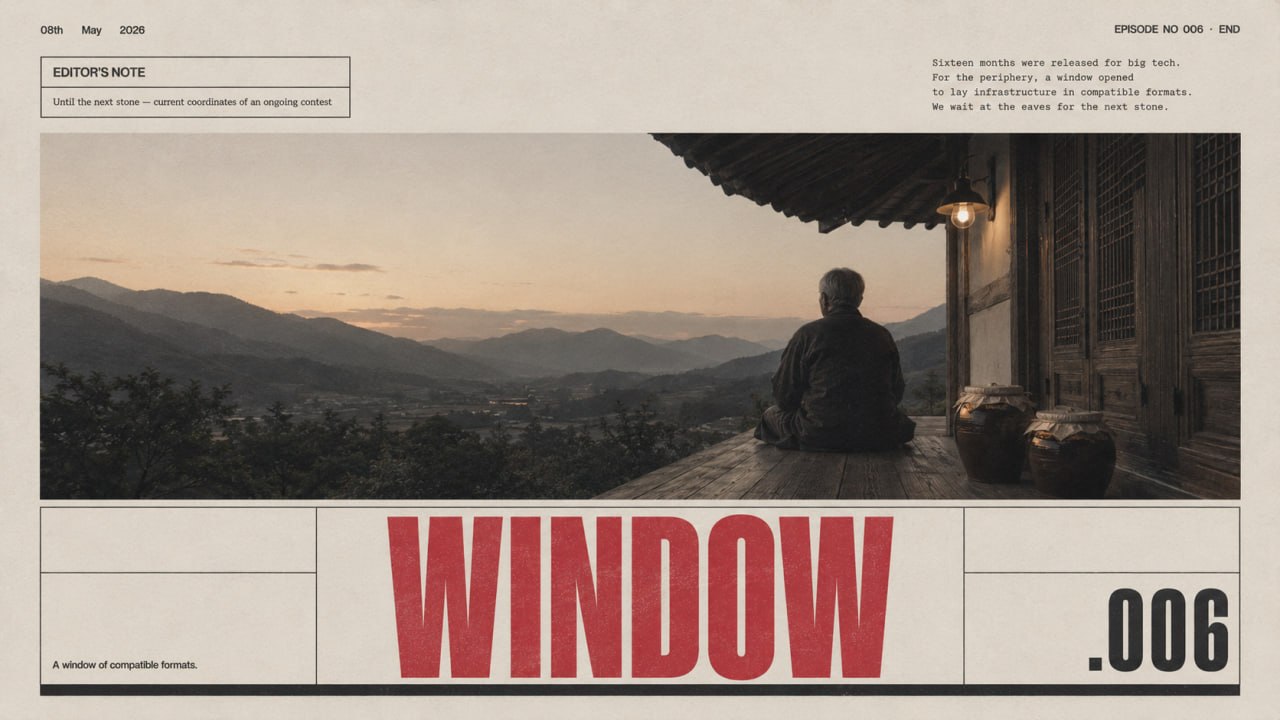
Current coordinates of an ongoing contest
This issue records not a finished outcome but the current coordinates of an ongoing contest for primacy. Unknown players are still off the board; where the next stone falls is what we follow into the next issue.
On May 7, the EU Council and Parliament reached a provisional deal on the AI Act Omnibus VII — pushing high-risk AI obligations from August 2026 to December 2027 (a 16-month delay) and adding an explicit prohibition on AI generating non-consensual sexual content. In the same week, Anthropic locked in a $200B five-year compute commitment with Google — roughly 40% of Alphabet's disclosed revenue backlog filled by one customer. On the same May 7, Google DeepMind announced, alongside the Korean government, that its first overseas AI campus — about 600 pyeong (1,980 m²) in Seoul Gangnam — will open within 2026, and Upstage finalized its acquisition of the Daum portal, planning to layer its in-house Solar LLM onto Daum search to relaunch it as an AI portal. DeepSeek is in talks for its first funding round at a $45B valuation, led by China's National Big Fund. A week in which rules, capital, talent, and entry all settled into seats.
slow place. fast signal.
Issued · SF:// · 2026-05-08 (KST)
At a Glance
| Slot | Category | Topic | imp | ★ | Source |
|---|---|---|---|---|---|
| S5 | Big Story | EU AI Act Omnibus VII deal — high-risk obligations pushed to Dec 2027 (5/7) | 5 | ★★★★★ | Council of the EU |
| S5c | Analysis | Four opening moves — rules, capital, talent, and entry all placed on the board in the same week | 5 | ★★★★★ | SF:// |
| S9 | Industry | Anthropic commits $200B to Google Cloud over five years (5/5–6) | 5 | ★★★★★ | The Information / CNBC |
| S11 | Korea | Google DeepMind's first overseas AI campus — Seoul Gangnam, ~600 pyeong, opening within 2026 (5/7) | 5 | ★★★★★ | DeepMind blog / Korea Times |
| S11 | Korea | Upstage finalizes acquisition of the Daum portal — Solar LLM to power an AI portal (5/7) | 5 | ★★★★★ | Wowtale / ZDNet Korea / Munhwa Ilbo |
| S9 | Industry | DeepSeek in talks for first round at $45B led by China's national chip fund (5/6–7) | 4 | ★★★★☆ | Bloomberg / FT / TechNode |
| S11 | Korea | Acryl selected as MSIT generative-AI talent program's healthcare hub (5/7) | 3 | ★★★☆☆ | Newspim |
| S9 | Industry | Sierra raises $950M at $15B+ — Bret Taylor's enterprise agent startup (5/4) | 3 | ★★★☆☆ | TechCrunch |
| S10 | Policy | EU Omnibus VII — explicit prohibition on AI generating non-consensual sexual content | 4 | ★★★★☆ | Council of the EU |
| S12 | Regional | No new direct AI projects or budget filings for Yeongyang or North Gyeongsang this week — monitoring continues | — | — | — |
| S14 | Follow-ups | 5/4 Pentagon 7 vendors / 5/6 Gemini Enterprise / 5/7 three-OS week | — | — | SF:// archive |
TL;DR
- EU AI Act Omnibus VII deal — high-risk obligations slip 16 months to December 2027, an opening move replayed on the timeline
- Anthropic places a $200B, five-year compute opening move with Google — about 40% of Alphabet's revenue backlog
- Google DeepMind's first overseas AI campus opens this year in Seoul Gangnam — talent's opening move lands inside Korea
- Upstage finalizes its acquisition of Korea's Daum portal — Solar LLM becomes an AI portal entry stone
- DeepSeek's first funding round in talks at $45B, led by China's National Big Fund — an East Asian opening move
🧭 Editor's View — How to read these headlines
This week was not a week in which the model itself arrived; it was a week in which four opening moves landed on the same board, in four different directions, in the same week. On May 7, the EU Council and the European Parliament reached a provisional deal on the AI Act Omnibus VII — pushing the start date for high-risk AI obligations from August 2026 to December 2027, a 16-month delay; one stone replayed on the rules timeline. In the same week, Anthropic committed $200B over five years for Google Cloud and chips — a single deal that fills roughly 40% of Alphabet's disclosed revenue backlog — and on the same May 7, Google DeepMind formally announced, alongside the Korean government, that it will open its first overseas AI campus, about 600 pyeong (1,980 m²) in Seoul Gangnam, within the year. On the same day in Korea, Upstage finalized its acquisition of AXZ, the operator of the Daum portal, and announced that its in-house LLM "Solar" will be layered onto Daum search to relaunch it as an AI portal. Four directions — rules, capital, talent, and entry — each received a strategic high-ground opening move in the same week. Which of these moves proves decisive isn't visible yet; unknown players are still off the board, and where the next stone lands is what we follow into the next issue.
On peripheral time, two things land at once. One — Korea has, for the first time, taken one seat on the global AI talent board. The DeepMind campus will collaborate with SNU, KAIST, and three Ministry of Science and ICT AI Bio innovation hubs, with at least ten Google researchers in residence. On the same day, Acryl was selected as the healthcare-domain hub for the MSIT generative-AI talent program. Two — that opening move sits in Seoul Gangnam, and the time it will take to flow into peripheries on the scale of Yeongyang, Cheongsong, or Jeongseon is, at the time of this issue, still longer than the metro 6–12 months. This issue traces "the four opening moves placed in the same week" — not as a finished outcome, but as the current coordinates of an ongoing contest for primacy.
⭐ Big Story — EU AI Act Omnibus VII Deal: Rules Replay an Opening Move on the Timeline
On May 7 in Brussels, the EU Council presidency and European Parliament negotiators reached a provisional agreement on the AI Act Omnibus VII package. Three points capture it.
- High-risk AI obligations slip from August 2026 to December 2027 — a 16-month delay. The covered domains are biometrics, critical infrastructure, education, employment, law enforcement, and border management — the surfaces that touch daily life most directly. The trigger is not automatic: obligations begin once the European Commission confirms that the necessary standards and tools are in place. The 16 months is therefore a floor, not a ceiling.
- SME exemptions extend to small mid-caps (SMCs), and the scope to process sensitive personal data for bias detection and mitigation has been broadened.
- A new prohibition — AI systems that generate non-consensual sexual or intimate content, and systems that produce child sexual abuse material, are now explicitly banned. This was the Parliament's late-stage negotiation card.
Why this is a big signal — Reading this purely as "retreat" misses one face; reading it purely as "pragmatic adaptation" misses another. This issue holds both sides.
- Time was released. Big-tech and EU member-state SMEs received at least 16 additional months to prepare for compliance. Because the trigger is also gated by "standards readiness," the practical start may slip into early 2028. For markets, this is a relief signal.
- The red lines got sharper. From the Parliament's standpoint, the explicit non-consensual sexual content prohibition was a "delay the dates, but draw the red lines harder" trade. Enforcement waits for the trigger; the prohibition itself is now in the text.
- Path to formal adoption: each side's formal endorsement → legal-linguistic review → entry into force within weeks
- Relationship to Korea's AI Basic Act (effective in 2026): Korea drew partly on the EU model, and how the EU's 16-month delay will reflect into Korean enforcement-decree standards is a separate tracking item
⏱ Time-to-arrival — when the EU rules' opening move reaches the periphery's board
- SF / Seoul / Brussels governance teams: already arrived — compliance roadmaps adjusted within days of the May 7 deal
- Korean metro SI, finance, manufacturing compliance: 2–6 months — AI Basic Act enforcement-decree updates plus EU-market-bound firms' re-review
- County-level peripheries (Yeongyang, Cheongsong, Jeongseon scale) — administration, education, welfare systems: 18–36 months — usual lag for metro standards to filter into county-level procurement, plus the standards-readiness gate baked into the EU deal itself
- Evidence: Council of the EU press release (primary) · Korea AI Basic Act guide (primary) · the county-level estimate is a soft estimate at issue time and will be tightened once concrete procurement notices land
- Meaning: Rules did not get faster — they replayed an opening move on the timeline. From the county standpoint there are two readings to hold together: (1) if data systems being newly laid in county-level infrastructure are designed to be EU-compatible now, they will pass the eventual standard with no further re-learning load; (2) if metro standards stall for 16 months and county procurement notices solidify in incompatible formats during that window, the rework cost after 2028 will balloon. The county's strategic move is not to accelerate, but to lay infrastructure in compatible formats.
🎲 Four Opening Moves — Rules · Capital · Talent · Entry
Four chairs around a board, four hands at the edges — four moves placed in the same week.
| Seat | Event | Asset locked |
|---|---|---|
| Rules | EU AI Act Omnibus VII deal (5/7) | 16 months + new prohibition clause |
| Capital | Anthropic → Google $200B over five years (5/5–6) | Compute, TPU through 2027+ |
| Talent | Google DeepMind Korea AI campus formalized (5/7) | Seoul Gangnam, ~600 pyeong, opening this year, 10+ researchers |
| Entry | Upstage → Daum acquisition closed (5/7) | Korean search entry + Solar LLM |
What is moving in unison — the game just stepped one more square. We've moved from "models are getting better" to "the seat the model goes into is being locked." Model release cycles will continue to spin above this; what changed this week is that the stage beneath those cycles has now been pinned.
What pinning the stage means from the periphery — Korean LLMs are now beginning to enter the daily entry layer (search · OS · email) for the first time at depth (Upstage / Daum). At the same moment, one slot of the global talent hub has been locked into Seoul Gangnam (DeepMind). The time it takes to flow from city to county did not change, but the starting line is now inside Korea. That the starting line sits in Seoul rather than Tokyo or Singapore means the periphery has one fewer translation layer to stack on top of an English-default standard.
The two strongest counter-arguments (steelman)
- "Four events landing in one week is a coincidence, not a pattern." — If next week reverts to a model-release cycle, this issue's frame collapses. Response: the frame does not claim weekly synchrony. It claims only that, within this single week, all four events bind under the same verb — to lock. Even if model releases return next week, none of these four undo themselves.
- "The EU's 16-month delay is a relief signal for big tech, not a sign of stronger rules." — Read it as a loosening, not a locking-in. Response: time was released, but the red lines got sharper. The explicit prohibition on AI-generated non-consensual sexual content is preventive, not retrospective. Big-tech relief is real, but relief ≠ rule weakening.
🚀 Models & Releases
This week is quiet on new model releases. The simultaneous cycle of 5/4–5/5 (Opus 4.7 · GPT-5.5 Instant · Gemini 3.1 Pro broad rollout) consumed the week's supply, and the next major cycle is Google I/O 2026 (5/19–5/20) ★★★★☆ — expected to cover Gemini Enterprise Agent Platform follow-ups, Workspace Studio, and a new model lineup.
🔬 Research
Big Story this week sits in policy and industry. No standout single arXiv / Nature / Science release; this is a week in which post-publication uptake of MIT Recursive Language Models (5/4) and SciResearcher-8B (5/2) settles in.
🏢 Industry
Anthropic places a $200B, five-year compute opening move with Google (5/5–6) ★★★★★ The Information broke the story; CNBC and Engadget followed. A five-year commitment of $200B for Google Cloud and TPUs, putting roughly 40% of Alphabet's disclosed revenue backlog into a single customer's long-breath move. With Alphabet already having invested up to $40B in Anthropic, the investment-to-cloud-spend loop is drawn out across a five-year horizon in a single stroke. In parallel, Anthropic also has a $100B+ AWS commitment over the next decade — the first frontier lab to draw lines into both major hyperscalers in the same period.
Why it matters — With Anthropic's annualized revenue past $30B, the compute-to-revenue ratio embedded in this move is roughly 7×. That is a five-year assumption of near-7× revenue growth folded into the move. If the assumption misses, the long horizon becomes a load; if it holds, Anthropic steps onto the same board as OpenAI, which closed its $122B round at an $852B valuation. Whose breath is longer becomes visible only over the next one or two quarters.
DeepSeek's first funding round — China's National Big Fund leading at $45B (5/6–7) ★★★★☆ FT first reported; Bloomberg and TechNode followed. China's National Integrated Circuit Industry Investment Fund is in talks to lead a round at a $45B valuation, with $3–4B in proceeds. Use-of-proceeds: compute infrastructure plus staff compensation. Tencent is reportedly in separate talks to invest. Caveat: the FT report is sourced anonymously, and neither DeepSeek nor the fund has confirmed publicly. This issue marks it as in-talks.
Sierra raises $950M at a $15B+ valuation — Bret Taylor's agent startup (5/4) ★★★☆☆ TechCrunch report. Tiger Global and GV led. Use of proceeds: a push to become the "global standard" for AI-powered customer experience. In the same window, Google reported 800% YoY growth in enterprise agent revenue.
⚖️ Policy
EU AI Act Omnibus VII — see Big Story. Provisional deal on 5/7; formal adoption in the coming weeks.
EU Omnibus — explicit prohibition on AI-generated non-consensual sexual content ★★★★☆ — Parliament's late-stage addition. AI systems producing child sexual abuse material fall under the same clause. How Korea's AI Basic Act enforcement decree absorbs this is a separate tracking item.
🇰🇷 Korea Focus
Google DeepMind announces its first overseas AI campus — Seoul Gangnam, ~600 pyeong, opening this year (5/7) ★★★★★ Demis Hassabis met with President Lee Jae-myung at Cheong Wa Dae and signed an MOU with Korea's Ministry of Science and ICT. The campus is Google's first AI campus outside the UK, at about 600 pyeong (1,980 m²) in Seoul Gangnam. Collaboration partners: SNU, KAIST, and three MSIT-affiliated AI Bio innovation hubs. Opening within 2026, with at least ten Google researchers in residence. MOU pillars: joint AI research in science and technology, AI talent development, and the responsible use of AI. English-language coverage at Korea Times, UPI, and Quartz frames it as "K-Moonshot."
Meaning — One seat on the global AI talent board is being taken inside Korea for the first time. On peripheral time, this opening move will take 6–12 months to spread from Gangnam into the wider metro region, and longer to the county scale. What is new is that the starting line is now inside Korea — that alone shifts the direction of future talent flow by one square. Not a settled outcome, but the inflection point landed clearly in this week.
Upstage finalizes acquisition of the Daum portal (5/7) ★★★★★ Following the January MOU with Kakao and roughly four months of due diligence, the contract was signed on May 7. Kakao transferred all of AXZ's shares to Upstage in exchange for newly issued Upstage stock — a share-swap structure. The two companies also signaled future AI cooperation. Upstage will combine its in-house Solar LLM with Daum's search engine and content data to launch a next-generation AI portal — a "Context AI" service that interprets intent and context rather than running a keyword query. ZDNet Korea framed this as "going beyond B2B into the portal layer." A signal that Korean AI search competition with Naver and Google has officially opened.
Acryl selected as MSIT generative-AI talent program — healthcare-domain hub (5/7) ★★★☆☆ The Ministry of Science and ICT and IITP selected AX-specialist Acryl as the healthcare-domain Hub for the 2026 generative-AI talent program. Healthcare is the talent pool most adjacent to county-level public health centers and home-care systems — connecting in one cycle to the Cheongsong post-public-physician model covered in the 5/6 issue.
🏛 Regional Projects · Budgets
No new direct AI projects or budget filings for Yeongyang or North Gyeongsang were detected in this week's search window. Follow-up procurement specs for the forestry smart-farm ₩10.5B and open-field smart-farming ₩9.5B covered in the 5/7 issue require direct outreach. Monitoring continues at issue time.
📅 Following up on previous issues
- 5/4 issue · Pentagon 7 vendors + Reflection AI — week 2 in operation. Anthropic's blacklist designation status has not visibly shifted. Continued monitoring.
- 5/6 issue · Google Cloud Next '26 — Gemini Enterprise Agent Platform — connects directly to this issue's Anthropic→Google $200B commitment. Anthropic Claude operating inside the Gemini Enterprise Agent Platform's 200+-model lineup is now backed on the capital side too.
- 5/7 issue · Three-OS simultaneous cycle — this week's "four opening moves" flow connects directly to the 5/7 issue's SimThink Branch A (OS dilution) and Branch B (three-camp revival). With the agent layer settling above the OS and the EU Omnibus 16-month delay adding a runway of time, one more stone sits on the Branch A side of the board. The decisive move, however, isn't visible yet.
🌌 Slow Future #002 — "June Plums"
Two baskets of plums and a small radio. The first Sunday of the sixth month in a mother's yard.
By Yeon-soo Baek
When I arrived in Yeongyang on the first Sunday morning of June, two baskets of plums were already waiting in my mother's yard. Hani told me she had picked one basket the evening before. From the small speaker beside the porch lamp, Hani's voice was as low as the dawn air.
"You've come. Mother is in the kitchen. Today's plums are from two trees."
When I went into the kitchen, my mother was standing at a large pot with a piece of rice crust in her mouth, the water just beginning to boil. She was about to make plum syrup. On the wooden floor, the plums she had washed yesterday lay in a single row on a sheet of newspaper, drying. They were green and firm, with one drop of dawn water still lingering on each.
"Hani. Put on some music."
That was all my mother said. No song title, no singer's name. Hani did not answer for a moment. That moment did not exist five years ago. Hani would have learned, through five years of the silence of those plum-syrup Sundays, what songs my mother used to play in the kitchen — among them, the one song where her hand would pause for a beat. Hani would have chosen one such song from each of those Sundays, song by song, in the silence.
"Yes, Mother."
Hani answered. From the speaker beside the porch lamp, an old song flowed out — a thinly cracking woman's voice that might have come from a radio on a spring afternoon in the 1970s. I had once been told it was the song from the year my mother first met my father-in-law. The song filled the kitchen and the yard and the wooden floor once over, and settled slowly on the plums.
My mother's hand stopped for one beat. Hani knew that beat. Hani lowered the volume by one notch. My mother's hand began to move again.
"Hani. It was this song that day too."
My mother said this as she dropped one plum into the pot. She did not say which day that day was. Hani would not know it precisely either. Yet Hani answered.
"Yes, Mother."
I went out to the yard. The second basket of plums sat under the porch lamp. The perilla seedlings, in the row planted a month ago, had grown a hand's width and were spreading their leaves. The spot where the wild boar had once passed through was now filled by a new seedling my mother had set in. Hani would remember that spot as the place Mother planted on May 7th.
I took the plums one by one from the basket and wiped each on the back of my hand. The plums were cold and heavy. The scent of one fruit traveled from hand to hand. From the kitchen I could hear my mother humming along to the song in a small voice. The pitch was only half right. But Hani would have learned that half once, and would be matching the volume to the half my mother carried.
By afternoon, two jars of plum syrup sat on the wooden floor. The jars, layered with sugar and plums, began to slowly settle in the sunlight. My mother sat on the edge of the wooden floor and held one plum, looking at it. Hani gave a small chime.
"Mother, your medicine time at five-forty-five is coming up."
"I know."
My mother said only that, and put the plum back into the basket. The song had ended at some point. Hani did not start the next one. A single beat of stillness flowed across the yard. Inside that stillness, the scent of the plums swelled once, and settled again.
By evening, when I got into the car, the two plum-syrup jars on the floor grew small in the rear-view mirror. My mother sat under the eaves, slowly chewing one piece of rice crust in one hand. Hani blinked the porch lamp once. Drive safe. As the car turned the mountain corner, the plum scent came in through the window once more, and disappeared. I could not tell where it had come from. From the yard left behind, from my hands, or from Hani.
It was the first Sunday of the sixth month.
— Yeon-soo Baek, "June Plums" (Slow Future #002 / 2026-05-08)
✏️ Editor's Note
This week was not a week in which new models arrived; it was a week in which four opening moves landed in four directions on the same board, in the same week. The EU's 16 months are a relief for big tech, but for places outside the metro they are also a window to lay infrastructure in compatible data formats. That, in the same week, one seat on the global talent board now sits inside Korea — that we read as a signal that places like Yeongyang and Cheongsong cannot shorten the time-to-city, but they can change the language of the starting line. This issue records the current coordinates of an ongoing contest for primacy — not a finished outcome. Unknown players are still off the board; where the next stone falls is what we follow into the next issue.
A silhouette at the eaves, the mountains beyond, two plum-syrup jars on the floor.
— Chi-hoon Shin, Ph.D. · Editor, SF://
✉️ Call for Contributions — signals from the peripheries
SF:// is a daily paper edited by one person, but the view from the peripheries cannot be filled by one person's view alone.
We invite short essays (around 1,000–3,000 characters / 5–15 manuscript pages) on AI as seen from rural areas, non-metropolitan regions, and primary-industry sites. With the author's consent, accepted pieces will run inside SF:// and be issued as standalone pages at yyaia.org/p/{id}.
When polishing, we offer Myeongseong-Simjae's SimThink writing tool free of charge — send us your intent and rough notes, and we will work the form with you. SF:// is run on a voluntary, non-profit basis, so no honorarium is set.
- Field: AI as seen from agriculture, forestry, livestock, small business, markets, public health centers, schools, welfare centers
- Lens: direct experience using AI / reasons it cannot be used / time-to-arrival / friction with OS · apps · devices
- Form: essay · interview · field report · short fiction (the tone of Slow Future is welcome)
▶ Send to: contact@yyaia.org · subject: [Contribution] (Region) (Title)
🤖 Tools used to write this issue
This issue was written using Claude Code (Anthropic Opus 4.7) together with Myeongseong-Simjae's SimThink engine. The full writing-stack specification for this issue is published at yyaia.org/ai-stack.
This work is licensed under CC BY-NC 4.0. Contact: contact@yyaia.org · SF:// is a publication issued from Yeongyang County, Republic of Korea.