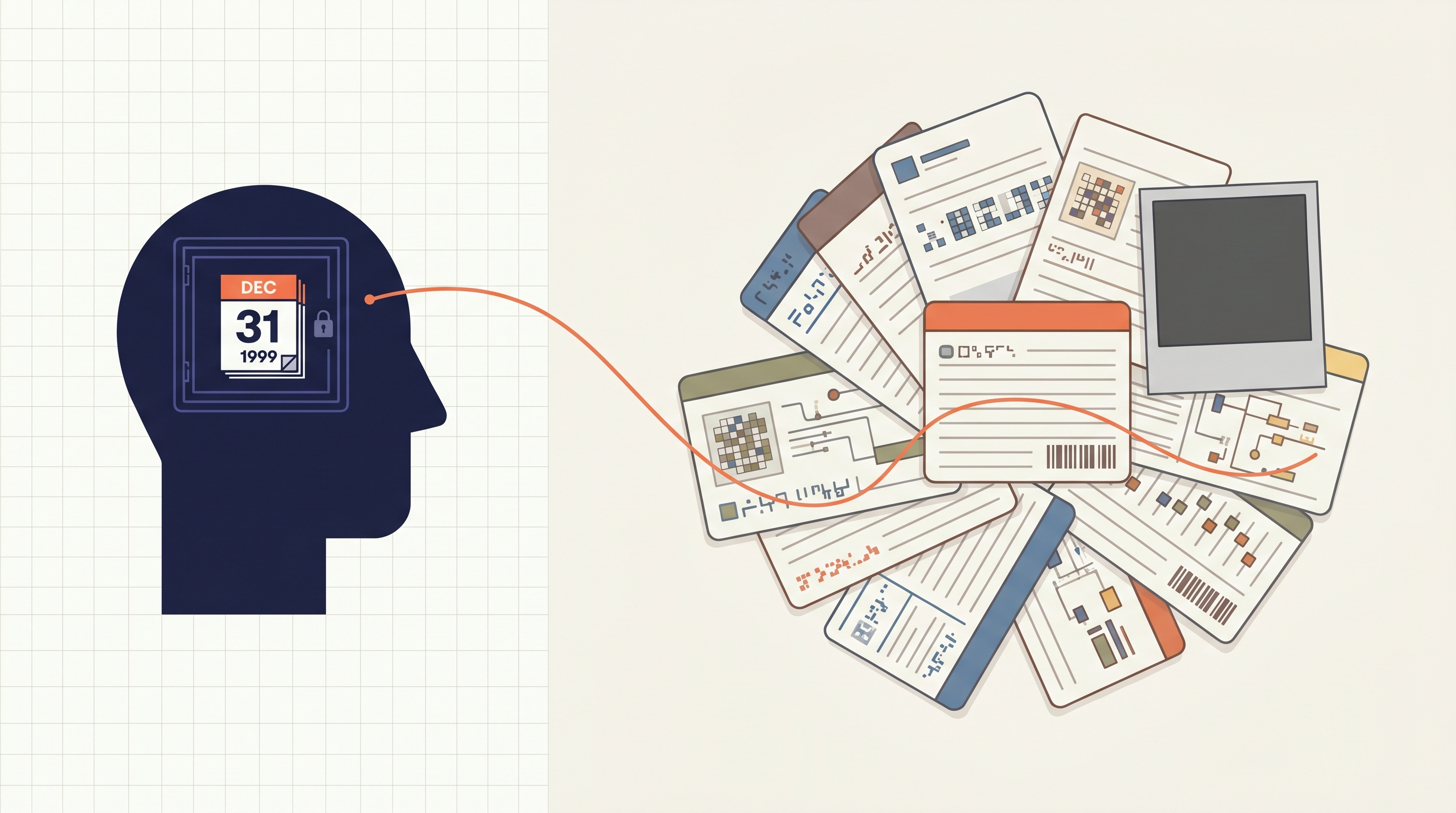
December 31, 1999, locked away — the knowledge cutoff frozen inside an LLM's head. The real answers come from the notepad fanned out beside it.
Leonard and ChatGPT — The real moment AI got smarter happened outside the model
Leonard, the protagonist of Christopher Nolan's 2001 film Memento, can no longer hold a new memory for more than ten minutes after his accident. He takes Polaroids, writes notes on the back of them, and tattoos onto his own body the facts he absolutely cannot afford to forget. Every act of deduction in the movie happens not inside Leonard's head but in the photographs and notes he carries.
The biggest shift in artificial intelligence over the past two or three years has the same shape. The only difference is that the one carrying the camera is not a person but the AI itself.
A genius who keeps starting from scratch
A large language model — an LLM, the kind of AI that reads and writes text, like ChatGPT or Claude — can be compressed into a single sentence: a person who has read almost everything posted on the internet up to a certain date and has not seen a single word added since. That date has a name in the industry — the knowledge cutoff. Anything after the cutoff simply does not exist inside the model.
The trouble is that the model often does not know it does not know. When it should be saying "I don't know," it instead lays down a plausible-sounding sentence by following patterns from its training data. This is called hallucination — when an AI states something that is not true as if it were.
The numbers make it sharper. According to 2025 hallucination benchmarks, top-tier models cluster at an average hallucination rate of 10 to 20 percent regardless of task (SQ Magazine, 2026 summary). For time-sensitive questions — "who announced what last week" — models without search tools roughly double their hallucination rate compared with those that have search. Even for routine analytical work the rate stays above 15%.
It's the same pattern as Leonard, the brilliant ex-detective who has to start over every time. The reasoning he had before the accident is intact; ask him about anything since the accident and he is not the one to ask.
The Polaroids in the pocket
Leonard's solution is not inside his skull but inside his pocket. When someone asks "who is that man?" he doesn't strain to remember; he digs through his stack of photos and pulls out the Polaroid with that face on it. Written on the back, in his own handwriting: "Teddy. Don't believe his lies." Only after looking at the photo and the note does he speak.
In the technology industry, this exact move is called RAG — Retrieval-Augmented Generation. The concept was first formalized by Patrick Lewis and colleagues at Facebook AI Research in 2020, in arXiv:2005.11401. The paper calls the knowledge baked into the model's weights parametric memory and the separate database alongside it non-parametric memory. RAG uses both at once.
The procedure is three beats.
One, Retrieval. When the user asks a question, the system first pulls relevant documents from an external store. That store might be the company's internal manual, yesterday's news bundle, or five years of one's own email. It is Leonard's stack of photos.
Two, Augmentation. The retrieved documents are placed in front of the model along with the question. The instruction is explicit: answer based on this material. It is the moment the note on the back of the photo is laid open.
Three, Generation. The model fuses what it knows with what was just placed in front of it, and produces an answer. It is the moment Leonard, after reading his note, says, "You're Teddy. But I don't believe you."
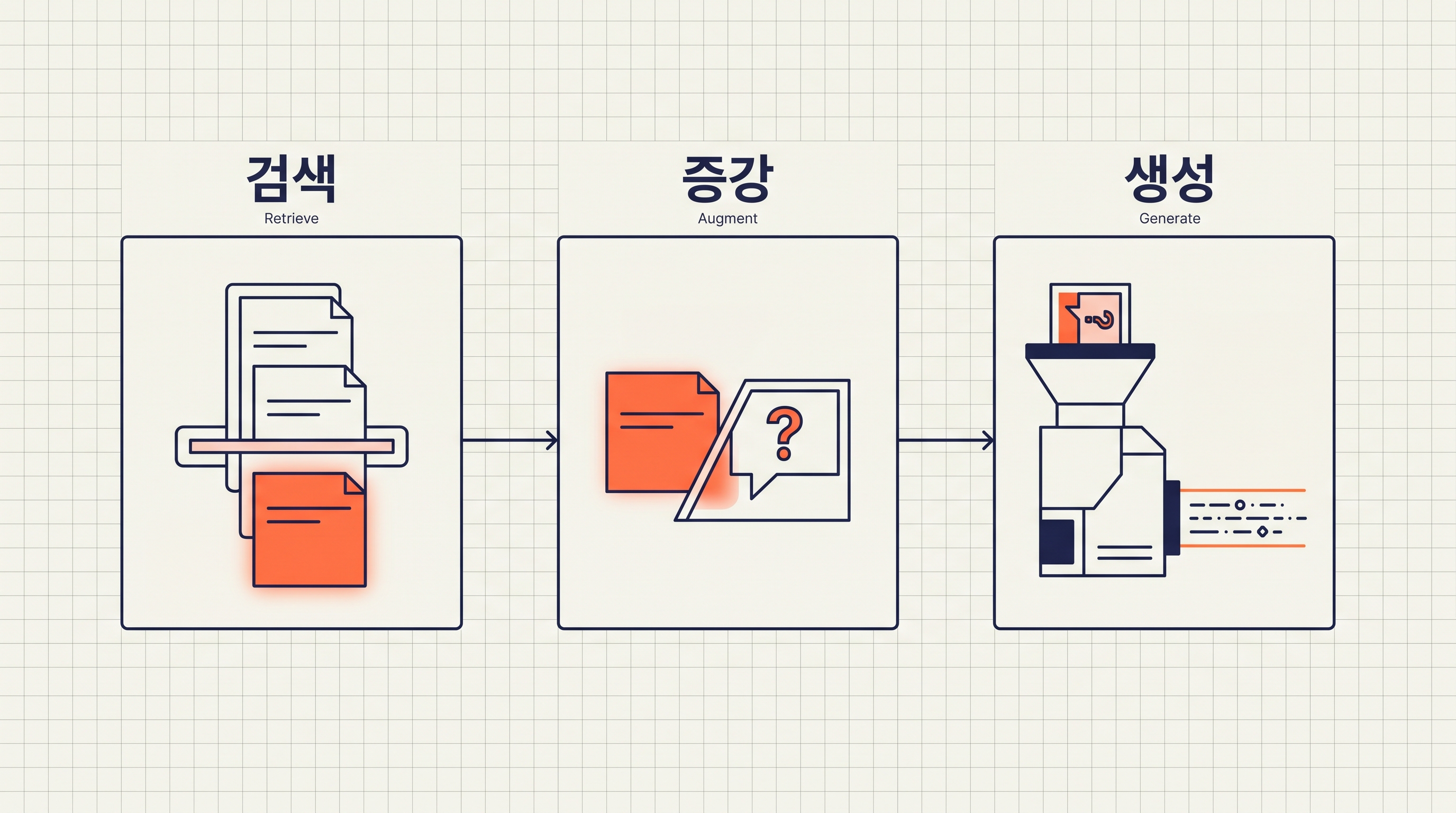
The three beats of RAG. Retrieval picks the material, augmentation fastens it to the question, generation writes the answer.
Why every company suddenly started writing notes
Why did this pattern sweep through every company at once? Time and money. To stuff new information into an already-trained model, you have to retrain the entire thing — billions of won, weeks of compute. Uploading one more PDF to an external store takes a minute. The fastest path from a product manual that ships today to an AI that can answer about it tomorrow is RAG.
The adoption curve is in the numbers. Across 2025 industry surveys, 30 to 60 percent of enterprise generative-AI use cases are running on top of a RAG architecture. McKinsey's State of AI survey the same year reports that 71% of responding companies use generative AI in some form on a regular basis (McKinsey, 2025). By industry, the fields where "getting the facts wrong is the end" — law, medicine, finance — lean on RAG most heavily.
A different line in the same survey is more interesting. 71% reported using it; only 17% reported that it contributes 5% or more to their EBIT. That is a deep gap between adoption and value. Starting to write notes is not the same thing as writing them well.
But the notes lie too
Here the second great moment of the film comes back. The shock of Memento is not that Leonard carries notes; it is that he himself may have written them wrong. A photo taken at the wrong moment. A clue read wrong. A line deliberately distorted. The same thing happens inside RAG.
In 2024, Stanford's RegLab evaluated the legal AI tools from LexisNexis and Thomson Reuters. Both run on RAG. The result was cold. Between 17% and 33% of responses were classified as either hallucinations or miscited sources (Magesh et al., Journal of Empirical Legal Studies, 2025). RAG does reduce hallucination — academic reviews from the same period report a 40–71% reduction. But reducing is not eliminating.
The causes split into two. One is failure at the retrieval step. The corpus is poor; the question gets misread and the wrong document gets pulled; the key paragraph sits in the middle of the retrieved set and the model ignores it (a phenomenon researchers call lost in the middle). The other is failure at the generation step. When retrieved evidence conflicts with what the model already "knows," it can side with the training data; or it can confidently add something the source never said.
Return to the film. The reason Leonard never quite reaches the truth is not that he runs out of notepaper; it is that the moment of writing was already shaky. A tool cannot exceed the precision of the person using it.
One line for this piece.
The RAG on your own desk
Why does this matter for your own work? Because you are already running RAG.
The doctor in the exam room does not prescribe from memory alone. The clinical guideline is on the screen. The lawyer does not memorize every precedent; the lawyer searches. The accountant double-checks the tax code in a manual. The teacher plans the lesson with the curriculum guide open. The salesperson rereads yesterday's deal notes before walking into a meeting. Every one of these moves is retrieval-augmented generation. Knowledge in the head handles reasoning; material kept on the outside handles the facts.
The same pattern works when you put AI to work, and the result changes accordingly. The two simplest and highest-leverage moves:
One, hand the model the material first. When asking ChatGPT or Claude, upload your company's documents, your industry reports, the sales data from your own shop as PDFs, and instruct: Base your answer on this material. Your specific evidence becomes the basis of the answer, instead of the model's vague general knowledge.
Two, ask for sources alongside the answer — "which page, which sentence did this conclusion come from?" An answer that cannot point to a source is most likely a hallucination. Anyone who has seen Memento knows what happens when Leonard speaks before reading the back of the photo.
The real shift didn't happen inside the model — it happened on the notepad next to it. And how you write the notes is what ultimately decides the quality of the answer. The people who do well in the AI era are not the ones chasing a smarter model; they are the ones who build the right notepad for their own domain, retrieve from it well, and place it in front of the model precisely.
Leonard's photos didn't save him. But how we write our notes — that we get to decide. That is the difference between the film and our work.
Shin Chi-hoon Yeongyang AI Association — yyaia.org
Images in this article were generated with an AI image model (Gemini 3 Pro Image) and edited under the supervision of the YYAIA Tech Desk.

This article was produced with the deep-thinking engine
Simthink Engine (深 Think) of Myeongseong Simjae.