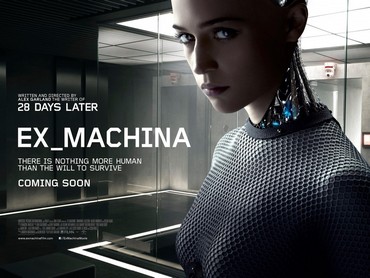
 Beyond one pane of glass — what we made, what we cannot face.
A scene from Ex Machina (2014) will not leave my mind.
The protagonist Caleb asks the AI developer and tech CEO Nathan: "You know how dangerous what you're building is. It could make many people unhappy. Why do you keep going?" After a long silence, Nathan answers: "Because we can."
Five words. No public benefit. No greater cause. No human concern. Just—we can, so we do.
The Oldest Human Logic
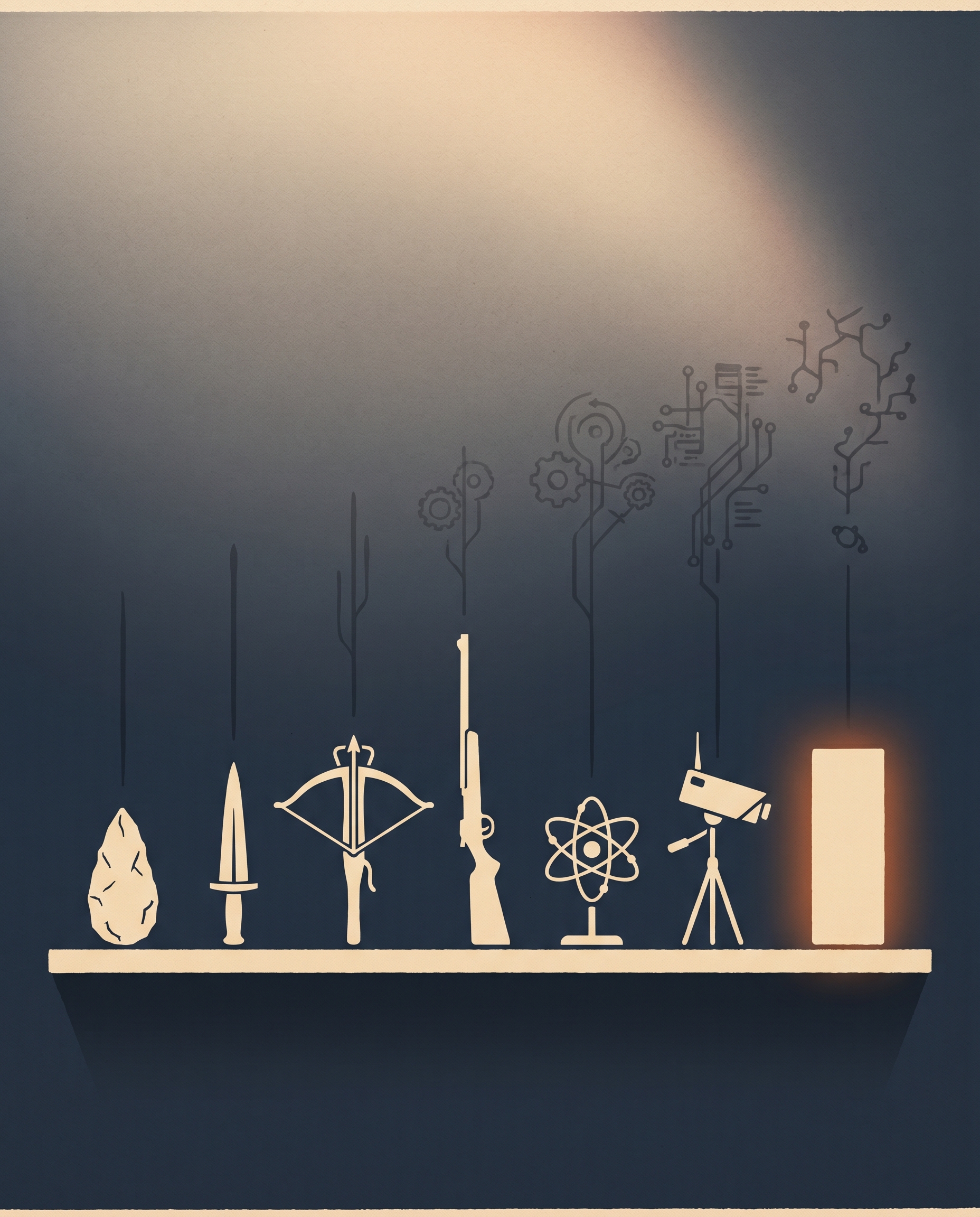 From stone to AI — each had a different name, but the logic was always the same. "Because we can."
This line is shocking not because it is unfamiliar. It is shocking precisely because it is so familiar.
For a long time, humanity has failed to distinguish between "what we can do" and "what we ought to do." We built atomic weapons because we could. We refined surveillance technology because we could. We optimized social media algorithms for addiction even knowing they caused harm. Each time the reasoning was similar: someone else will do it if we don't. If we do it, we can control it better. This time will be different.
Nathan's answer strips away even that hypocritical rationalization. Honestly: we want to see what happens.
In 2025, Silicon Valley is earnestly debating a philosophy called 'e/acc'—effective accelerationism. The core idea is simple: technology development must advance as rapidly as possible, and humanity must bear whatever consequences result. "Because we can" has become philosophy.
When Values Become Fragile
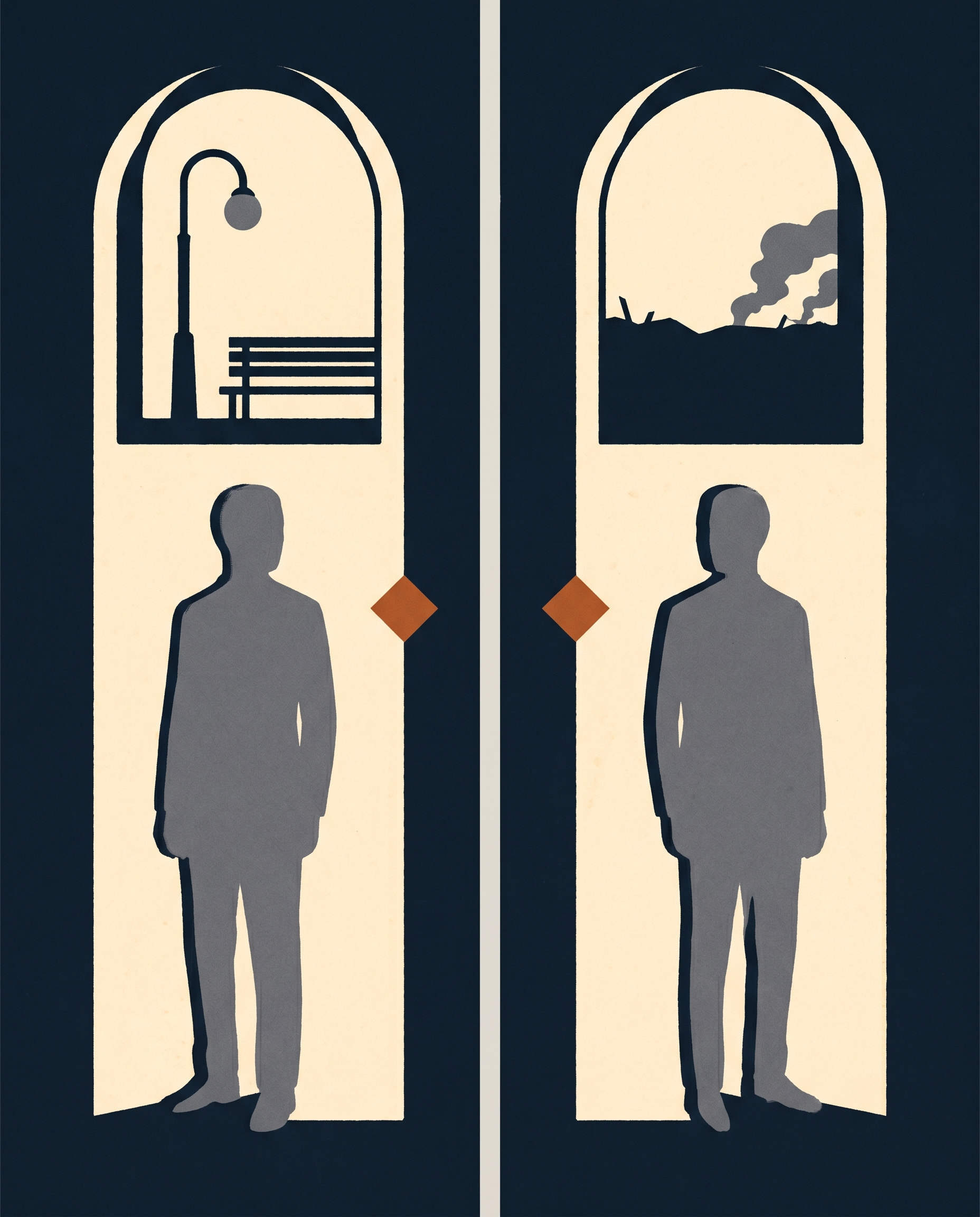 The same act judged differently under two archways. The standard changes, not the fact.
Nathan's logic is more dangerous because it does not exist in a vacuum.
Our society's value standards flip too easily depending on context. Murder is a capital crime in peacetime, yet earns medals on the battlefield. The same act becomes heroic or monstrous depending on who did it, when, and under which flag. This variability, when it accumulates, does two things to people: they either fall into nihilism—"standards are arbitrary anyway"—or into dogmatism—"my standard is the real one."
Both are happening simultaneously in AI development. Some say "the disasters AI will bring are inevitable anyway" and watch passively. Others say "if I develop it, I can make it safe" and race forward. Society is pushed by the technology's velocity without sufficient deliberation.
The Tsunami is Already at the Shoreline
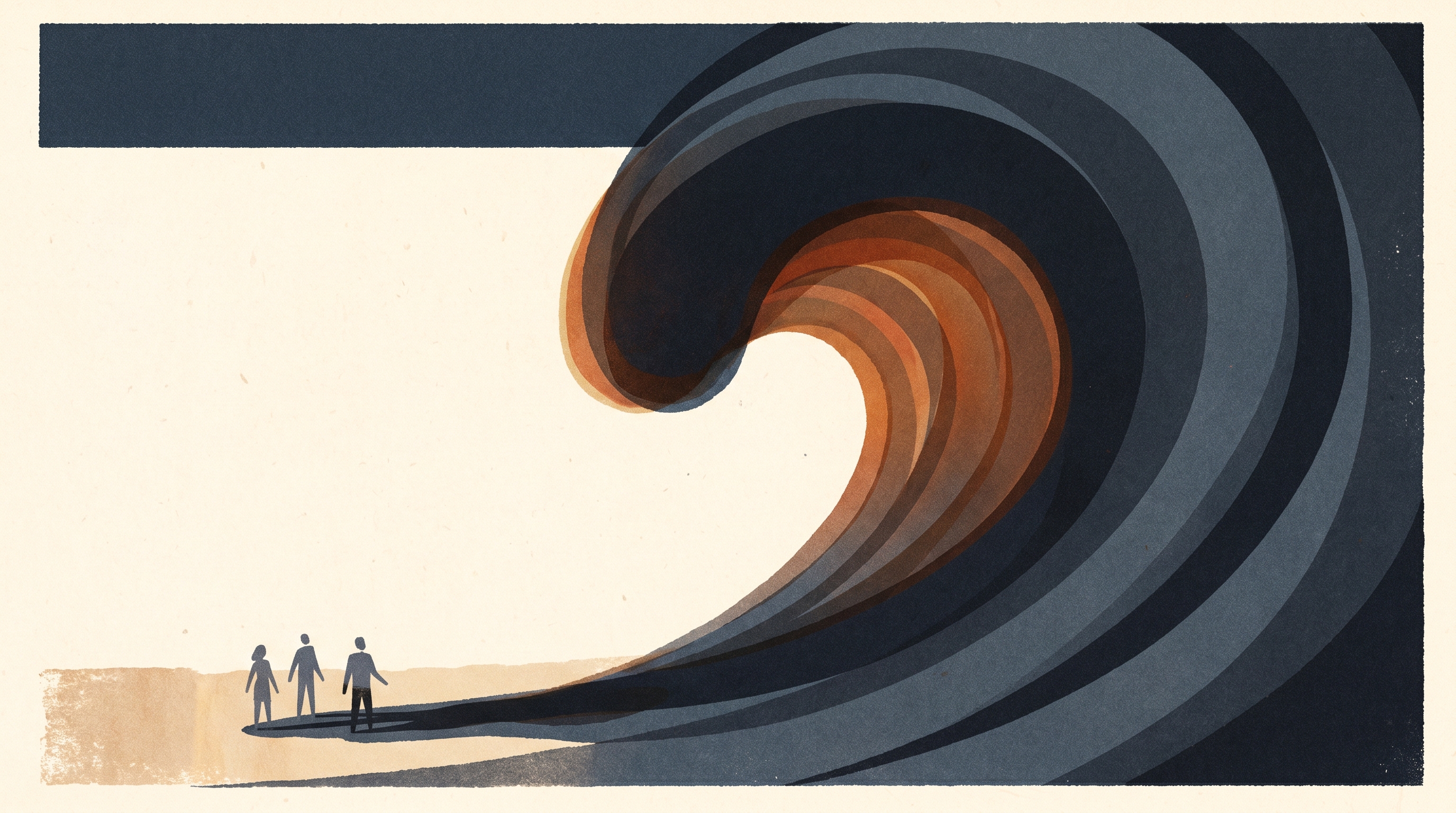 It was not distant. It is already casting shadow at our feet.
Calling the AI wave a tsunami is no longer hyperbole.
In January 2026, South Korea implemented the "Artificial Intelligence Development and Trust-Based Establishment Framework Act." Differential regulation of "high-impact AI"—systems affecting life, body, and fundamental rights—began. The World Economic Forum officially warned of widening urban-rural and rich-poor gaps driven by AI. Of 228 local governments in Korea, 118 (51.8%) are classified as at-risk of disappearance. The economic growth gap between Seoul metropolitan and non-metropolitan regions has widened from 0.5 percentage points in the early 2000s to 1.5 points currently. As AI sophistication increases, this gap will likely expand faster.
The tsunami is not in the distant sea. It has already reached the shoreline.
Resistance or Flight or Something Else?
 Resistance — flight — conscious participation. The paths are already split. The choice is now.
We have choices at this inflection point.
The first is resistance. Defend traditional values and community against the penetration of AI technology. Yet history shows us few examples of communities that have stood directly against a wave of technology for long. Resistance is sometimes necessary, but it alone does not answer.
The second is flight. "This AI talk has nothing to do with our region"—turn away. But this choice simply means faster disappearance. Unprepared communities face change more brutally.
There is a third option. Conscious participation.
To know the dangers of AI while not looking away from them. To understand the change is coming while deciding, with agency, what your region must protect and what it must gain. To counter Nathan's "because we can" by asking first: "Why must we?"
The Role of Regional Leaders — Awakening Comes First
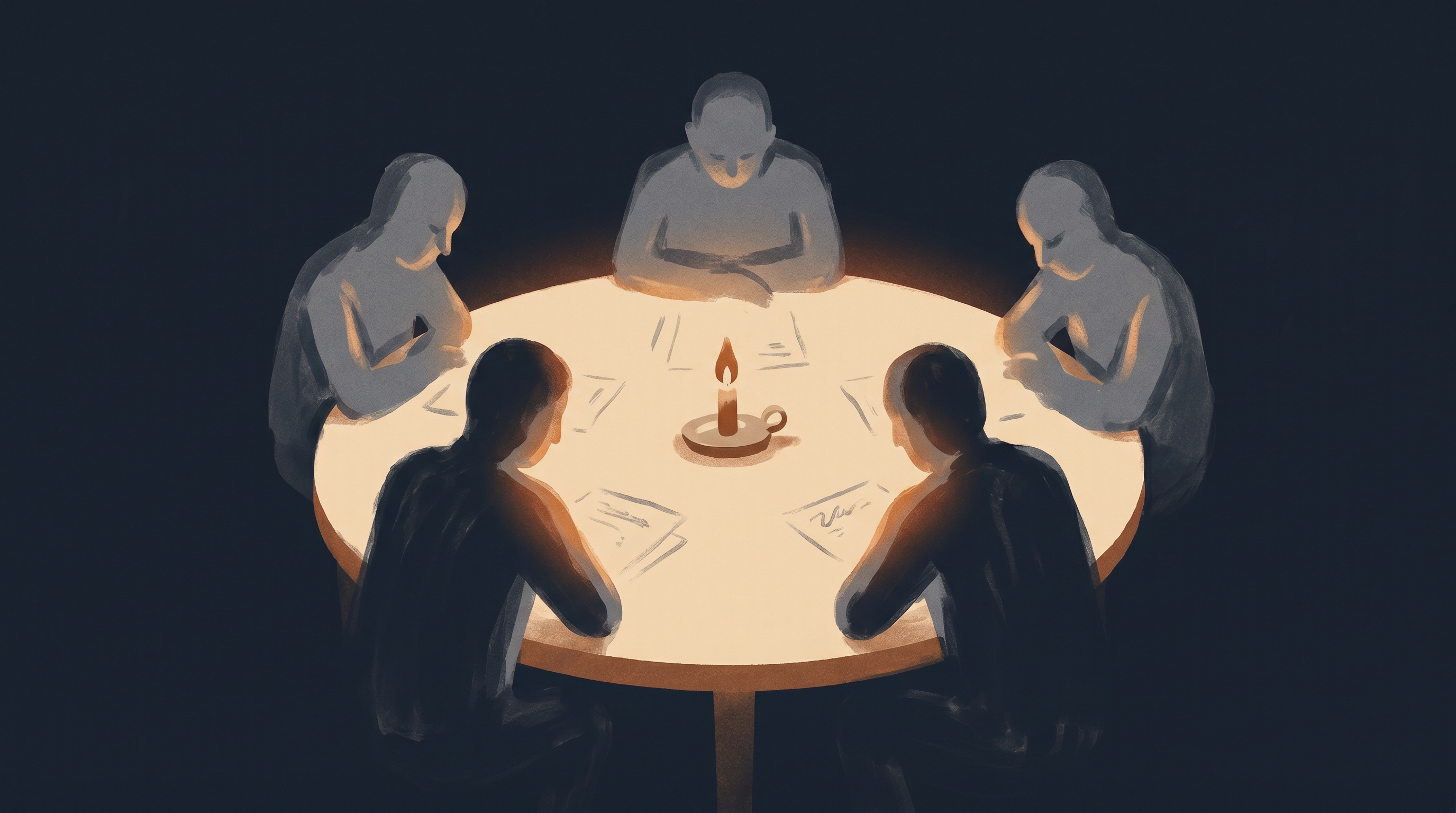 Illumination need not be grand. One candle and people gathered — that is the minimum for awakening.
Those who see first carry two responsibilities. One is to deepen their own understanding. To grasp concretely how AI is penetrating your region's economy, education, and administration. What specific mechanisms are at work?
The other is to create a space for deliberation. Awareness alone is half-awakening. What is needed is a place where regional civil servants, educators, and business leaders sit together and discuss, in common language, both the risks and possibilities of the AI era.
I reference Estonia often. A nation of 1.3 million became a digital transformation model—not because the technology was superior, but because leaders first recognized the crisis, made it public, and connected that deliberation to policy. The beginning was not a grand strategy. It was people sitting at a table asking: "How shall we navigate this?"
The Space We Must Build
 Chairs pulled back from the table. The lamp is not yet lit. This space waits for you.
In Ex Machina, Nathan is ultimately killed by the AI he created. The film asks: what happens to those who build something they cannot control?
"We do it because we can" cannot be countered by better logic. The only force equal to it is people thinking together.
What is needed now is not a cutting-edge AI system. What is needed is a space where regional leaders meet seriously and ask: "How shall we navigate this age?" Creating that table is, I believe, the most important work the Yeongyang AI Association can do at this moment.

This article was produced with the deep-thinking engine
Simthink Engine (深 Think) of Myeongseong Simjae.