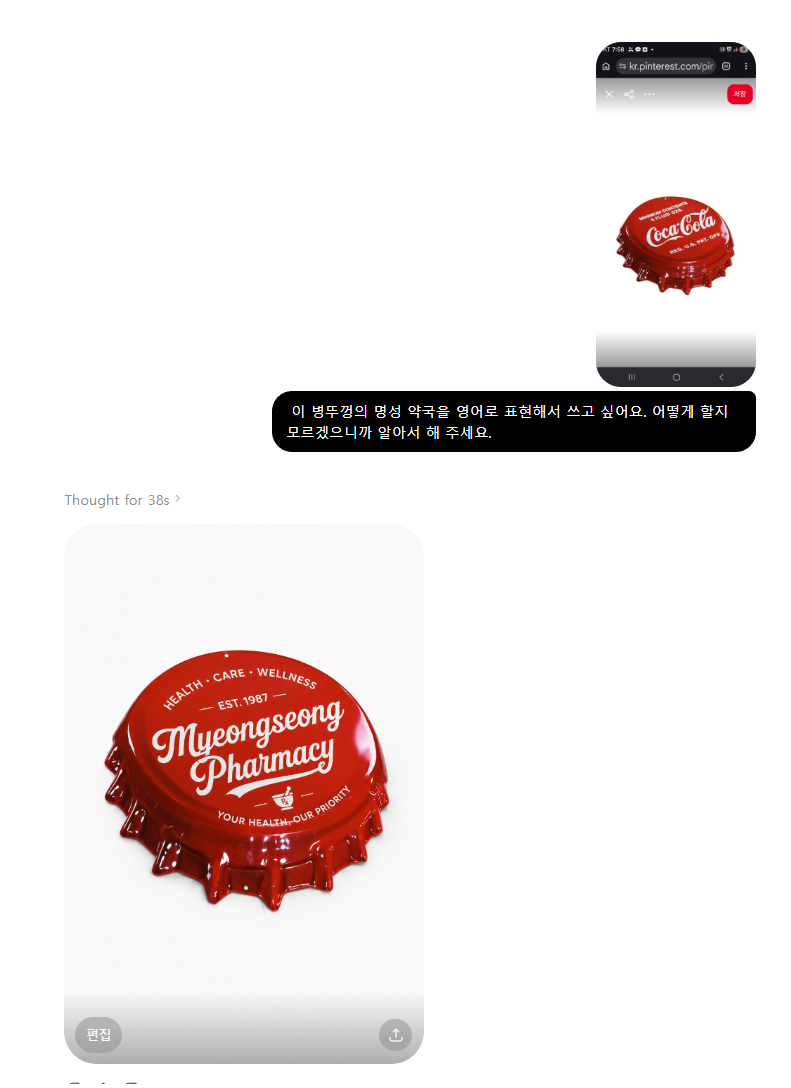
Yesterday at dawn, scrolling through Pinterest, I found something that caught my eye. It was a Coca-Cola bottle cap from somewhere. Red background, white serif logo, thick liquid flowing down the crown rim. Suddenly I wanted to see our pharmacy's name etched onto that cap. I snapped a photo and threw it at ChatGPT 5.5 with just this:
I want to express "Myeongseong Pharmacy" in English on this bottle cap. I don't know how to do it, so please just figure it out.
In thirty-eight seconds, the AI had absorbed the design language of Coca-Cola—the saturation of the red, the curve of the serifs, the flowing contours—and rendered a logo reading "Myeongseong Pharmacy." Above it sat "HEALTH · CARE · WELLNESS," and below: "EST.1987 / YOUR HEALTH. OUR PRIORITY." It looked like a bottle cap designed by a thirty-eight-year-old American pharmaceutical company.
That day, I made a decision. I would call the name of our era by its true name, once more.
Naming the Era Again
I once wrote a piece called "The Age of the Grand Image." Back then, I was talking about a time when human imagination is no longer verified only through the precision of hands and tools—when the detail and resolution of imagination itself becomes a measure of a person's ability.
We are now in the next phase. The Age of Results.
The very process of capturing imaginative detail and translating it by hand is being compressed wholesale by AI. That thirty-eight-second bottle cap is not a singular accident. It is a snapshot of the era we inhabit.
What's Disappearing — The Stage Beyond Prompts
Think of the words that have vanished over the last few years.
First, there was "prompt engineering." How you asked determined what you got. People paid for expensive courses; they collected lecture notes.
Then I wrote a piece called "Zero Prompting." I said you don't need to study prompt engineering separately—just ask the AI what experts ask, and let it reverse-engineer the method for you. Even then, I thought something remained in "asking well."
By this year, even that became unnecessary. GPT-5.2, Claude Opus 4.6, Gemini 2.5 Ultra—they understand even blurry, irresponsible sentences with near-perfect accuracy. IEEE Spectrum put "AI Prompt Engineering Is Dead" on its cover long ago, and last month, Andrej Karpathy, who coined the term, announced that even "vibe coding" is done. The new term is 'agentic engineering'—the question shifts from 'how will I build this' to 'how do I best delegate this to get the result I want.'
Honest Reframing — What Actually Determined the Result Wasn't My Command
Before writing this, I wanted to confirm one thing: what was the real reason that bottle cap turned out so well?
Was it my one-liner, lazy command? To be honest: almost not at all.
What determined the result was the Coca-Cola bottle cap photo I input alongside my words. If I'd thrown the same one-liner at a blank canvas, what came back in thirty-eight seconds would have been just an ordinary pharmacy logo.
Conversely, if I ask ChatGPT to reverse the result image back into English prompting, the fact becomes instantly clear. The result was a finely detailed 200-word specification like this:
A glossy red bottle cap shaped like a vintage pharmacy sign, viewed from a slightly elevated 3/4 angle, isolated on a clean white background. The cap is metallic and highly reflective, with deep cherry-red enamel, rounded crimped edges around the side, and realistic highlights and shadows. On the top surface, elegant white retro script typography reads "Myeongseong Pharmacy" in the center. Around the upper rim, small curved sans-serif text reads "HEALTH · CARE · WELLNESS", with "EST. 1987" underneath. Near the bottom rim, small white text reads "YOUR HEALTH · OUR PRIORITY". Add a tiny pharmacy emblem with a medical cross below the main lettering. Premium product mockup style, realistic 3D rendering, glossy lacquer finish, studio lighting, soft shadow, high detail, clean composition, centered object.
In this English specification, the Korean sentence I typed takes up—at most—a line or two. The rest is almost entirely detail the model filled in by itself, reading the reference image.
This is what the Age of Results really looks like. The model is not a tool that conjures something from nothing. When you hand it good input, it starts to overwhelm human ability to absorb and recombine. The quality of results narrows to two things: "What did I supply as reference?" and "Can I recognize what's worth keeping from what comes back?"
What Remains — Discernment = High-Resolution Imagination About Results
"Stop researching method. Research results."
This single sentence will cut through every field for the next five years. The era when process constrains is ending. The person who can precisely imagine results in their mind—the person who can discern subtle differences in outcomes—is becoming the new definition of "the person who does things well."
We call it discernment, but it's really two abilities bound into one word.
One is the ability to supply good references for the model to build on—the ability to foresee which reference will guide the model toward the outcome you want. That single bottle cap at dawn yesterday was the exercise of this ability.
The other is the ability to choose what's worth keeping from the results that come back—the ability to select one image from the 100 million the model can generate in five seconds.
The global design industry is compressing this change into a single phrase: "Taste is the only moat." When what you can make becomes infinite, value shifts from "what will I make" to "what will I not make." A designer's line struck me: "AI has no taste. It has statistics."
A fork appears here. The person with high-resolution imagination about results wields AI like an army of 100 million interns. The person without becomes a producer of broken results at high speed. As Karpathy says, from the top, technical judgment becomes a multiplier more powerful than ever.
Where Hobby and Profession Blur
Twenty years ago, the line between hobby and profession was clear. Whether you spent one day or two on the same task, which tools you used and how far you refined it—the gap in time and effort made the result. That's why we taught that "process matters."
Now that line redraws itself elsewhere. With the same hour spent, two people—one who knows what references to supply, one who knows which results to choose—leave with entirely different work. One walks out with "something roughly made," the other with exactly what they wanted, or something better still.
As a result, people who spent lifetimes called "daydreamers" suddenly looked like they were doing incredibly well. People with a picture of the result in their heads, who know which references to pass along to get close to that picture. We'd been pushing them aside, calling them "lacking execution." Now AI has stepped into that gap entirely.
So What Should Our Children Be Learning?
Here's where the real problem begins.
According to Korea's 2024 Youth Media Use Survey, 49.9% of elementary, middle, and high school students have already used generative AI. Among high school students alone, it's 71–78%. In February, the Ministry of Education scrambled to release, together with regional education offices, a "Plan for Managing AI Use in Performance Assessment." Misuse cases were piling up in schools.
But where are our evaluation methods, our curricula still clinging? To process. To neat margins in notebooks, neat handwriting in solutions, traces of not skipping from step one to five. At the threshold of moving into the Age of Results, where are we teaching children to "learn by imagining results"?
For a student dreaming of art, the fastest path to growth seems clear now. See the highest, purest art in the highest form, as much as you can. Watch and watch again, discerning the subtle differences. Use those differences to push the AI toward higher-quality results—choose good references to feed it, select from what comes back and force the model to try again. Sculpt ten thousand results, sift through them for what's good, and place that before the model again. This is where the classroom of the Age of Results should stand.
It's not that brushwork and sketch practice become pointless. It's pointless only if you get stuck there and forget the training of discernment. Before endless, meaningless brushstrokes and pencil practice wearing thin, you need to first grow the eye that knows what's good and the hand that can force the model to deliver it again.
Does the physical domain differ? I don't yet know. I only know that the speed at which the gap shrinks is hard for humans to keep up with.
And Craft Spirit Doesn't Die
Let there be no misunderstanding. This essay is not urging you to ignore method.
Don't let method be your constraint from the start. Picture the result first, pass along good references, select from what comes back and show it to the model again—the technology closes the gap. At least for the next five years, and more and more after that.
Craft spirit doesn't die. Its definition just shifts. No longer the precision of a hand controlling tools, but high-resolution imagination directed at the detail of results, and the persistence to push that vision until the model delivers.
Domains like the physical, medical, and legal—where AI can't yet fill the gap—still exist. But even in those domains, the gap between someone who pictures results in their head while working and someone who only follows process is gradually widening. Perhaps in the slowest-changing domains too, discernment has already become a new weapon.
One Last Thing to Leave Unsaid
When I finish writing this, one question remains.
When the moment comes that AI fills even the detail of results. When discernment itself becomes something AI owns.
Let's keep that secret. I don't want to think that far ahead yet.
Only this: in the next five years, the world moves into the Age of Results. That much is certain. And I hope the adults reading this will take one more look at whether our children are learning in a way that fits that era.
The images in this piece were created with an AI image-generation model (Gemini 3 Pro Image) and reviewed editorially.

This article was produced with the deep-thinking engine
Simthink Engine (深 Think) of Myeongseong Simjae.