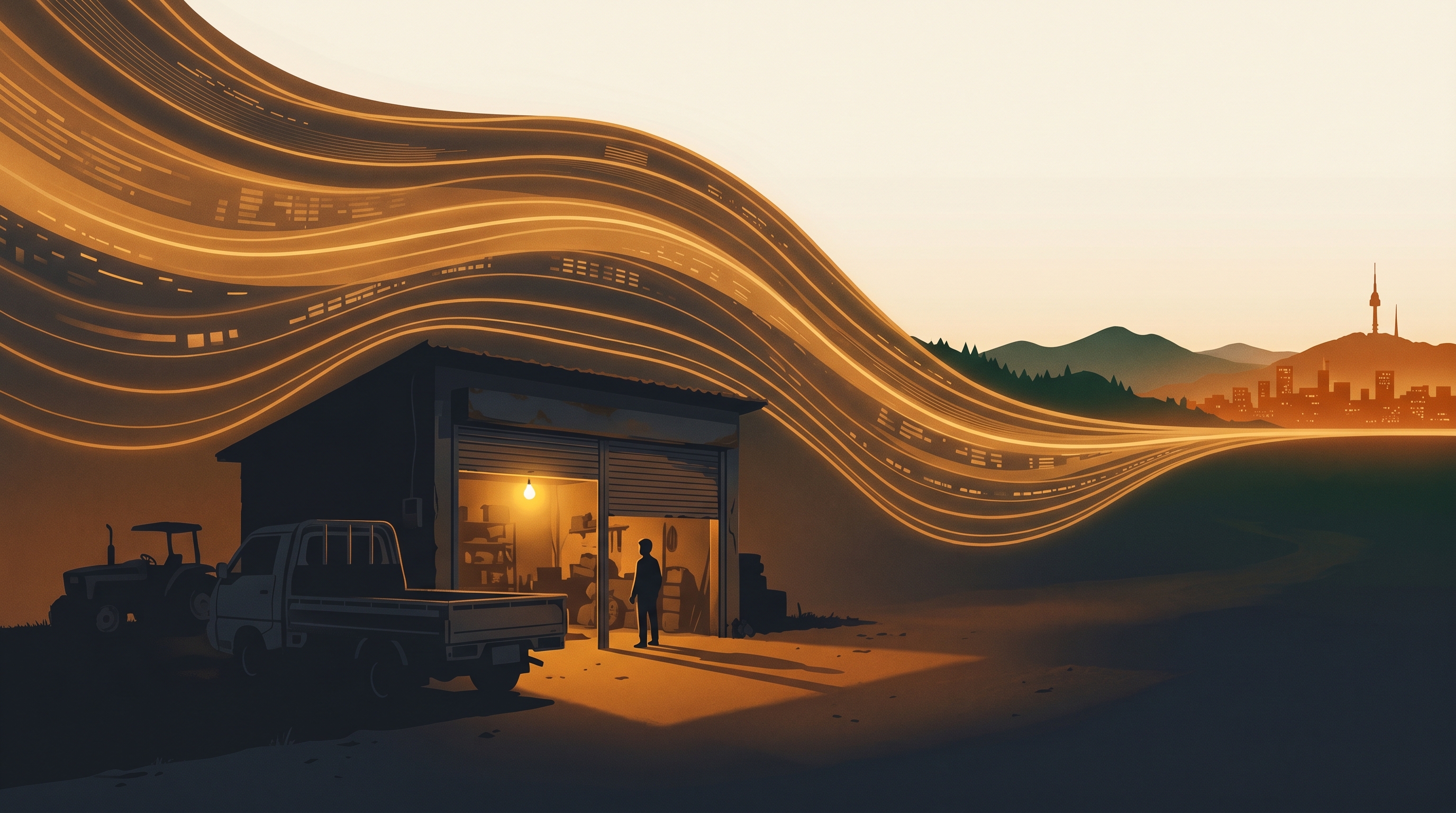
The river of data flowed past the village — what remains where repair shops closed?
Each time a county-level repair shop closes in Yeongyang, the village's tractors, trucks, and 1-ton cargo lose a home. Is AI watching silently, or is it complicit in building this landscape?
1. What remains where repair shops have closed
City dwellers do not realize how few repair shops exist in Yeongyang's townships. There might be one or two. When one closes, village residents towing a broken-down vehicle must travel 30 kilometers to the county seat. If a vehicle is too damaged to tow, towing alone costs tens of thousands of dollars. How many 65-year-old farmers in our village can absorb that?
A repair shop is not just a shop. In rural areas, it fixes cars, tractors, tillers, rice transplanters, 1-ton cargo vehicles, and brush cutters. While urban shops compete over import-car specs, Yeongyang's shop takes a farmer's tiller at 6 a.m. So when a township shop closes, it is not a business closure — it is the severing of village mobility and farming itself.
This is already happening nationwide. Seoul branch of the Korea Auto Repair Association (KAPOS) had 2,700 members five years ago. Today: 1,700. If a 37% decline occurred in the city in five years, rural areas could not escape. Yet we have summarized this entire landscape in one phrase: "electric vehicles killed it." Is that the whole story?
2. "Electric vehicles wrecked us" — half the truth
Electric vehicles do reduce repair work. Jeju Island, reaching 5% EV penetration between 2015 and 2019, lost 59 auto repair shops — 12.6% of the total. EVs require half the routine work and cut service time by 65%. Eight hundred thousand repair technicians face job threats. This diagnosis is months old.
But during the same period, Tesla, BMW, and Renault Samsung expanded brand-direct service networks nationwide. It is not that repair work vanished — it shifted. To manufacturer service centers, certified networks, and one invisible place: inside data.
For rural mechanics, this distinction is decisive. "Electric vehicles ruined me" becomes personal failure to adapt. "My shop never received the car's data" points to the architecture of that data loss. The second question is what we should ask: why does that data never arrive?
3. Beyond the OBD2 port — the invisible wall
Modern cars are computers. Somewhere under the hood sits an OBD2 port. Plug in a small scanner, and the car speaks its state in codes. Domestic startups like Infoca make smart scanners that plug into OBD2 and decode 600+ standard data points in 17 languages. Dreamace uses LLMs to analyze fault signals, explaining cause and repair steps in natural language. Technically, a one-person shop owner in rural Yeongyang could diagnose as well as a luxury import specialist in the city.
The wall is what comes next. Hyundai is deploying wireless over-the-air updates (OTA) as standard on new cars and will begin producing software-defined vehicles (SDVs) with proprietary OS from 2026. Critical car faults are not reported to the OBD2 port. They go to the manufacturer's cloud and are fixed by OTA. The mechanic is not reading the car's mind directly — they are waiting for the manufacturer service center's decision.
Here, the real reason repair shops close emerges. AI does not replace mechanics. The ownership structure of AI tools does. Who has the right to read the car's fault codes — that determines who can bill for repair. The thousand KAPOS Seoul members who disappeared did not because revenue dropped. Their revenue dropped because the codes they could read disappeared.
4. Mechanics aging, certifications aging faster
If data walls are half the crisis, the other half is people and systems.
Of Korea's 2.36 million small/medium enterprises operated by age 60+, 28.6% — 675,000 — face closure risk with no successor. Auto repair is no exception. Half the township shop owners in Yeongyang and Bonghwa are over 65. Their children have already moved to the capital region. When they retire, those shops vanish forever.
New mechanics are not coming because certifications lag the times. Korea's Industrial Human Resources Development Institute's auto repair technician exam has kept roughly the same shape for nearly 25 years — ABS, engines, transmissions. The ability to interpret AI diagnostic data, manage battery systems (BMS), read OTA-delivered fault reports: none of this is in the certification. The certificate no longer licenses you for the SDV era.
Before AI takes mechanic jobs, it is taking their right to read the car. Systems age faster than people. That is the second truth of rural repair crisis.

The OBD2 cable does not reach the car's mind. Between them: an invisible glass wall.
5. Yeongyang tractors, Bonghwa 1-ton trucks, and missing datasets
Even if a Yeongyang shop owner held the same AI diagnostic tool, results would not match a city shop's. The datasets the tool learned from are different.
The Insurance Development Institute's AI repair quote system, Encar's used-car diagnosis chatbot, third-party maintenance platforms' dispatch matching — all were built for urban users, personal sedans, and vehicles under five years old. Data on 1995 Bongo 1-ton trucks rolling through Yeongyang roads, 25-year-old diesel tractors on Bonghwa farms, generator-mounted cargo rigs at Yeongdeok fish markets: that data is sparse or absent.
AI tools look equal, but what vehicle they diagnose well and what they miss is decided by training data. Even if tools spread evenly, rural vehicles remain outside the tool's sight. This is not a technology gap — it is a data gap.
This gap was not created with rural mechanics at the table. The Ministry of Environment is rolling out retraining programs to convert mechanics into EV charging infrastructure technicians, but few asked how many electric vehicles are in Yeongyang County. Policy maps drew the countryside empty.
6. "Grandma, call a dispatch technician through Kakao" — is that the answer?
Where rural repair shops close, city-based repair platform dispatch services arrive. Register your vehicle, summon through app, a nearby technician comes out. In cities, this works cleanly.
Getting that app installed on a 70-year-old farmer in Yeongyang is a different problem. Kakao authentication, vehicle photos, payment card setup, GPS permissions. After clearing every step, the dispatch reply often reads: "We don't service Yeongyang." A county of 16,000 does not have a technician for 6 a.m. tractor breakdowns.
Platforms are not the answer because rural users are not platform priority. A village shop is not a business — it is the first responder of the village. Where ambulances take too long, the shop owner is the village's 119. Lose that, and no digital platform fills the gap.
7. Equalization, not protection — the decision other nations already made
When rural mechanic policy comes up, "protectionism" follows immediately. Protect mechanics, the worry goes, and farmers end up paying higher repair bills. That worry masks something: who is protected right now?
Massachusetts voted in 2020 on the "Right to Repair" law, letting independent mechanics access vehicle data. It blocked automakers from locking diagnostic data inside their own service networks. The EU began rolling out vehicle data access in 2024, designing frameworks that grant independent repair networks data access rights within cybersecurity rules.
The core principle: equalize who can access vehicle data, not protect the repair shop. The reason a rural mechanic cannot read new-car fault codes is not laziness — it is that law denies him that right. Other nations are already changing that law. Korea has not started that conversation.
Three things Yeongyang can begin with this quarter — tools, training, and recognizing the neighborhood as first responder
8. Three things Yeongyang can start this quarter — tools, training, distribution
We cannot overhaul the system at once. But three things are within reach next quarter.
First, map a rural distribution network for AI diagnostic tools with the county office and association. Domestic tools like Infoca and Dreamace already exist. The Yeongyang County AI Association and county office supply OBD2 scanners and LLM diagnostic subscriptions free for six months to 7–10 township mechanics as pilot, and hold monthly use-review sessions. Cost is manageable at the county level. We learned from other rural subsidy schemes that even if tools arrive, they land in desk drawers without manuals.
Second, redesign mechanic retraining around rural vehicles and equipment. Not urban repair textbooks, but real rural cases: diagnostic codes for 25-year-old diesel tractors, OTA rejection patterns in 1-ton cargo rigs, LLM diagnosis limits on aging engines. The Yeongyang County AI Association runs a Saturday morning 3-hour workshop monthly with the KAPOS Yeongyang branch — six sessions as pilot. If auto repair certification cannot keep pace with the times, we can build a local license first.
Third, officially recognize the neighborhood mechanic as village first responder. Partner with the county office, township offices, and village leaders to register shop owners as official primary responders in the village vehicle/equipment emergency hotline, and have the county subsidize part of dispatch fees in a pilot program. This is not protection — it is deciding rural mobility is not left to markets alone.
The hardest of these three is not the first or second. It is the third. The choice to not leave everything to markets always carries the heaviest political burden. Yet the day the last township repair shop in Yeongyang closes, we will know what that decision cost us.
AI does not replace mechanics. AI positions itself between car and mechanic and decides who reads the car's mind. If Yeongyang does not sit at that table of decision, Yeongyang cars will be repaired only outside Yeongyang. Repairing a car is not just repair — it is a village fixing itself.
Director of Strategic Planning, Shin Chi-hoon | Yeongyang County AI Association
The illustrations in this article were created using AI image generation (Gemini 3 Pro Image) and underwent editorial review by Yeongyang County AI Association.

This article was produced with the deep-thinking engine
Simthink Engine (深 Think) of Myeongseong Simjae.