April 29, 2026 · Director of Strategic Planning, Shin Chi-hoon
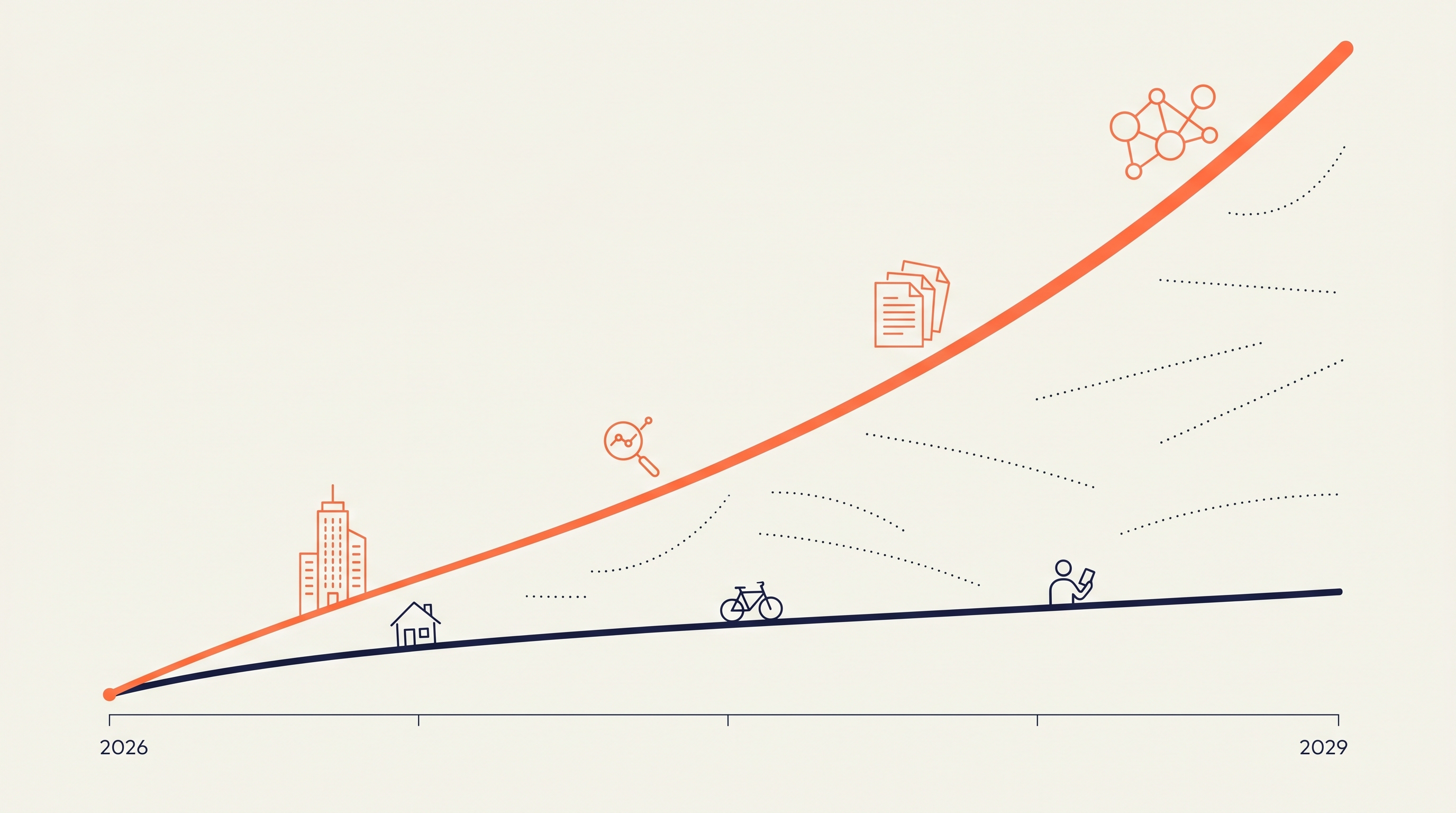
Ray Kurzweil predicted that machines would reach human-level intelligence by 2029 and that human intelligence would expand into non-biological form by 2045. It sounds outlandish. Yet his 35-year prediction accuracy stands at 86%. In the 1970s, he said computers would beat chess champions by 1995. They did.
This 86% number unsettles people for two reasons. One is the hope that "it might come faster than we think." The other is an assumption that "this change will reach everyone at once." Kurzweil himself holds this assumption — just as mobile phones went from billionaire luxury to eight billion hands in a decade, so too, he says, AI will eventually reach everyone.
I do not share this second assumption. And not because I am pessimistic. The singularity not reaching everyone is not a flaw or mistake — it is how the system actually operates. Disparity is not accident; it is the default. If we do not change that default, then Kurzweil's 86% accuracy will prove itself with equal precision in widening the gap.
Where the mobile phone comparison breaks down
Kurzweil's mobile phone analogy stops at one crucial point. A mobile phone's utility was almost entirely in the possession itself. Making calls, sending texts, taking photos. The threshold for use was low. So adoption rates nearly matched usage rates.
AI is different. Getting it into your hands is only the beginning; real use starts from there. You must learn how to ask questions. You must master how to validate answers. You must spend time fitting it into your own work. The use threshold is far higher than the adoption threshold. Adoption can reach 100% while usage stays below 50%. This is the decisive difference between phones and AI.
People rarely feel this difference because they assume their neighbor uses ChatGPT the way they do. But the same tool in two hands becomes radically different. One person extracts the work of an entire lawyer. Another uses it as a search bar and stops. They are not using the same tool. They are using different tools wearing the same shape.
Disparity is not one dimension — it's multiplication across three
Step further. Disparity does not happen along a single axis. It happens simultaneously across capital, language, and cognition — and the three are multiplied, not added. If any one approaches zero, the product approaches zero. The higher all three are, the more the product grows exponentially.
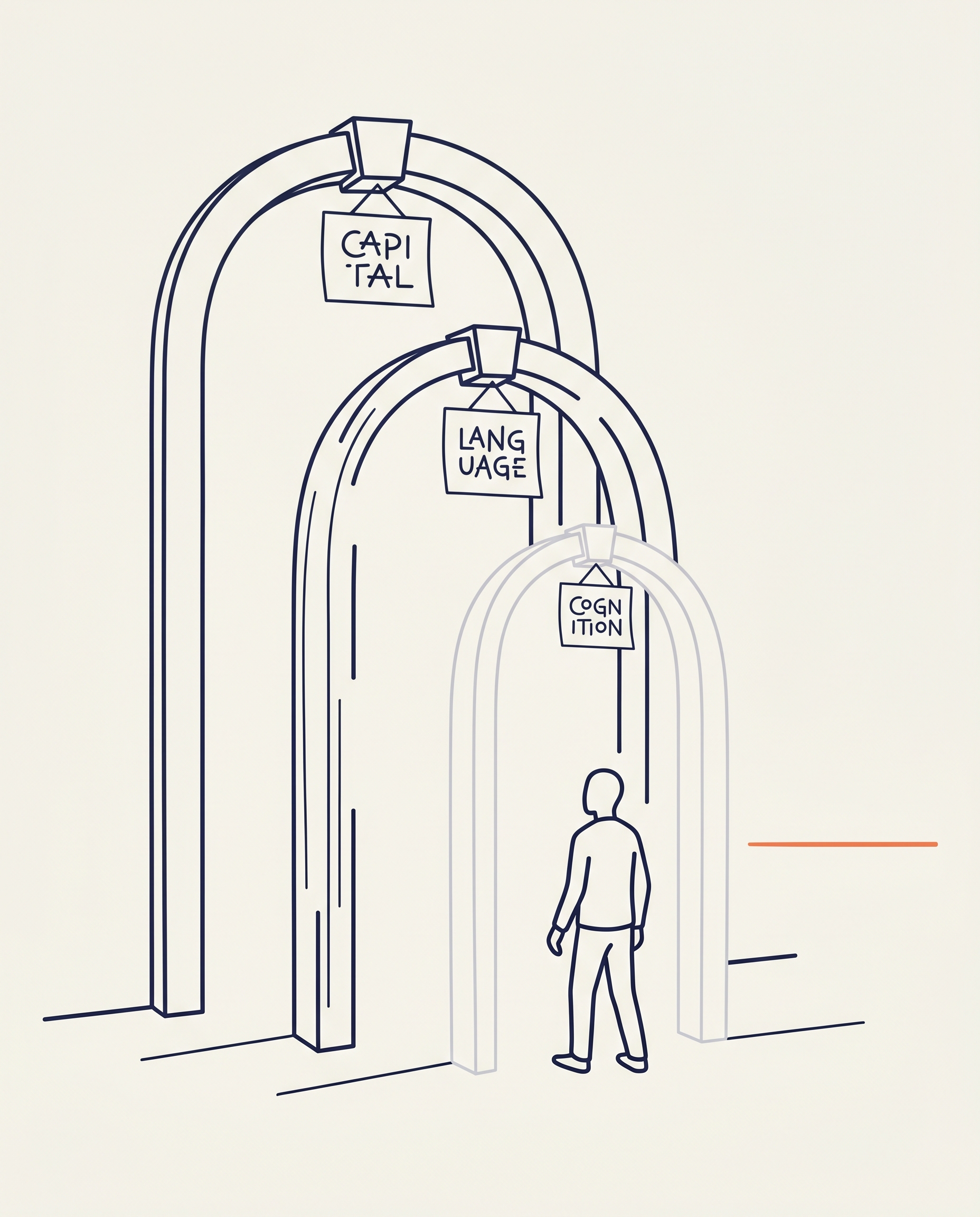
The capital axis. Using cutting-edge models requires paid subscription. Better results come more often from better models. The enterprise market is clearer still — API usage, in-house infrastructure, data pipelines, security certification, consulting. In Mexico, the richest fifth of earners is 5.6 times more likely to hold a job leveraging GenAI than the poorest fifth (IDB and World Bank data). Across Latin America and the Caribbean, roughly 17 million jobs could theoretically benefit from GenAI. Yet those workers lack computers, internet, and basic digital tools. Markets optimize for those who already have.
The language axis. Large language models work best in English and Mandarin. Korean is classified in academic terms as a "low-resource language" (arXiv 2506.21595, "Thunder-LLM"). The same model shows measurable differences in answer accuracy between English and Korean queries. One study tracked a multilingual model trained to reduce false responses — falsity dropped 63% in English but rose in low-resource languages or dropped negligibly. Language itself is an axis of disparity. And within Korean, layers exist between standard Korean and rural dialects, elderly speech patterns, and domain-specific terminology. The further inward you look, the sharper the gap.
The cognition axis. Korea's National Intelligence Service (NIA) 2024 survey found digital literacy at 71.4% for the elderly and 80.0% for rural and fishing communities. These improved 0.7 and 0.5 percentage points from the prior year, yet gaps remain wide relative to the general population. And "digital literacy" means "owns a device and can browse the internet." Whether someone can use AI is a separate question. Measurement at that next level is not yet standardized.
These three axes do not add independently. They multiply. The distance a rural 70-year-old Korean speaker must travel using free AI tools is not simply "a bit further" than a 30-year-old bilingual English-Korean speaker using paid tools in the city. The product of the three axes multiplies the distance by itself.
AI precariat — naming a new underclass
Since 2025, the World Economic Forum has repeatedly examined one concept: AI precariat — the precarious class of the AI age. It is the AI-era version of "precariat" (precarious workers), a term British economist Guy Standing created in 2011.
The original precariat was defined by "insecurity, exclusion, and anxiety." AI precariat adds a new dimension. The sorrow of job loss, exclusion from society, and the collapse of civic trust itself. Not simply because work disappears. It is the structure of experiencing your entire field collapse twice in five years, with society telling you "you fell behind" in between.
WEF's 2026 Global Risks Report sketched the larger picture. Business and economic power concentrate toward new extremes, and the digital divide can widen both within societies and between nations. The implication is clear: disparity does not narrow naturally. Left to market forces, it widens.
Market's default is disparity
This is the hardest part to accept. We are used to narratives where technology eventually becomes universal. Cars, electricity, the internet, mobile phones — all did. Yet that universalization did not happen on its own. Public infrastructure investment, universal service obligations, subsidies, and mandatory education made it happen. Markets did not do it alone.
A 2024 Brookings Institution analysis of US data confirms this. ChatGPT adoption rates are sharply higher in cities and coastal regions than in rural, Southern, Appalachian, and Midwestern areas. Microsoft's own research reports the same. Within the same country, language, and timeframe, gaps still widened. Who will stop that gap? Not the market. The market simply creates more advertising and premium tiers the wider the gap grows.
The picture is clearer viewed from Yeongyang County. Population 16,000, 45% over age 65, AI search volume below the measurement threshold on Google Trends. Left to market forces, Yeongyang is queued at the very back of line to receive the singularity's benefits — and only after the cities have exhausted them. More likely, Yeongyang never makes the line at all.
The capillary's work
So what do we do? We know already that no single large policy narrows the gap. If disparity opens across the product of capital, language, and cognition, then closing it must happen across all three axes simultaneously.
On the capital axis, the public must move first with free tools, education, and infrastructure. The realm of universal provision. Markets do not do this.
On the language axis, we need work building Korean — and the many layers within Korean (elderly speech, rural voice, domain terminology) — into model foundations. Small RAGs, small ontologies, AI that answers in the local voice, locally. Neither government nor markets do this well. Small regional units must.
On the cognition axis, we need someone sitting in the same place every week, next to the same person, saying "try clicking this." That first 30 minutes when a 70-year-old's fingers open ChatGPT. No algorithm, no government program can substitute for this.
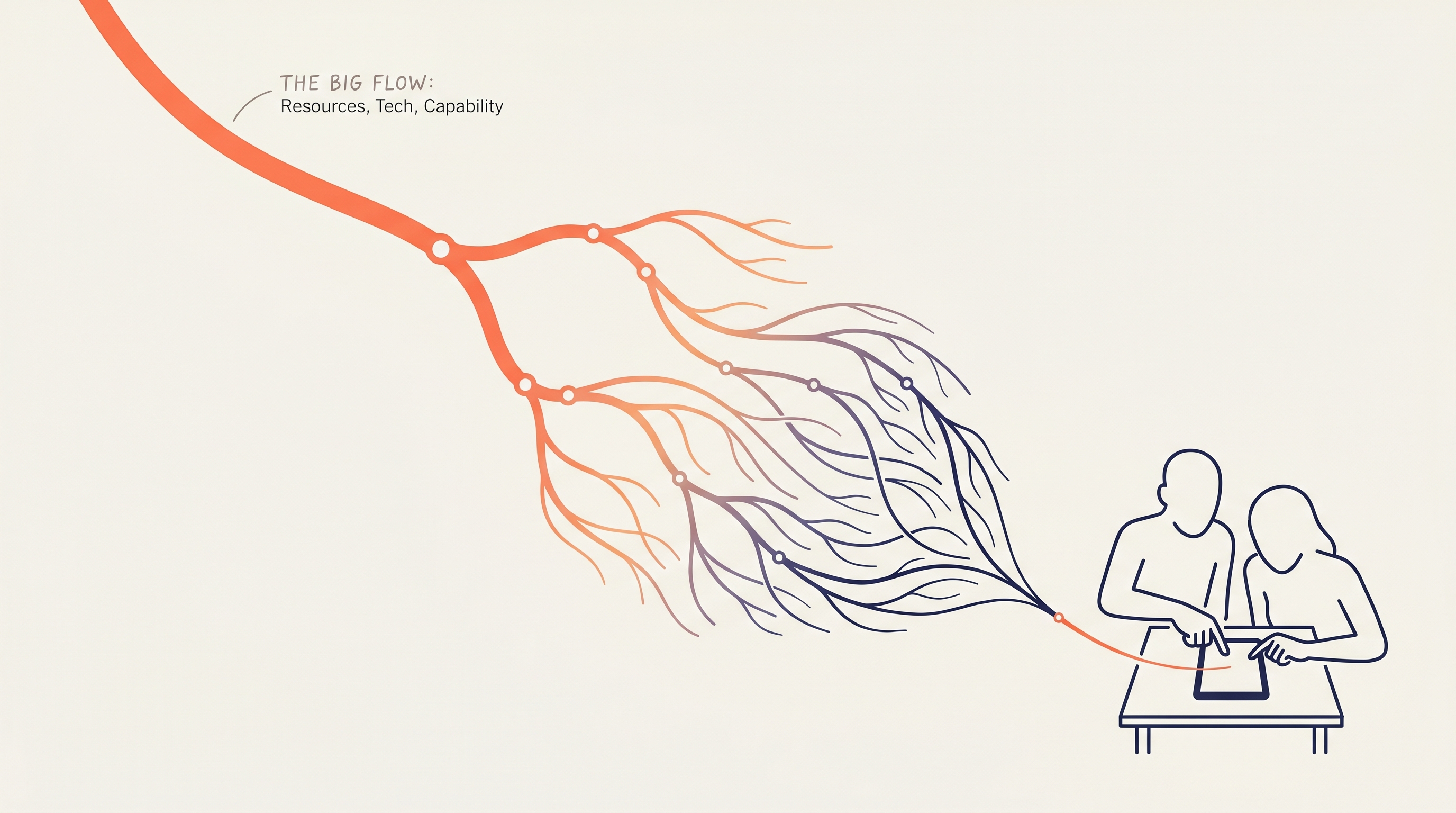
This is capillary work. The finest vessels connecting artery and vein. Linking the city's great flows to the countryside's small breath. Market forces do not create these capillaries. They are made by intention. They require someone to place hands directly here, with these people, at this time.
Conclusion — before 86% accuracy
What makes Kurzweil's 86% frightening is that if he is right, we have little time left. 2029 is four years away. In those four years, as urban users handle legal advice, medical diagnosis, and business strategy with AI, what becomes of a county where AI search volume reads zero?
This essay's conclusion is not the familiar "starting now is not too late." To be more honest: left to market forces, you are guaranteed to be late. To avoid being late, there must be someone who becomes a capillary. That person must repeat, week after week, small gestures that simultaneously close the gap in capital, language, and cognition.
Yeongyang County AI Association intends to be that capillary. Not because we alone can do it, but because if we do not, no one in our town will. The market puts Yeongyang at the back of the line. Government sees the average. The average might work, but it means nothing to a 70-year-old in Yeongyang County.
The singularity does not come for everyone. Yet that is not an inescapable fate. It is a result that changes based on what we do now — something that partly rests in our hands. If the person with 86% accuracy is right, then we must move that fast. With slow hands, but in the same place, every week.
Sources:
- Ray Kurzweil — The Singularity Is Nearer (2024). 35-year prediction accuracy 86%; projects 2029 AGI / 2045 singularity
- World Economic Forum — The Overlooked Global Risk of the AI Precariat (2025)
- World Economic Forum — Global Risks Report 2026, Chapter 2
- World Economic Forum — How the Global South Is Reimagining the Future of AI (2026)
- arXiv 2506.21595 — Thunder-LLM: Efficiently Adapting LLMs to Korean with Minimal Resources (Korean as low-resource language)
- arXiv 2406.13748 — Every Language Counts: Learn and Unlearn in Multilingual LLMs (English -63% vs low-resource language gap)
- Ministry of Science & ICT / NIA — 2024 Digital Divide Reality Survey (elderly 71.4%, rural/fishing 80.0%)
- Brookings — Why AI Readiness Requires Digital Literacy and Inclusion / AI Transforming Middle-Class Jobs, Can It Help the Poor?
- Microsoft Research — ChatGPT Regional Adoption Analysis (coastal cities vs South · Appalachia · Midwest)
- Stanford — Generative AI for Health in Low & Middle Income Countries
- Guy Standing — The Precariat: The New Dangerous Class (2011), expanded to AI version

This article was produced with the deep-thinking engine
Simthink Engine (深 Think) of Myeongseong Simjae.