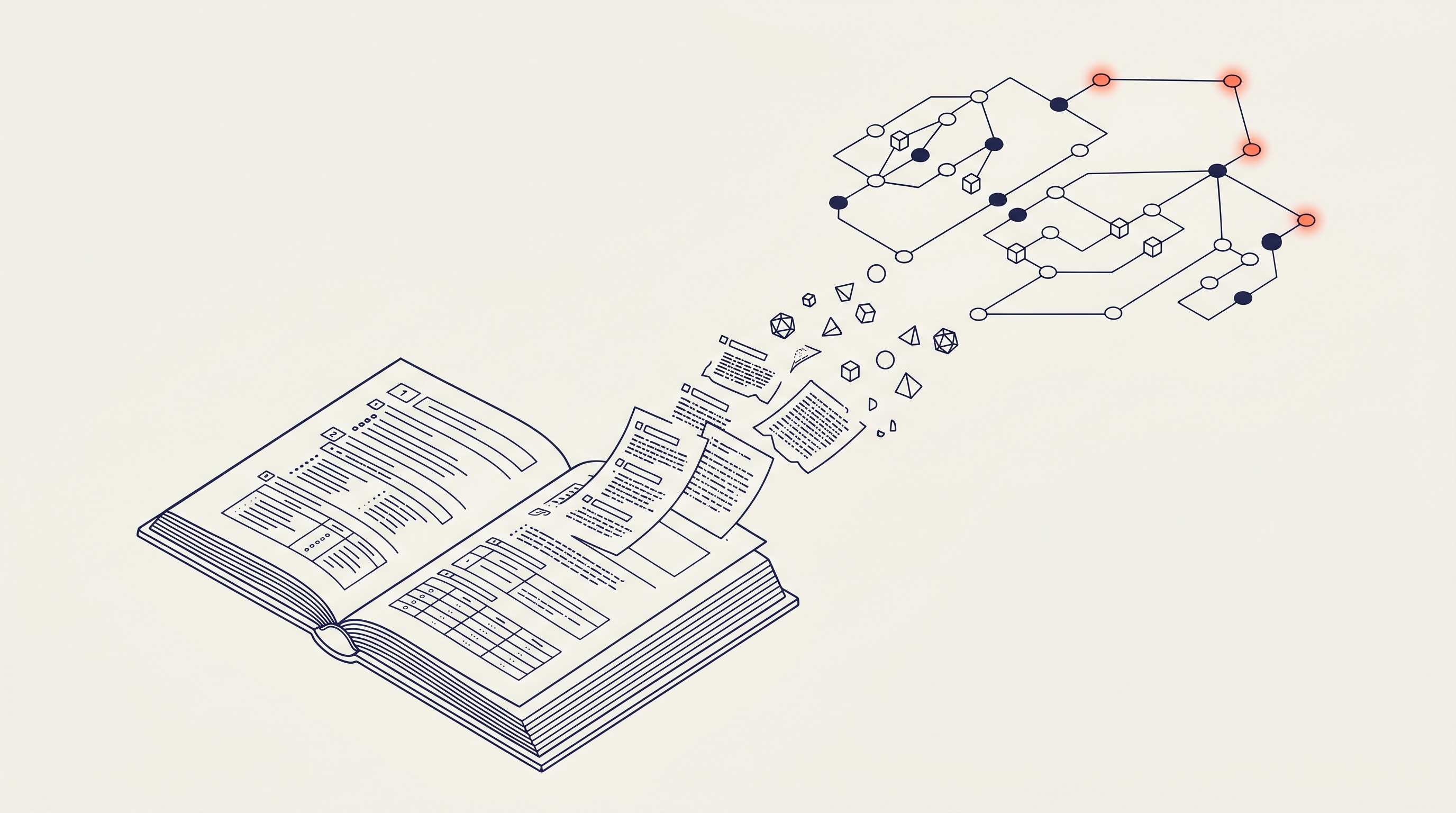
 Korea's two-decade effort to codify job specifications has inadvertently created something else entirely: a machine-readable automation template. The peak of standardization becomes the entry point for displacement.
I attended a training session in the Human Resource Development (HRD) field yesterday. The classroom was well-organized, and the instructor had deep subject-matter knowledge. Korea's National Competency Standards—the NCS—represent a remarkable achievement. Over 1,000 occupations codified into 8 proficiency levels, each with detailed competency units and performance criteria. The system specifies how hiring, training, and evaluation should all align within this framework. Listening to the presentation, I felt a fresh appreciation for the sheer capital investment—both financial and temporal—that Korea has made in managing human capability as a social resource.
Yet walking out of that classroom, I felt an unease settle in one corner of my mind. This elegant system is missing something happening right now. I spent several days reflecting on the source of that discomfort, and I reached a singular conclusion: NCS was designed as Korea's system for standardizing human resources. But what it actually created is something else entirely. It is Korea's automated blueprint for the entire labor market. And the architects who drew that blueprint with the greatest precision are the very ones who cannot see what it actually means.
Reading Job Specifications as LLM Specifications
I examined NCS job specifications as coursework. How each occupation functions at various proficiency levels. What knowledge, skills, and attitudes are required. What behavioral sequences must be executed, and in what order. Everything was hierarchical and precise—exactly how to break work into measurable units.
As I read, I kept seeing the same format superimposed from elsewhere: large language model (LLM) agent skill specifications. Which tools to invoke when. What input to receive, how to process it through each stage, what output to deliver under which conditions before passing to the next step. Same structure. Same hierarchical depth. Even the atomization principle—"work must be broken down fine enough to be evaluable"—was identical.
This is not coincidence. NCS's design philosophy ("decompose work into objective, standardized, evaluable units") meets LLM agent design philosophy ("decompose work into modules, tools, and evaluable outputs") at precisely the same point. The two systems emerged in different eras with different intentions, but they arrived at nearly identical answers to the question: how do you make human work machine-speakable?
Push one step further, and a chilling possibility emerges. If NCS specifications are already sufficiently codified, it means those specifications can be read directly and fed into automation systems. Extract only the parts that require genuine tacit knowledge—the truly human components—and the rest becomes something an agent and RAG system and workflow can handle. Korea invested two decades of collective effort to create a standard, and that standard has become, paradoxically, the input specification for automation itself.
The Domains That Were Most Automatable Are Automating First
This is not speculation. In January 2026, Anthropic released a labor market impact study measuring occupational AI exposure. The highest-exposure occupations were not simple data entry. Computer programmers: 75%. Customer service: 67%. Data entry: 67%. This contradicts intuition. "Professional" categories showed greater exposure than expected. The same study surfaced a striking observation: workers in high-exposure occupations were older, more educated, and higher-paid than average.
The World Economic Forum's Future of Jobs Report 2025 traces the same pattern. By 2030, 92 million jobs are projected to disappear while 170 million new jobs emerge—a net gain of 78 million. But the people losing jobs and the people gaining them are not the same. Displacement does not automatically translate to transition.
Here is one Korean-specific context. Korea has codified occupations more thoroughly than almost any nation via NCS. That level of codification lowers the friction for automation entry. Whether this is good or bad depends on your vantage point. For a young person who has prepared to compete for NCS-defined jobs, the narrowing door is a threat. For someone designing automation atop NCS specifications, you are looking at nearly complete input data.
Why Precise Systems Lag During Change: Sunk Costs and Incumbent Advantage
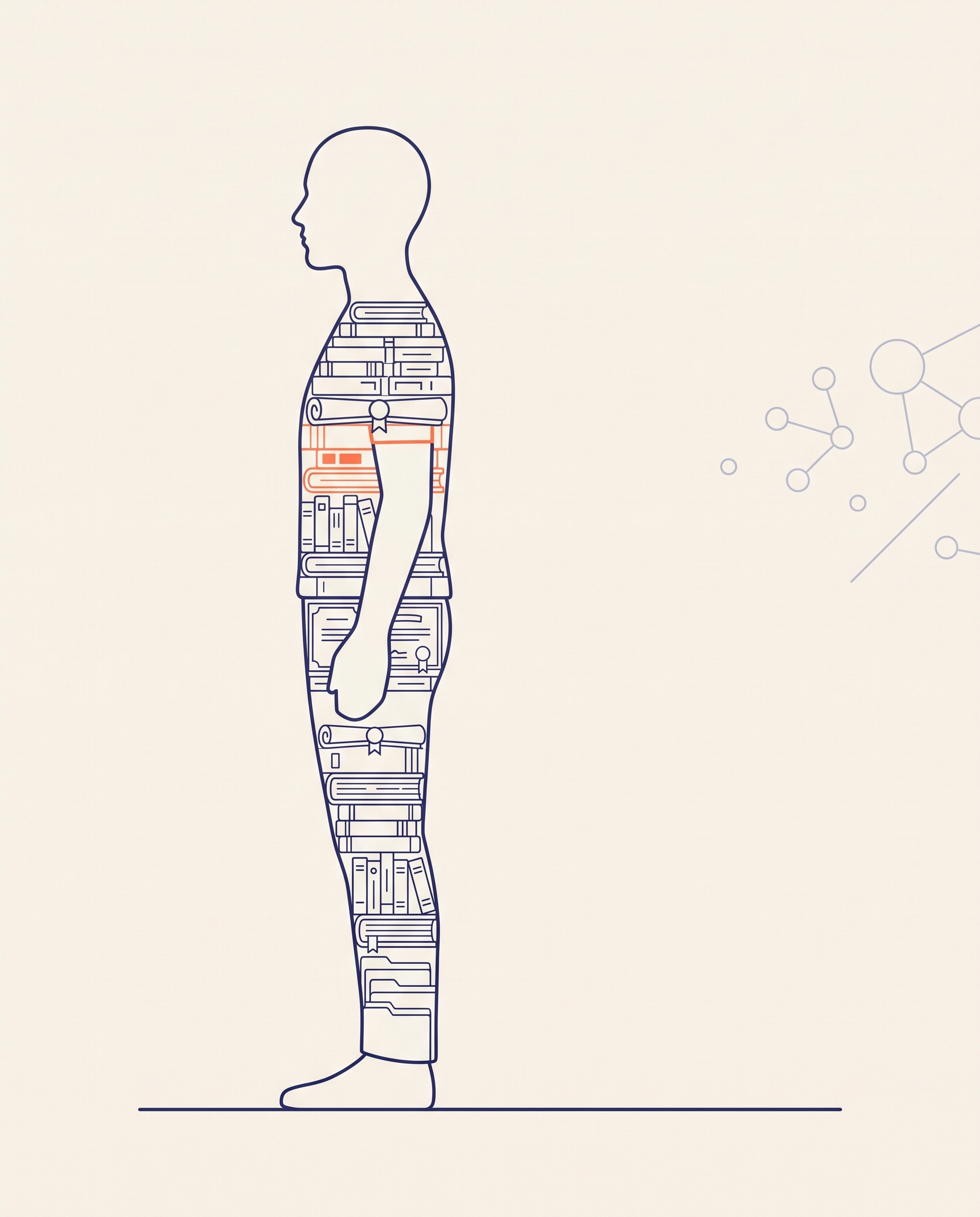 A person's silhouette is filled with horizontally stacked books, certificates, and file folders. A few layers near the chest are highlighted in coral. New abstract shapes flicker faintly in the background beyond.
So why do those who are most expert in these systems not see the change sooner? The answer is not individual failure but cognitive architecture—what kinds of thinking traps the human mind is susceptible to.
Two concepts from decades of Harvard Business Review coverage apply precisely here. The first is the sunk cost effect—the tendency to continue down a losing path because you have already invested time and money. The second is Clayton Christensen's innovator's dilemma—the insight that good managers listening carefully to customers and investing wisely in their domain often cannot see new disruption precisely because of those correct behaviors. Not because they did something wrong. But because what they did well becomes exactly why they cannot see what comes next.
HRD in Korea is a capital base built over an entire generation. Trainers, certification systems, evaluation tools, government funding, university degrees—many people stand on that platform. Telling someone who has built a lifetime career on this foundation that "the core of your field may be automated within five years" does not get heard, regardless of the listener's capabilities. It is not the person's fault. Sunk cost creates that barrier.
The problem does not stop at the individual level. When a society's most sophisticated institutions are managed by those who best understand those institutions, and when those same experts are simultaneously the slowest to accept that institution's transformation, the pace of societal change becomes locked to their sunk cost. This is the deepest cost of expert gatekeeping becoming expert entrenchment.
Who Survives as an Expert? Polanyi's Answer and Its Update
Fifty years ago, Michael Polanyi wrote a line that has never left thinking about expertise: "We can know more than we can tell." The insight was that explicit, articulable knowledge sits atop a substrate of tacit knowledge—the things we understand but cannot write down. For a long time, automation worked on the explicit layer. Tacit knowledge remained humanity's last fortress.
But a series of studies emerging in 2025-2026 is cracking that fortress. Research like arXiv 2507.03811 suggests LLMs can infer tacit knowledge not from explicit text but from behavioral traces themselves—from patterns in how people actually work, not how they describe working. Another paper in the same direction (arXiv 2507.16078) argues that automation and AI are now transforming the intergenerational structure of knowledge transfer itself. The assumption that tacit knowledge is automation's final defense is beginning to fray.
The implication is not simple. It is not Polanyi's conclusion we must abandon. We must update it. The surviving expert is not "someone who possesses tacit knowledge." It is someone who can integrate their tacit knowledge with the new system. Someone who surrenders their explicit knowledge to the tool and elevates their tacit knowledge to the meta-level—deciding how the tool should be used.
From HRD to ARD: The Name of the Next Capital
Here I venture a prediction. If HRD was the field managing Korea's human capital for one generation, then ARD—AI Resource Development—will occupy that same structural position in the next. Not people as resources, but agents, models, and systems as resources. Consulting on how to recruit, train, evaluate, and deploy them. McKinsey already points this direction with its report "HR's Transformative Role in an Agentic Future." Deloitte's 2026 Human Capital Trends traces the same graph. So does the World Economic Forum's workforce report. All are drawing the same pattern from different angles.
When ARD takes hold, new standards and job specifications and certification systems will be built again. Over time, another generation's capital will accumulate on top of that. Sunk cost will form again. And then the next disruption will threaten it. I am not exempt from this cycle. If I myself root deeply in the ARD field, the statistical likelihood that I will be the slowest to accept the next transformation in five years is high. Humans are made that way.
One Question Remains
 A person wearing a name badge points toward the right. What they point to shows a small knowledge graph, bridge structures, and a gently ascending line, highlighted in coral.
So what remained with me walking out of that classroom, and on the road afterward, was this question.
When someone offers me an insight that conflicts with my vested interest, can I recognize it? And even if I recognize it, can I accept it?
This is not a grandiose question. The instructor who taught yesterday certainly received the same question from someone younger, offering a different view. And faced with that question, they chose to keep their seat. Anyone in that position does. And statistically, I will do the same in five years.
So the answer is not abstract talk of an "open mind." The answer must be more concrete. It is to practice weekly the discipline of seeing direction, not credentials. Even when others see in me a title and a resume, not to grow frustrated that they do not see where I am pointing. Instead, to show what can be seen through results. To keep a second brain at my side—a tool—and to demonstrate "here is how the world is coming" not through words but through what emerges.
This was the greatest asset the classroom gave me yesterday. That moment of hesitation before elaborate systems has become the firmest resolve. I am grateful to the instructor. What their position taught me was far larger than they intended.
Sources:
- National Competency Standards (NCS) — ncs.go.kr (8-level framework, competency units, performance criteria, knowledge, skills, attitudes)
- Anthropic — Labor Market Impacts of AI: A New Measure and Early Findings (2026)
- World Economic Forum — Future of Jobs Report 2025 (92M displaced, 170M created by 2030)
- Anthropic / arXiv 2506.06576 — Future of Work with AI Agents: Auditing Automation and Augmentation Potential across the U.S. Workforce
- arXiv 2507.03811 — Leveraging Large Language Models for Tacit Knowledge Discovery in Organizational Contexts
- arXiv 2507.16078 — Automation, AI, and the Intergenerational Transmission of Knowledge
- McKinsey — HR's Transformative Role in an Agentic Future (2026)
- Deloitte — 2026 Global Human Capital Trends
- Harvard Business Review — How Susceptible Are You to the Sunk Cost Fallacy? (2021)
- Clayton Christensen — The Innovator's Dilemma (HBR archive)
- Michael Polanyi — The Tacit Dimension (1966)

This article was produced with the deep-thinking engine
Simthink Engine (深 Think) of Myeongseong Simjae.