What the number zero is saying — inside the system that creates blind spots
April 29, 2026 · Director of Strategic Planning, Shin Chi-hoon
What the zero means — reading the silence of the number precisely
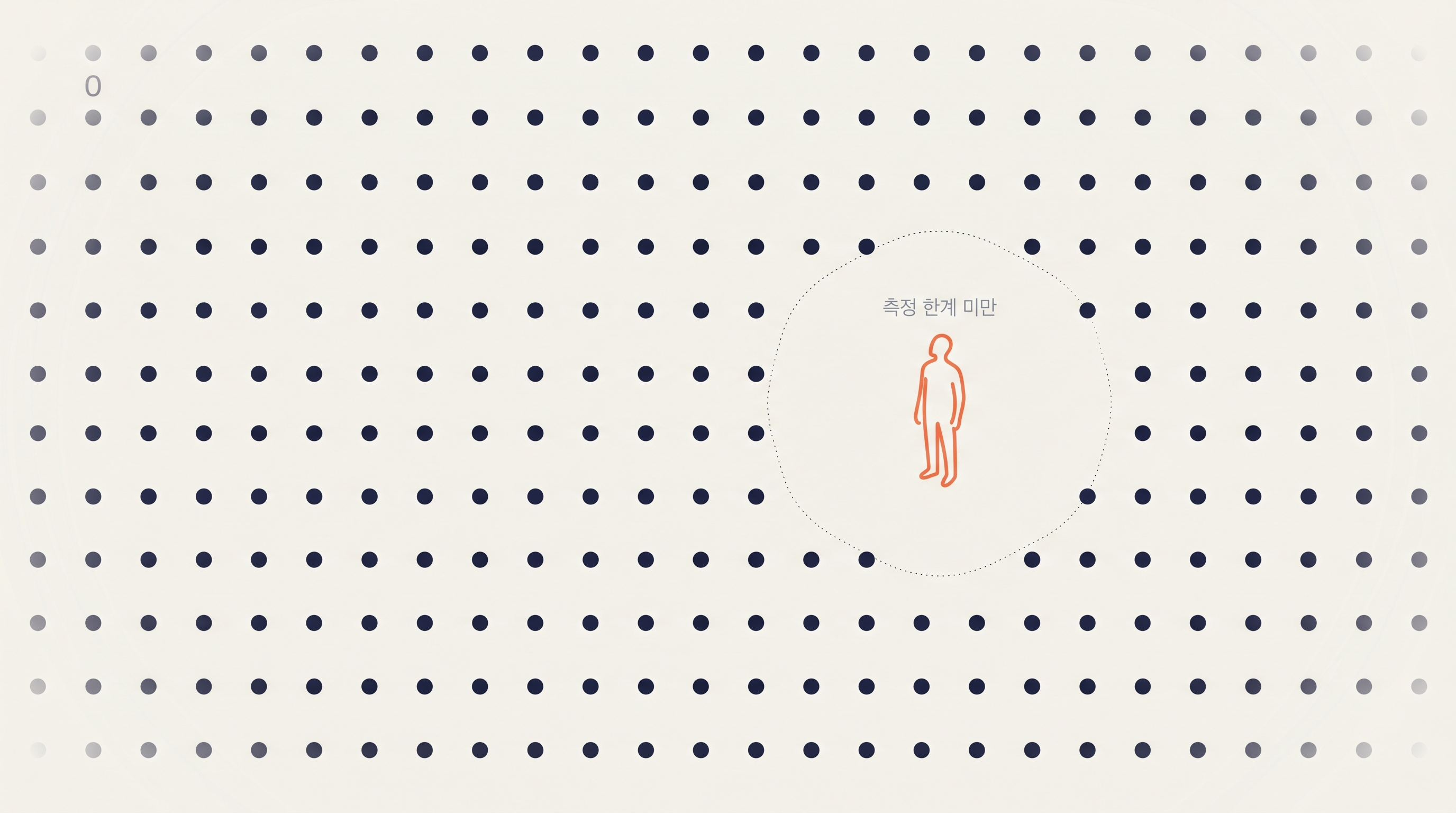
The AI search interest for the five northern counties of North Gyeongsang — Yeongyang, Cheongsong, Bonghwa, Yeongdeok, Uiseong — is 0. Stated more precisely, the state Google Trends marks as "Not enough data."
Without naming what this 0 means, the column goes off course at the start. In Google Trends, 0 does not mean "there were no searches." It means "there were searches, but they are not displayed." According to Google's own guidance, when search volume falls below a certain threshold, the data is rendered as 0. The reason is twofold. First, user privacy — in a region with too small a population, exposing the search of one or two people could allow them to be identified. Second, statistical reliability — when the sample is too small, meaningful comparison becomes impossible.
This single line transforms the landscape of Yeongyang County in one stroke. A score of 0 does not say "there is no one here interested in AI." It says "someone here did search for AI, but because the population is small enough that the person could be identified, the system intentionally rendered it invisible."
Yeongyang County's population is 16,000. Someone searched. Yet that person stepped into the blind spot of the statistic. Zero is not the record of indifference. It is the silence built to protect a single person.
The blind spot of data — how the countryside disappears from the system
This silence does not belong to Yeongyang County alone. According to a 2025 analysis published in Nature Communications, global population datasets underrepresent rural populations by between −53% and −84%. Even the most accurate dataset misses more than half of the rural population. This is because the datasets were calibrated against urban environments.
A 2019 paper by Justine Humphry of the University of Sydney and Sora Park of the University of Canberra in Information, Communication & Society (vol. 22, pp. 934–953) summarizes it in one phrase. "Exclusion by design." Digital systems do not deliberately exclude anyone. Yet the design of the system itself renders certain populations invisible. What they observed in Australia's automated welfare system was that the processing rules the system built for efficiency ended up most deeply excluding the most vulnerable populations.
Yeongyang County's 0 sits inside that blind spot. Google Trends did not miscalculate. No one targeted Yeongyang for concealment. Yeongyang's invisibility is the result of the system functioning normally. And this invisibility does not end as a problem of statistics alone.
The self-reinforcing loop — why 0 stays 0 forever
If the story ended at invisibility, it would be the conclusion of an academic paper. But this invisibility, the moment it becomes an input to policy, does something else.
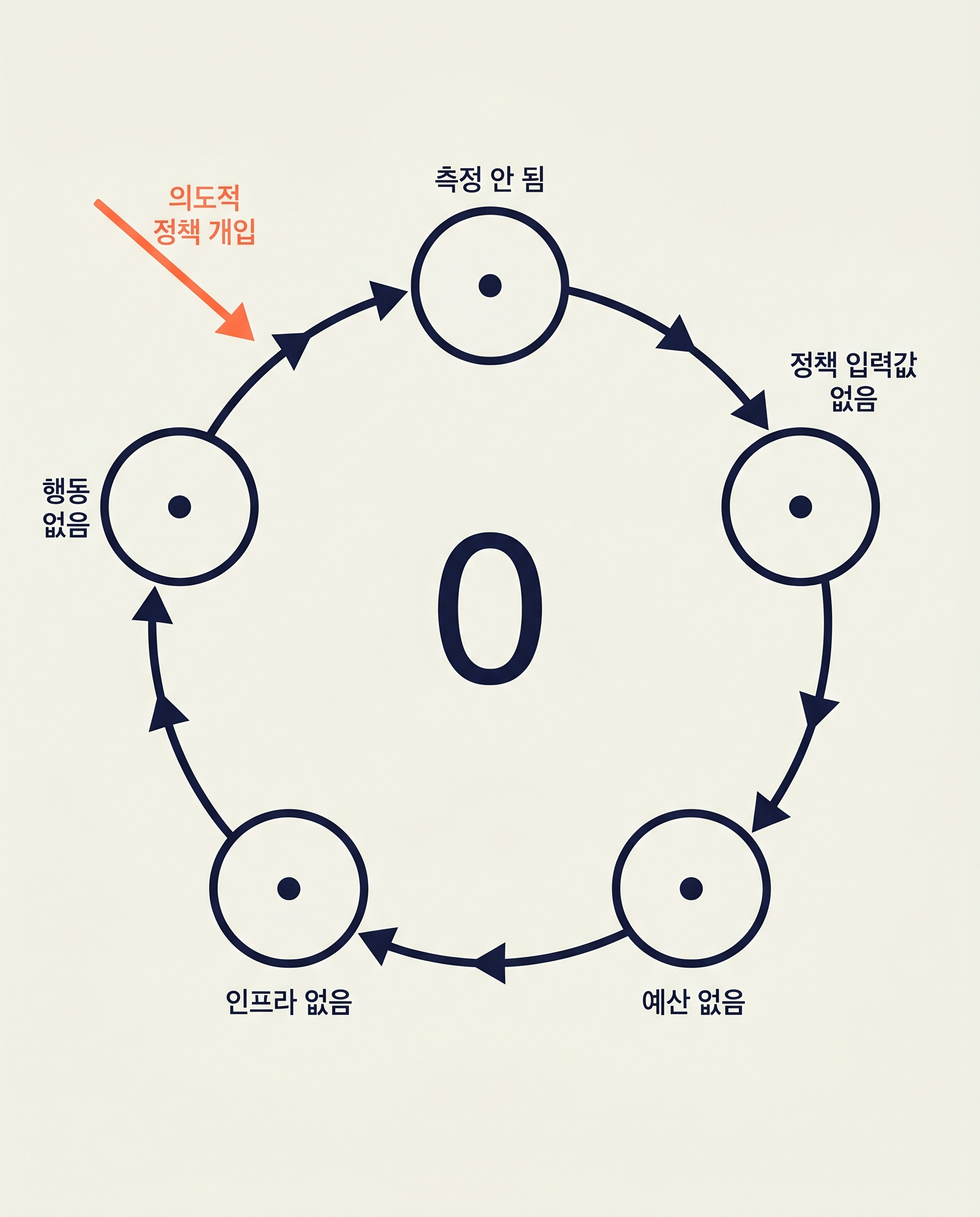
Follow the sequence. Yeongyang County is not measured. Not measured, it does not enter as a policy input. Not entering as input, no budget is allocated. With no budget, infrastructure, education, and service investment do not happen. With no investment, digital behavior — search, use — does not form. With no digital behavior, again, it is not measured.
This is a self-reinforcing feedback loop. The score of 0 is not a starting point but an equilibrium reproduced every year. Time does not naturally bring it to 1. Inside the loop, 0 hardens as the steady state.
The market produces the same outcome. The OECD's 2018 report Bridging the Rural Digital Divide states it plainly. Rural areas are unprofitable for ICT service providers, and some regions may never receive market-based investment. Their analysis is that the subscriber base is too small for even broadband infrastructure to be laid down by market logic. In Yeongyang County, even the telecommunications infrastructure carries that mark; AI as a downstream service stands further away.
Left to its natural state, Yeongyang County's 0 is Yeongyang County's fate. It is the market's fate, the average policy's fate. But this is not the end.
Yet inside the blind spot, action is possible
Stop the column here, and it becomes defeatism. And that is not an accurate diagnosis.
The self-reinforcing loop model describes equilibrium under the natural state. Yet the history of human policy is full of records of external force breaking that natural equilibrium. Finland's digital inclusion programs, since the 1990s, have delivered digital capability to rural older adults through a combination of civil society, regional libraries, and volunteers. Japan's "Digital Promotion Members" system (デジタル推進委員), beginning in 2022, is informal infrastructure in which citizens commissioned in each region directly help their neighbors with digital learning. The common thread of these models is that they are deliberate external force, not the natural operation of market or average policy.
The natural-state equilibrium can be broken. But it does not break naturally. Someone, in some position, must begin it intentionally.
This diagnosis matters because if the column ends as a critique of the system, the agency of Yeongyang's residents disappears. The residents of Yeongyang sit inside the system's blind spot, but inside that blind spot action is possible. It is only that the action does not arise naturally. Who will make that first action possible — that is the real question.
From 0 to 1 — one person's hand creates the critical mass
Be honest here. The search of one person alone does not turn Yeongyang's 0 into 1. The exact threshold of Google Trends is not public, but in a population of 16,000, the action of one person does not reach the statistical threshold. That is true.
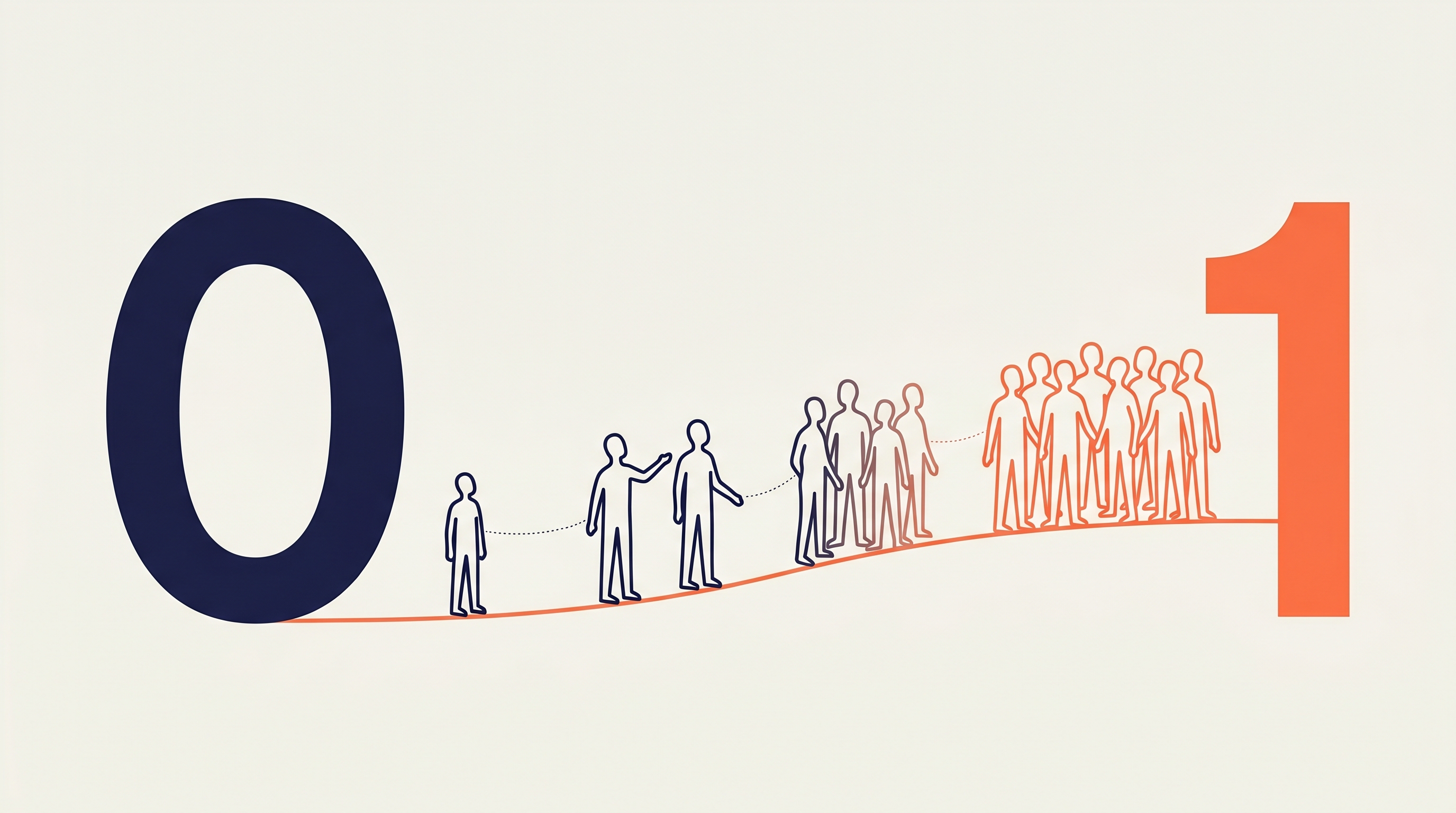
Yet the structure in which one person's hand calls the next person's hand makes a different arithmetic possible. If, every week in the same place, one person teaches an elder beside them how to search ChatGPT, and that elder brings a friend the next week, then four weeks later four people are searching. Eight weeks later, eight. Sixteen weeks later, sixteen. Six months later, a portion of Yeongyang County's population carries the behavior pattern of searching AI every month.
This is the arithmetic by which a critical mass forms. The hand of one person cannot move the statistic, but the next person's hand that the first hand created can. It is the moment the function replicates itself. At some moment, Yeongyang County's search volume on Google Trends crosses the threshold. The first 1 — no longer 0 — appears in the statistic.
What that 1 means is not simply "the number of searchers has grown." It is the signal that the system has begun, at last, to see Yeongyang County. Once a data system begins to see, it becomes a policy input; once it becomes a policy input, budget follows; once budget follows, infrastructure follows. The self-reinforcing loop begins to run in reverse.
What it honestly means to say "0 is possibility"
Only here can we say "0 is possibility" honestly. It is not consolation.
In other regions, the search of one person sinks into the average. The act of one person in Seoul searching ChatGPT does not change the landscape of the statistic. But in Yeongyang County, it is different. Every first action that takes place here is a new input to the statistic. If one person searches every week, that person's behavior immediately becomes part of Yeongyang's data, and that data becomes part of policy.
This is at once burden and authority. The burden comes from responsibility; the authority comes from leverage. In a region close to 0, one person's search is itself a policy signal. It is an arithmetic that other regions do not enjoy.
The Yeongyang County AI Association understands this arithmetic precisely. That we teach one elder how to search ChatGPT every week in the same place is not simply the act of helping that elder. It is the act of creating one point in Yeongyang's data, the signal variable that calls the next elder, and one step toward critical mass.
Conclusion — what it means to refuse the natural state
In the natural state, Yeongyang County's 0 perpetuates itself. The market does not enter because it is unprofitable; average policy cannot see what is not measured. Time does not naturally turn 0 into 1.
Refusing the natural state — that is the precise name of the work we are doing. The work the market does not do, the work average policy cannot do — someone must begin it, for 0 to become 1. That someone must appear in the same place, at the same time, as the same person, every week.
If this column reaches policy makers — diversify the inputs of AI-divide policy beyond Google Trends. Self-administered data, the regional association's own reporting, on-site interviews — input channels that supplement the blind spots of the measurement system must be built. If it reaches civil-society activists — recognize that the rural 0 is the product of the system, not the fate of the region. And if it reaches the elders of Yeongyang — your single search sits in a position from which it can move the entire statistic. It is a position other places do not enjoy.
The number zero is not Yeongyang County's indifference. It is the silence the system built, the natural equilibrium of the market, the self-reinforcing loop of policy. But it is also the position waiting for someone's first action. From that position, we have begun the work of refusing the natural state.
Sources:
- Google. FAQ about Google Trends data — Trends Help. (Low search volumes are rendered as 0 to protect user privacy and ensure statistical reliability.)
- Park, S., & Humphry, J. (2019). Exclusion by design: Intersections of social, digital and data exclusion. Information, Communication & Society, 22(7), 934–953. doi:10.1080/1369118X.2019.1606266
- Nature Communications (2025). Global gridded population datasets systematically underrepresent rural population — confirms rural populations underrepresented by −53% to −84% in datasets.
- OECD (2018). Bridging the Rural Digital Divide. OECD Digital Economy Papers No. 265 — analyzes rural unprofitability for ICT service providers and the limits of market-based infrastructure deployment.
- Korean Ministry of Science & ICT / NIA (2025-03-27). 2024 Digital Divide Reality Survey — elderly 71.4% (+0.7%p), agricultural/fishing residents 80.0% (+0.5%p), four major vulnerable groups average 77.5% (+0.6%p).
- The three-layer structure of generative AI divide (access divide / capability divide / outcome divide) — general academic frame organized in arXiv 2410.19806 and related work.
- Japan Digital Agency. Digital Promotion Members system (デジタル推進委員, 2022~) — informal infrastructure in which regional citizens help their neighbors with digital learning.
The illustrations in this article were created using an AI image generation model (Gemini 3 Pro Image) and underwent editorial review.

This article was produced with the deep-thinking engine
Simthink Engine (深 Think) of Myeongseong Simjae.