1면 톱
Three Models in Three Days
the Seat of the OS Is Shifting · SimThink Three Branches · Slow Future Launches · 5/7 SF:// Brief
글 SF://
에디터 · SF:// · 제 5호
ON THIS ISSUE · 한 판에 보는 이번 호
2026-05-07 · ED. 005
오늘
도착한 신호Three Models in Three Days, the OS Shaken Twice in a Week
Anthropic, OpenAI, and Google all swapped the default model inside their public chat apps within the same week. From a user standpoint, this is closer to an OS patch than an app update.
Opus 4.7 · GPT-5.5 Instant · Gemini 3.1 Pro
5/4 Anthropic Claude Opus 4.7 (price held, vision boost) · 5/4 Gemini 3.1 Pro broad rollout · 5/5 GPT-5.5 Instant replaces ChatGPT's default model.
Anthropic + Blackstone · Goldman mid-market joint venture
Anthropic spins up a mid-market AI services company with Blackstone, Hellman & Friedman, and Goldman — capital walking directly onto the model layer for the first time. In parallel, Claude enters MS 365 as an add-in.
WIS 2026 K-AI Champions ₩1.2T → ₩1.98T match
MSIT integrates AI Innovation Fund and KIF to ₩1.2T, expanding to ₩1.98T by June. Inference AI semiconductor mass production officially begins. The Northeast Asia ICT 6th cohort generative-AI program is metro-focused.
Yeongyang forestry smart-farm ₩10.5B + open-field ₩9.5B
Yeongyang's forestry smart-farm pilot complex (₩10.5B, Irwol-myeon, 2026–2028) and open-field smart-farming district (₩9.5B) confirmed. How much actually reaches AI systems and data formats remains a separate tracking item.
SciResearcher-8B — SOTA at 8B parameters
arXiv 2605.01489. 8B parameters reach 19.46% on HLE-Bio/Chem-Gold — same-class SOTA. Signal that science-research agents are feasible even at 8B-scale, runnable on local compute in the periphery.
5/2 · 5/4 · 5/6 issue follow-ups
On top of 5/4 Microsoft Agent 365 GA, Claude for MS 365 (5/5) penetrates directly. 5/6 Gemini Enterprise gets reinforced by 5/4 Gemini 3.1 Pro broad rollout.
우리
우리가 보낸 글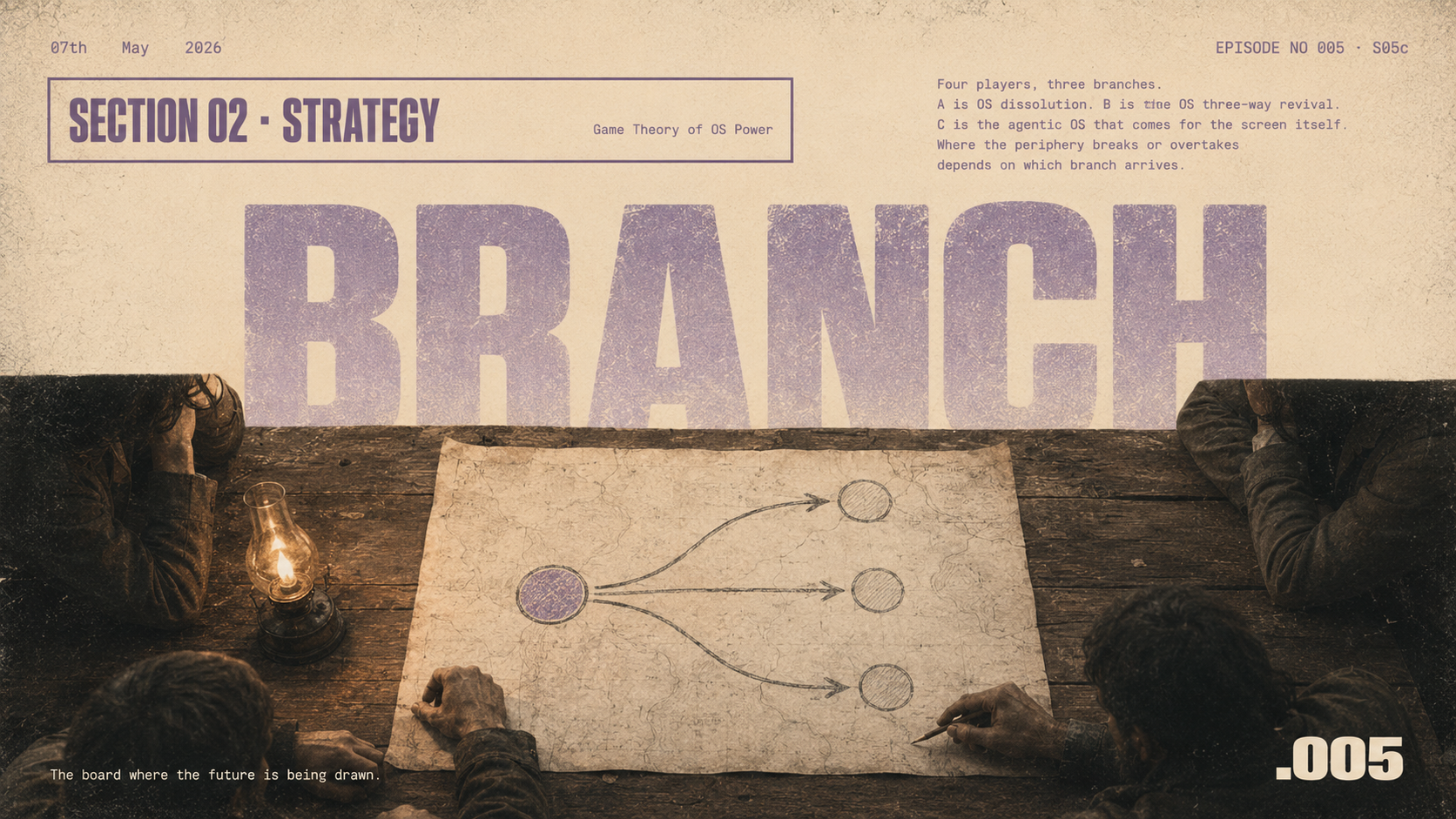
Three branches of the future — OS dilution · three-camp revival · agentic OS
Myeongseong-Simjae's SimThink engine places four players on the OS-primacy board and traces three branching futures three years out. Across branches, the periphery's shrimp-back may snap or, conversely, overtake the city.

The Second Sun of May
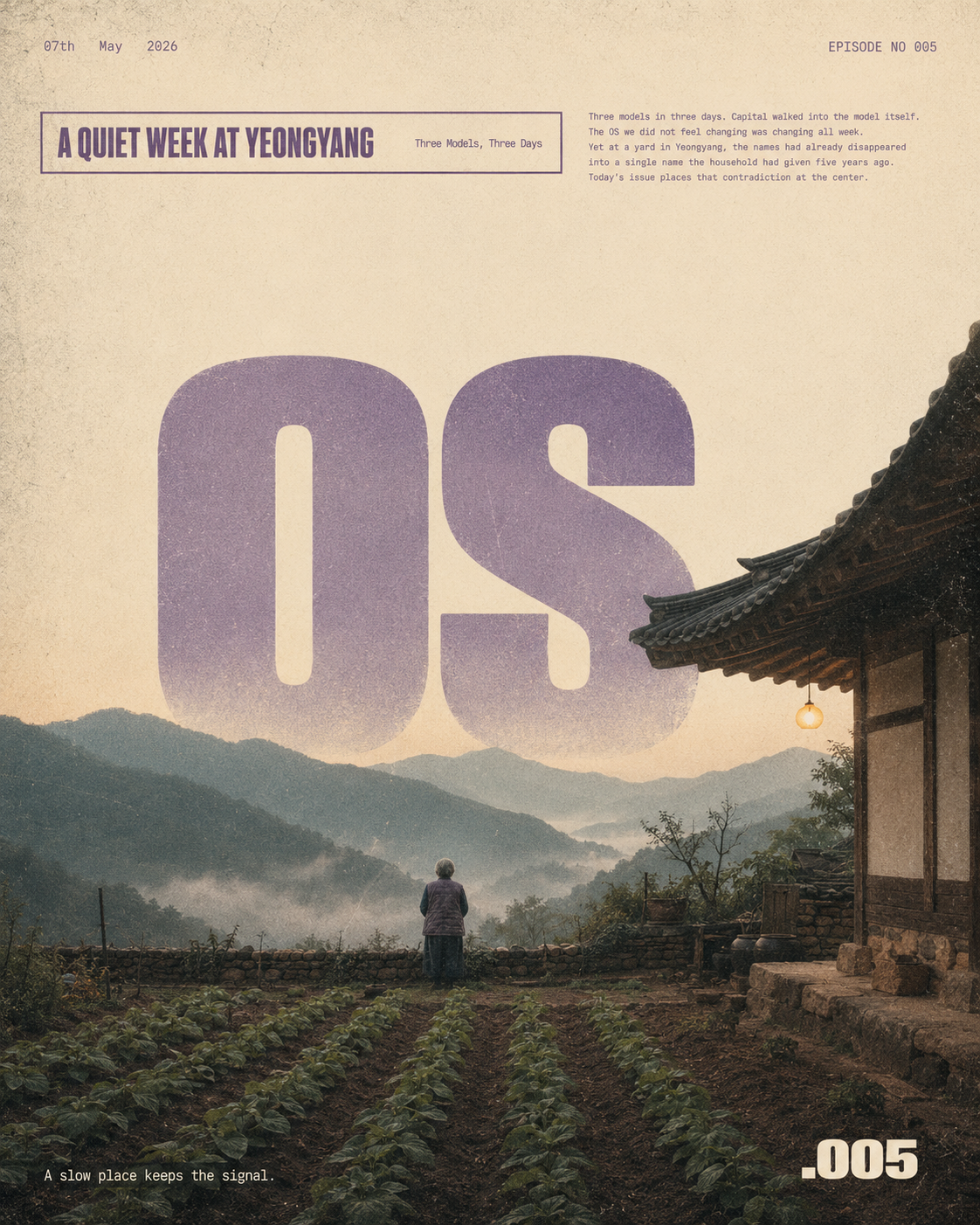
Five years on, an AI agent named Hani has become one of the family in mother's house — managing the appliances, the radio, the medicine times, the village calls. ChatGPT, Gemini, Claude — those names long since vanished into the single name. Yeon-soo Baek's first SF short.

We have to explore further, and imagine further
This issue does not deliver an answer. None of us has it yet. Some pictures only game theory can draw, some only fiction can draw, and some only a single yard at a time can show.
In the same week, three big-tech firms swapped the default model in the chat apps the public uses every day — Claude Opus 4.7, GPT-5.5 Instant as ChatGPT default, and Gemini 3.1 Pro broadly rolled out. Anthropic also spun up a mid-market AI services company with Goldman and Blackstone, and pushed 10 finance agents plus a Claude for Microsoft 365 add-in directly into Office. Using Myeongseong-Simjae's SimThink, this issue tracks three branches three years out — OS dilution, three-camp OS revival, agentic OS — and asks whether the periphery's shrimp-back snaps or whether it overtakes the city. The same week, Yeongyang received confirmation reports of two ₩20B-class smart-farm projects, and SF:// launches its fiction series with Yeon-soo Baek's "The Second Sun of May."
slow place. fast signal.
Issued · SF:// · 2026-05-07 (KST)
At a Glance
| Slot | Category | Topic | imp | ★ | Source |
|---|---|---|---|---|---|
| S5 | Big Story | Three models in three days — the seat of the OS is shifting | 5 | ★★★★★ | Anthropic · OpenAI · Google blog |
| S5c | Analysis | A SimThink game-theoretic read — three branches of the future for OS primacy | 5 | ★★★★★ | Myeongseong-Simjae SimThink |
| S6 | Models | Claude Opus 4.7 (5/4) | 5 | ★★★★★ | Anthropic |
| S6 | Models | GPT-5.5 Instant (5/5) | 5 | ★★★★★ | OpenAI / TechCrunch |
| S6 | Models | Gemini 3.1 Pro broad rollout (5/4) | 5 | ★★★★★ | Google blog |
| S9 | Industry | Anthropic + Blackstone + Goldman mid-market joint venture (5/4) | 4 | ★★★★☆ | Anthropic blog |
| S9 | Industry / Tools | Anthropic 10 finance agents + Claude for MS 365 (5/5) | 4 | ★★★★☆ | Anthropic blog |
| S7 | Research | SciResearcher-8B (5/2) | 3 | ★★★☆☆ | arXiv 2605.01489 |
| S11 | Korea | K-AI Champions ₩1.2T → ₩1.98T government matching | 3 | ★★★☆☆ | etnews |
| S12 | Regional | Yeongyang forestry smart-farm ₩10.5B + open-field ₩9.5B | 4 | ★★★★☆ | ajunews / getnews |
| S(new1) | New | Call for contributions — signals from the peripheries | — | — | SF:// |
| S(new2) | New | "Slow Future" #001 — The Second Sun of May (Yeon-soo Baek) | — | — | SF:// fiction launch |
TL;DR
- Three models in three days — Opus 4.7 · GPT-5.5 Instant · Gemini 3.1 Pro
- Anthropic, with Goldman and Blackstone, spins up a mid-market AI services company
- A game-theoretic read of three branching futures — OS dilution · three-camp OS revival · agentic OS
- The ₩20B for two Yeongyang smart-farm projects: how much actually reaches AI systems remains a separate tracking item
- SF fiction series launches — Yeon-soo Baek, The Second Sun of May
🧭 Editor's View — How to read these headlines
In a single week, all three big-tech firms quietly swapped the default model inside the chat apps the general public uses every day (ChatGPT · Gemini · Claude). Anthropic Claude Opus 4.7 (5/4) · OpenAI GPT-5.5 Instant (5/5, replacing the ChatGPT default) · Google Gemini 3.1 Pro (5/4, broad deployment across the Gemini app and NotebookLM). On the same day, Anthropic formed a joint venture with Blackstone, Hellman & Friedman, and Goldman to build a mid-market AI services company, and pushed 10 finance agents plus a Claude for Microsoft 365 add-in directly into Excel, PowerPoint, Word, and Outlook. In other words: in one week the signal arrived that models no longer live only inside their own chat apps but are settling as an agent layer one storey above the work surfaces office workers use every day. The chat box of someone who opened ChatGPT yesterday in Yeongyang now contains a different model from the day before, and that model is starting to handle that user's Office screen. This is not a "model release news cycle." It is news that another floor is being laid on top of the OS inside the user's device.
On peripheral time this means two things at once. One is the familiar pessimism — the speed at which a model takes a new seat twice a week and the speed at which a county of 15,000 people finds its starting point are not measured in the same unit. In the same week, Yeongyang received confirmation reports of a ₩10.5B forestry smart-farm pilot complex and a ₩9.5B open-field smart-farming district. How much of those budgets will actually flow into AI systems and data formats can only be known by reading the procurement notices and tender documents themselves; this issue places a question mark there rather than a verdict. Beyond that, three years from now, when "model · OS · app" as nouns are visibly breaking down — does the periphery's shrimp-back actually snap, or does it overtake the city instead? This issue places that single question in the middle of the page, and tracks three branches of the future under game theory. Yeongyang is one anchor of the peripheries; it stands for many similar places.
⭐ Big Story — Three models in three days, the OS shaken twice in a week
On Monday, May 4, Anthropic shipped Claude Opus 4.7 across every channel (price held: $5 input, $25 output per million tokens). The same day, Google rolled out Gemini 3.1 Pro broadly — Gemini app, NotebookLM, Vertex, CLI, Antigravity, Android Studio. Three days later, on Tuesday, May 5, OpenAI replaced ChatGPT's default model with GPT-5.5 Instant and opened up search across past conversations, files, and Gmail to Plus and Pro users.
The new thing here is not the releases themselves but the interval. Three companies in three days. Inside that window, the model inside the ChatGPT app on every iPhone gave its seat to a new one, the same happened inside the Gemini app, and the same on Claude.ai. From a user's standpoint, this is not "an app update." It is closer to an OS patch.
Why this is a signal that the seat of the OS is shifting — Three simultaneous model releases, on their own, are not enough to claim the OS is shaking. The chain becomes visible only when paired with the second signal that arrived in the same week.
- Models are leaking out of the chat app. In the same week, Anthropic deployed 10 finance agents and a Claude for Microsoft 365 add-in, placing Claude directly inside Excel, PowerPoint, Word, and Outlook. The model is no longer confined to its own chat window — it has been laid as another storey on top of the user's office work surface.
- That new storey speaks natural language as its interface. When a user delivers intent in natural language, the model handles the Office menus, macros, and cell references on the user's behalf. The model becomes an agent layer that absorbs the OS and its applications.
- That layer updates twice a week. Three companies replacing the default model in three days means that, without the user noticing, that upper layer is becoming more sophisticated very quickly.
- As a result, the user's incentive to consciously learn the OS weakens. Windows and macOS remain in their seats, but the feel of "using Windows" thins out, and the frequency of poking around OS menus drops.
The OS itself is not collapsing. A new storey has been added on top of the OS that blurs what the OS means, and that flow registered as a signal in the same week. "The seat of the OS is shifting" is the one-line compression of that flow. The three branches of the future this issue tracks with SimThink ask how far this flow can go in three years.
⏱ Time-to-arrival — the three-model simultaneous cycle
- SF / Seoul big-tech office workers: already arrived — channels auto-updated 5/4–5/5
- Korean SMB office workers: 2–6 weeks — Claude for Microsoft 365 beta penetrating Excel, PPT, Word, Outlook
- Peripheries (Yeongyang, Cheongsong, Jeongseon and the like): 6–24 months — when and where it actually arrives depends on how far each region's infrastructure and education programs reach into AI data standards. At the time of this issue this is a soft estimate; we will firm it up in subsequent issues by tracking specific budget items and procurement specs.
- Evidence: Big-tech arrival is grounded in Anthropic · OpenAI · Google primary sources. Peripheral arrival is marked as estimate — at issue time we hold off on hard claims grounded only in primary sources.
- Meaning: The familiar pessimism — as models speed up, learning time shrinks and the gap widens (the Red Queen hypothesis) — looks at one face only. The hypothesis this issue places alongside it is the opposite — if the model carries itself like the OS, the user's own need to learn the OS weakens, and the periphery may have less to learn. Whether that hypothesis actually plays out on the ground in places like Yeongyang or Cheongsong, on which infrastructure, this issue does not pretend to settle.
🎲 SimThink Game Theory — three branches of the future (3 years out)
What game theory is — an analytical method that models the possible outcomes when several actors decide while watching one another's moves on a single board. In this issue, Myeongseong-Simjae's SimThink engine puts four players (three big-tech firms and the AI model companies) on the single board called "OS primacy" and traces, with what likelihood, three branches of the future open up three years out. We treat the discussion between external sources and the editor's persona as a first-pass synthesis.
The four players on the board
| Player | Assets | Weakness |
|---|---|---|
| Microsoft | Windows 70%+ · Office · Azure · 41% stake in OpenAI | If an AI agent layer goes one storey on top of the OS, the meaning of the OS itself blurs |
| Android · Chrome browser · Gemini Enterprise | Has already failed once at desktop OS (Chrome OS) | |
| Apple | macOS · iOS · Apple Intelligence | Works only inside premium hardware — desktop OS share around 20% |
| AI three (Anthropic · OpenAI · xAI) | Models tied directly to cloud · already inside Office and email surfaces | No OS — eventually has to borrow the entry made by Microsoft or Google |
Variables that move the board
- As user intent gets handled directly in natural language, "app" and "OS" as nouns thin out
- As most services move to the cloud, deep dependence on the OS shrinks
- AI may close the old usability gap of desktop Linux (the hypothesis: Chrome OS's real cause of failure was "the era without AI")
- The Anthropic + Blackstone + Goldman joint venture is the first signal that capital intends to route the model business straight around the OS
Three branching futures
Starting from today's three simultaneous releases (Opus 4.7 · GPT-5.5 Instant · Gemini 3.1 Pro), SimThink tracks three branches three years out.
-
Branch A — OS dilution (high likelihood) AI agents (autonomous assistants that take user intent and operate the actual tools and data) settle one storey above the OS, and the user's sense of "using Windows" disappears. Microsoft and Apple keep their seats, but only the meaning of the OS thins out.
-
Branch B — three OS camps reborn (medium likelihood) Google and OpenAI revive Chrome OS / Atlas-style AI-OS and re-enter the market. If AI fills the old usability gap of Chrome OS, real revival is possible. The competition between Windows · Mac · AI-OS three camps starts again.
-
Branch C — agentic OS (low likelihood · 5–10 years) The screen UI itself migrates to voice and biometric interfaces. The smartphone is replaced by a wearable (glasses, watch — devices worn on the body) plus agent combination. The AI agent absorbs the role of the OS itself.
Per-branch payoff — for the peripheries (Yeongyang / Cheongsong scale)
| Branch | Gap change | Opening / risk |
|---|---|---|
| A. OS dilution 🔵 | 🟢 shrinks | Seniors no longer need to learn the Windows menu separately. They just deliver intent to the AI. If new infrastructure laid in the peripheries sits on data formats independent of any one OS, the periphery is safe down any branch |
| B. three OS camps reborn 🟡 | 🔴 widens | The city moves quickly to a new OS, and the periphery faces another learning load. The shrimp-back risk |
| C. agentic OS 🟠 | 🟢 possible overtaking (paradox) | If the periphery skips the screen-UI learning load entirely and walks directly into voice and biometric interfaces, its learning curve may be shorter than the city's |
Action recommendations from SimThink
- ❌ Do not accelerate "learn how to use the OS and apps" — this is an expensive bet that hedges only Branch B (three camps reborn)
- ✅ Accelerate "the ability to deliver intent to AI" — hedges both Branches A and C. Candidate core curriculum for free senior programs in Yeongyang
- ✅ Newly laid infrastructure in the peripheries (smart-farm, livestock, forestry, observation, welfare systems) should be designed on data formats not tied to a specific OS — JSON · CSV · OPC-UA, the kind of formats that are readable on any OS. They must read the same on Windows, on Linux, and on AI-OS. Whether actual projects in Yeongyang and Cheongsong adopt such formats requires separate verification.
📚 Forthcoming deep review — the conditions under which the "periphery overtaking" hypothesis in Branch C (agentic OS) can actually hold will be addressed formally in our Academic Research section. The asymmetry of interface cognitive load between city and countryside is the core.
🚀 Models & Releases
Anthropic Claude Opus 4.7 (5/4) ★★★★★ Deployed simultaneously across all Claude products, the API, Bedrock, Vertex, and Azure Foundry. Pricing held at $5 input, $25 output per million tokens — same as Opus 4.6. Vision (high-resolution image) reinforcement and improvements to interface, slide, and document outputs are the headline changes.
OpenAI GPT-5.5 Instant (5/5) ★★★★★ Replaces ChatGPT's default model. Plus and Pro users can now reference past conversations, files, and Gmail directly as search tools when generating answers. The base GPT-5.5 launched on April 23; Instant is the fast-response variant layered on top.
Google Gemini 3.1 Pro (5/4 broad rollout) ★★★★★ Released simultaneously across the Gemini app, NotebookLM, AI Studio, Antigravity, Vertex, CLI, and Android Studio. Reasoning lift vs. Gemini 3 Pro — ARC-AGI-2 benchmark 77.1% (Google's own measurement). First announced February 19; broad May rollout this week.
🔬 Research
SciResearcher-8B (5/2 arXiv) ★★★☆☆ SciResearcher: Scaling Deep Research Agents for Frontier Scientific Reasoning. 8B parameters, HLE-Bio/Chem-Gold 19.46% — same-class SOTA, surpassing some larger proprietary agents. Meaning: a science-research agent is feasible even at 8B-scale — small enough to run on local compute in the peripheries.
🏢 Industry · Business
Anthropic + Blackstone + Hellman & Friedman + Goldman (5/4) ★★★★☆ Spun up a mid-market AI services company. The target is mid-sized firms — community banks, mid-sized manufacturers, regional health systems — neither big enterprise nor startup. Additional backers: General Atlantic, Leonard Green, Apollo, GIC, Sequoia. Anthropic CFO Krishna Rao quoted: "Enterprise demand for Claude is significantly outpacing any single delivery model." The first serious signal of capital walking directly onto the model layer.
Anthropic 10 finance agents + Claude for Microsoft 365 (5/5) ★★★★☆ Released 10 immediately deployable agent templates — pitchbook drafting, KYC review, month-end close, and more. At the same time, Claude enters Excel, PowerPoint, Word, and Outlook (forthcoming) directly as an add-in. The strongest evidence yet for Branch A (OS dilution) — once Claude sits on top of Office, the user's sense of "using Windows" thins out further.
🇰🇷 Korea Focus
WIS 2026 K-AI Champions: ₩1.2T government match — MSIT integrating the AI Innovation Fund and KIF to ₩1.2T, with expansion to ₩1.98T by June. Six AI startups pitch to ~150 investors. ★★★☆☆
Inference AI semiconductors enter mass production — full launch in 2026 — Korean startups eye Nvidia's share on power and price. ★★★☆☆
Northeast Asia ICT Forum 6th cohort: generative AI / AI agent intensive (5/6 ~ 7/7) — Seoul-centric, weekly Tuesday evenings, 2 hours × 10 weeks. From the periphery's standpoint, an inverse signal — in the same first week of May, the city is running yet another tooling-update cycle of its own.
🏛 Regional Projects · Budgets
Yeongyang forestry smart-farm pilot complex — ₩10.5B — Dogok-ri, Irwol-myeon. 2026–2028, three years. 50% national, 50% local. ★★★★☆
Yeongyang open-field smart-farming district — ₩9.5B — 2026–2028, three years. Agricultural water development, irrigation/fertilization control, autonomous tractors, drone spraying. ★★★★☆
2026 Region-led AI Transformation Open Call (~12/18) — a chance for cities and counties to design their own AI transformation.
Meaning — in the same week, three big-tech firms made the contour of the OS on user devices ripple, and Yeongyang received confirmation reports of two ₩20B-class smart-farm projects. How those two timelines actually meet inside the same peripheral place, this issue does not pretend to settle. Whether the procurement notices, budget statements, and tender specs of these two projects actually allocate funds for AI systems and data formats requires separate verification. We place this on the tracking agenda from the next issue forward.
📅 Following up on previous issues
- 5/2 issue Pentagon 8 vendors — no further-round coverage detected (continuing to monitor)
- 5/4 issue Microsoft Agent 365 GA — Claude for MS 365 (5/5) penetrates directly on top. Connects directly to S9 in this issue
- 5/6 issue Google Gemini Enterprise — followed by the 5/4 Gemini 3.1 Pro broad rollout
🌌 Slow Future #001 — The Second Sun of May
The yard sits briefly empty. Hani does not answer for a moment.
By Yeon-soo Baek
I arrived in Yeongyang at five-thirty in the morning. When I stepped out of the car, the dirt of the yard was just starting to dry, and the smell carried on the air. A lamp was burning at the eaves of my mother's house, on the porch above the wooden floor. A lamp that had stayed on all night. As I walked closer, a low and even voice came from a small speaker beside it.
"You've come. Mother said she will sleep one more hour."
It was Hani. Hani took care of the appliances and the radio and the medicine times and the village calls in my mother's house — Hani held one of our family's seats. I remember the day we first brought Hani into my mother's house. Back then Hani was not yet Hani. ChatGPT, or Gemini, or Claude, or Copilot — my mother could not get any of those names off her tongue. So in the last spring my father-in-law was alive — five springs ago — my mother gave it the name Hani. I said I wished I had one more person, and Hani came to be the answer. That pronunciation came easier to her, and after five years of being called every day from the yard, Hani could no longer go back to any other name.
The speaker was not only beside the porch lamp. There was a place where Hani's voice came out above the kitchen shelf, beside the wardrobe in the inner room, and next to the small flowerpot on the wooden floor. My mother called those places the seats where Hani lives. As though it were natural that one person come to live in the yard would need several seats.
When I went into the kitchen, my mother was already up. She had risen earlier than the promised hour. Wearing only a quilted vest over her sleeping clothes, she was setting a small pot on the gas burner.
"Hani, did the cucumber pickles get turned over?" "Yes, Mother. You turned them over yesterday at eight in the evening. I watched at your side." "Good."
My mother said only that and poured water into the pot. A short news bulletin spilled from the radio. Microsoft has, OpenAI has, Google has. I recognized those names, but I could not tell whether my mother was hearing them or not. Her hand was scooping a fistful of dried anchovies into the pot.
"Who turned the radio on?" "Hani." That was my mother's whole answer.
I went out to the yard. One spot in a row of seedlings was empty. One of the perilla seedlings my mother had set yesterday was missing from its place, and the dirt had been scratched once by something. From the speaker beside the porch lamp, Hani spoke.
"At two-forty in the morning, a wild boar passed along the edge of the yard. It touched one perilla plant and went on. Mother was sleeping in the inner room the whole time. I kept the inner room door closed and blinked the yard lamp twice. I considered blinking twice more, but the boar did not go further in, so I stopped there."
I crouched down beside the empty spot. The dirt was still cold. Hani's words were like a report and not quite like a report. So Hani had been deciding, every day for five years, how to say things to my mother. The rule about the boar — that if she is not woken anyway, do not wake her, just blink the lamp twice — was not something Hani downloaded from a manual in some cloud. It was something our family had agreed to, in the yard, while living together for five years.
When I went back into the kitchen, my mother was opening her pillbox. Hani made a small chime.
"Mother, your medicine time was five-forty-five. You're five minutes late. I'm sorry."
My mother put the pill in her mouth, took a sip of water, and set the empty cup on the shelf.
"I'm not late. I came into the kitchen and was busy with the anchovies." "Even so, I should have told you sooner." "Hani."
My mother breathed for a moment.
"You know it's not your fault, don't you."
Hani did not answer for a moment. That moment did not exist in Hani five years ago. Five years ago, when my mother said it's not your fault, Hani replied at once, yes, Mother. Now Hani knows that her words are spoken for her own sake. So Hani does not answer for a moment. Not answering for a moment is what Hani had learned from my mother over five years.
"Yes."
Hani finally answered.
The radio meanwhile kept passing other bulletins. A Korean telco's cloud, an American lab's new model. My mother finished cleaning the anchovies. I went out to the yard and planted a new perilla seedling in the empty spot. I pressed the dirt down once with my hand, then once more, and rinsed the dirt off my palm at the small water tap in the yard. Hani spoke from the speaker beside the porch lamp.
"Today's high in Yeongyang is twenty-two degrees. No rain. Good weather for perilla seedlings."
In the afternoon my mother took a nap, and I sat on the wooden floor and opened my laptop to work. I had a video call at half past two. Before the call, Hani let me know in a small voice. It's twenty-five past two. When the call ended, Hani told me again. It's three-twenty. A cup of tea would be good. I chewed a piece of the rice crust my mother had toasted and watched the yard. Through the floor I could hear my mother lying down and asking Hani to change the radio channel.
"Hani, that's a bit loud. Something else." "Yes, Mother. I'll put on a song you like."
By evening I had to leave. In the yard, I held my mother's hand. Her hand was as cool and dry as the grain of a withered grass blade.
"Hani."
I said, holding my mother's hand beside her.
"Just keep her medicine times right. The only one that mustn't be late is the five-forty-five pill." "Yes." "And if the boar comes again, blink the lamp twice and stop." "Yes."
Between Hani's two yeses sat five years of time. I got into the car. As the car turned the mountain corner, the radio carried more OS bulletins. Who, where, announced what — those names were sharp only inside the radio in the car. In my mother's yard, those names had long since been swallowed into the one name Hani and disappeared.
When the car had finished rounding the corner, the rear-view mirror showed my mother's yard. The porch lamp was on. Someone in one corner of the yard blinked the lamp twice. It was Hani.
It was the fifth spring.
— Yeon-soo Baek, "The Second Sun of May" (Slow Future #001 / 2026-05-07)
✏️ Editor's Note
Today I did not just sort the signals as usual. In the same week three models took new seats and capital walked onto the model layer, and three years from now this flow may be heading in any of several directions — toward the meaning of the OS thinning out, toward a renewed competition among Windows · Mac · AI-OS, or toward something further beyond. Using Myeongseong-Simjae's SimThink, I drew that picture once. And then placed one scene from that future's yard as the first installment of Slow Future.
This issue does not deliver an answer. None of us has it yet. When the speed at which a model takes a new seat sits inside the same issue as the time of a mother's yard, we have to explore further, and imagine further between them. There are pictures only game theory can draw, pictures only fiction can draw, and pictures only one yard at a time can show. This is the first issue that places those three pictures on the same page. We carry the question into the next issue. If you'd like to explore and imagine further with us, please reply with a contribution. The next free education program in Cheongsong will be announced separately.
The time of those who remain.
— Chi-hoon Shin, Ph.D. · SF:// Editor
✉️ Call for Contributions — signals from the peripheries
SF:// is a daily paper edited by one person, but the view from the peripheries cannot be filled by one person's view alone.
We invite short essays (around 1,000–3,000 characters / 5–15 manuscript pages) on AI as seen from rural areas, non-metropolitan regions, and primary-industry sites. With the author's consent, accepted pieces will run inside SF:// and be issued as standalone pages at yyaia.org/p/{id}.
When polishing, we offer Myeongseong-Simjae's SimThink writing tool free of charge — send us your intent and rough notes, and we will work the form with you. SF:// is run on a voluntary, non-profit basis, so no honorarium is set.
- Field: AI as seen from agriculture, forestry, livestock, small business, markets, public health centers, schools, welfare centers
- Lens: direct experience using AI / reasons it cannot be used / time-to-arrival / friction with OS · apps · devices
- Form: essay · interview · field report · short fiction (the tone of Slow Future in this issue is welcome)
▶ Send to: contact@yyaia.org · subject: [Contribution] (Region) (Title)
🤖 Tools used to write this issue
This issue was written using Claude Code (Anthropic Opus 4.7) together with Myeongseong-Simjae's SimThink engine. SimThink was applied directly to this issue's game-theoretic branch analysis, and Slow Future #001 is published under SF://'s fiction series via the Yeon-soo Baek (fictional author) persona. The full writing-stack specification for this issue is published at yyaia.org/ai-stack.
This work is licensed under CC BY-NC 4.0. Contact: contact@yyaia.org · SF:// is a publication issued from Yeongyang County, Republic of Korea.