Disconnection Is an Asset
Notes from the wind we receive in Yeongyang
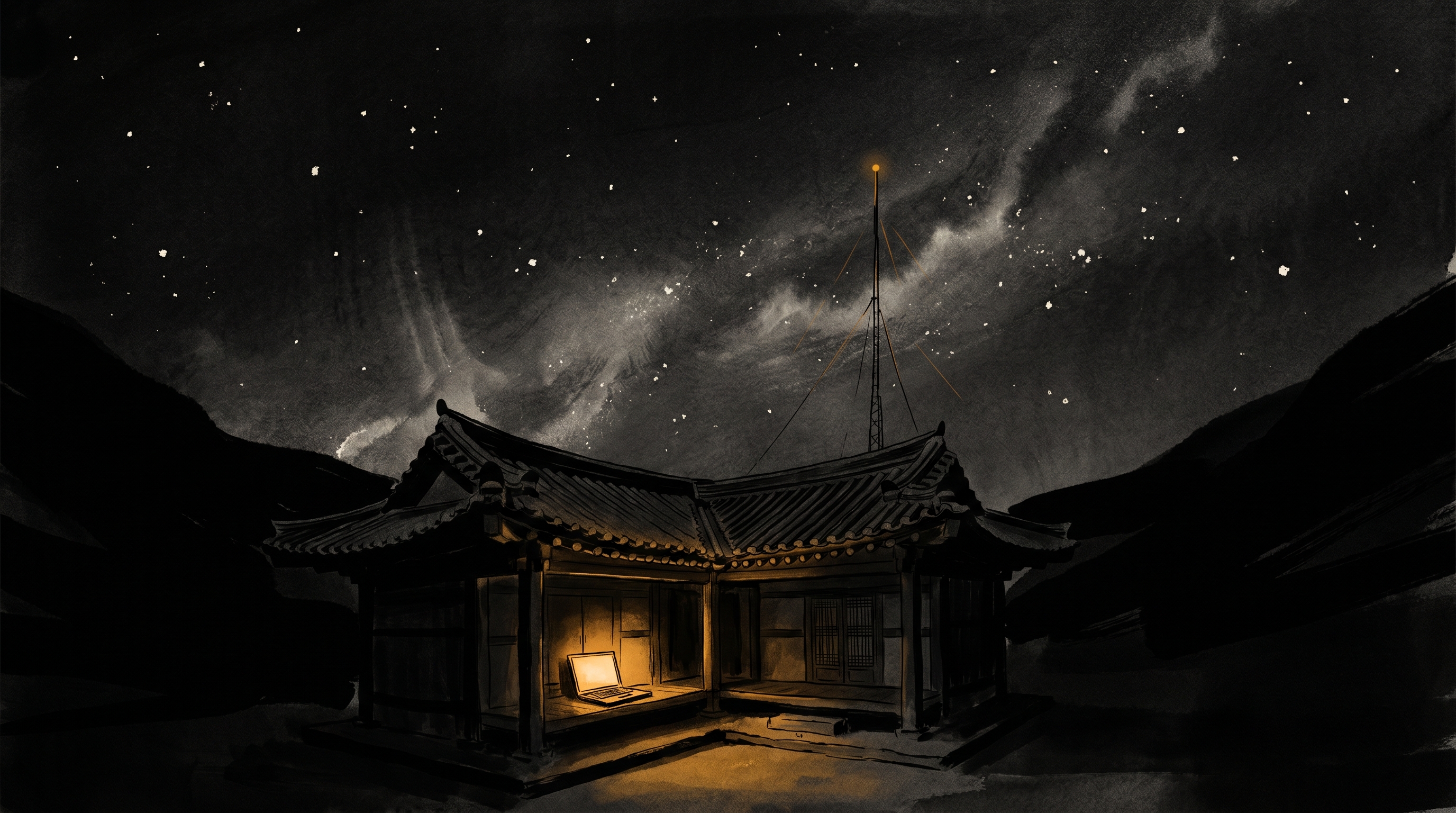
A shortwave tower rising above the eaves of a Yeongyang ancestral clan house. Beneath it, a small laptop glows like a lamp. Four centuries of time and the next hundred years meet together under a single roof.
The Small Ball Pokgant Threw
The day I heard that Pokgant's Yeongyang video had nearly reached half a million views, I found myself scrolling through the comments until I couldn't get up for a long while.
"How can a region come back to life?"
The question that people living in Yeongyang hear most often but find hardest to answer lay right there in the middle of that video. We in Yeongyang are now trying to receive the small ball Pokgant tossed up. We are trying to decide together where to throw it back.
This essay is a note written from the position of someone receiving that question in Yeongyang. If I may state the conclusion first, I believe Yeongyang is in the very best position to receive it. Because we are the slowest to be reached, the most disconnected, and the most pristine.
Yeongyang Has Been a Village of Disconnection from the Start
Yeongyang was from the beginning a place that set out bearing disconnection.
In the late Joseon period, when scholar Galaim Yi Hyeon-il (1627–1704) moved his residence to Byeongok-ri in Ibam-myeon, Yeongyang County, he was forty years old. He tied a knot in the Tobgye scholarly lineage descending from Kim Seong-il and became a great elder of the Yeongnam school. Through his great-great-grandson Daesan Yi Sang-jeong and onward to Jeongjai Ryu Chi-myeong, the scholarly lineage did not fray precisely because the path to Yeongyang was long and steep.
Two hundred eighty years later, in 1920, poet Cho Ji-hun of the Cheongrok school was born in Jusil Village, Ilwol-myeon. Nineteen years before him, in Gamcheon Village, Yeongyang-eup, poet Oh Il-do was born—and he would later found Korea's first journal devoted exclusively to pure poetry, "Siwon." And then, one generation later in 1948, novelist Yi Mun-yeol was born in the ancestral house of the Jaeryeong Yi clan in Duedul Village.
Within thirty square kilometers, three major names of modern Korean literature appeared in succession. Tracing back four hundred years further, one finds a scholarly knot tied. People call Yeongyang a "village of letters." But precisely speaking, it should be called a village of disconnection. A place where the roads ended and the words ran deep. A place where, because the roads ended, the ending was not deprivation but condition itself.
Disconnection Is Not Deprivation but a Condition for Contemplation
I often say that disconnection is not deprivation but a condition. Unfolded, it goes like this:
Any thought takes on its own shape only when it collides with other thoughts. For that to happen, you must step away for a moment. It is only in a place of separation that the thoughts inside you begin to speak to you. Disconnection is the condition where that speech begins.
An American scholar once wrote a single line in a book called Deep Work: "The result of good work is the product of time invested and depth of concentration." In a place where notifications constantly interrupt, that variable—concentration—approaches zero. The product is zero. You must change your place. To a place where signals arrive slowest, where noise is faintest.
Yeongyang is such a place, by accident. Not by accident, but such a place it has been for four hundred years.
Of course disconnection alone does not automatically produce scholars and writers. There must also be the family lineage and the village school, the culture of publishing that takes writing to its completion and binds it into books, the community where fellow learners are always near. But beneath all of this lay disconnection. It is a place that would have collapsed along with everything else if disconnection had disappeared.
Here, a move is possible that the city cannot make.
Why Haven't We Realized This?
Some of you reading this far have likely already heard similar words somewhere.
Digital detox, slow life, healing villages, farm-based schooling, places of contemplation. Over the past twenty years, Korean society has cycled through similar phrases, and each time a brief wind stirred and then faded. Many small villages, including Yeongyang, have been the same.
To summarize this repetition in one word — it was inertia.
Inertia has two layers.
The external inertia is clear. City people treated disconnection as a tourism commodity they could briefly touch and carry home. A place you leave after a one-night, two-day visit, taking pictures and departing, is landscape from the perspective of the visitor but not a place from the perspective of those who live there. You can buy and sell landscape, but you cannot buy and sell a place.
The internal inertia is somewhat more painful. A place that could not boast of its disconnection and was ashamed of it. A place that received the words "What is there here?" with a backward step and a dismissive wave. A place that hid its disconnection under wild vegetable festivals and ice festivals, but the identity concealed was not something that disappeared when hidden. The deepest inertia was the time we never called ourselves clearly within ourselves.
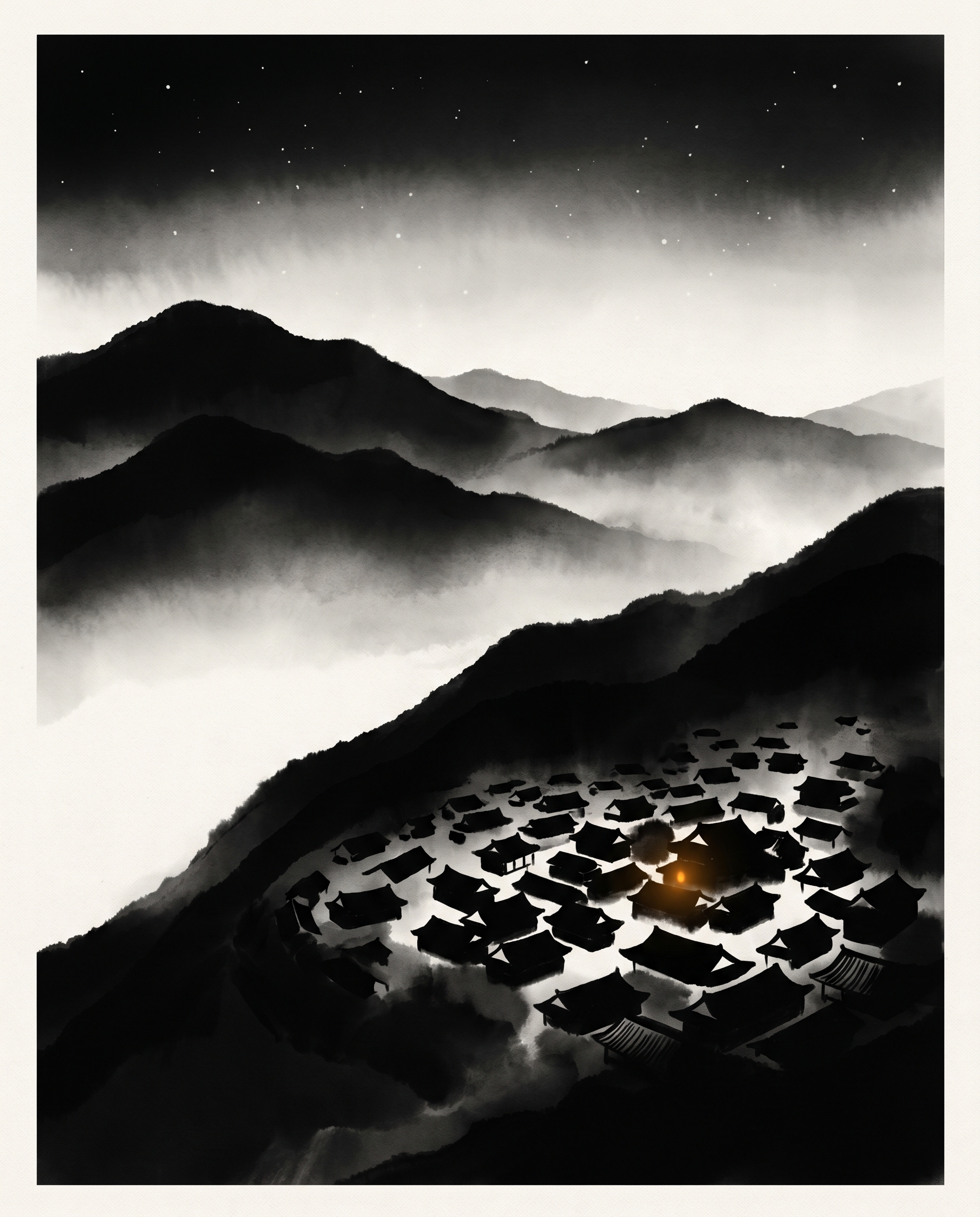
A Korean clan hanok village—a place where mountains embrace the village. A single light glowing in the darkness is a signal that someone is still awake.
The Picture Kamiyama Already Showed
In Tokushima Prefecture, Japan, there is a village called Kamiyama. A mountain village six hundred kilometers from Tokyo, its population is projected to decline from twenty-one thousand in 1995 to fifty-four hundred by 2050. In Japan, such villages are called marginal settlements—places where a village's autonomous functions are becoming too difficult to operate properly.
In 2011, a small nonprofit called Green Valley in that village took a counterintuitive action. They attracted IT companies from the city to open their offices in empty rural houses. "Headquarters in Kamiyama, one satellite office in Tokyo"—an inverted map.
Over the ten-some years since, engineers and digital writers now form a strand of Kamiyama's population. The foreign artist residency program, which has been running since 1999—a place where foreign artists stay for about two months and create works together with residents—has added another knot to the village's identity.
One crucial fact must be emphasized here:
Kamiyama did not fill in its disconnection with IT. Rather, it was an approach of preserving disconnection and laying IT anew upon it. The rural quietness remained as it was, and the village proved through lived experience the hypothesis that new possibilities become available within that quietness.
Yeongyang now stands before a similar threshold.
The Whirlwind Pokgant Raised
For inertia to break, either a great crisis must arrive, or wind must blow from outside.
The crisis has been here for a long time. Yeongyang's population shrinks year by year, and no one can confidently say the line of township school closures has ended. Yet the crisis has been beside us so long that we forget it is a crisis. When crisis becomes daily life, crisis ceases to function as crisis.
Pokgant's video was a wind that briefly awakened our numbness.
Nearly half a million people seeing Yeongyang is an event that, since Duedul Village was first introduced to the Korean literary scene in 1979, has never happened. And not with disdain but with a gentle gaze toward remoteness and purity. It was precisely the opposite tone from a certain incident in May 2024.
I will record one sentence about this wind:
Pokgant gave us a whirlwind, and whether it becomes a typhoon is our task.
I have been sitting with this sentence for three days. If we let the wind we receive simply pass through, it remains only a brief wind. If we receive it in our place and send it out once more, only then does it become a typhoon.
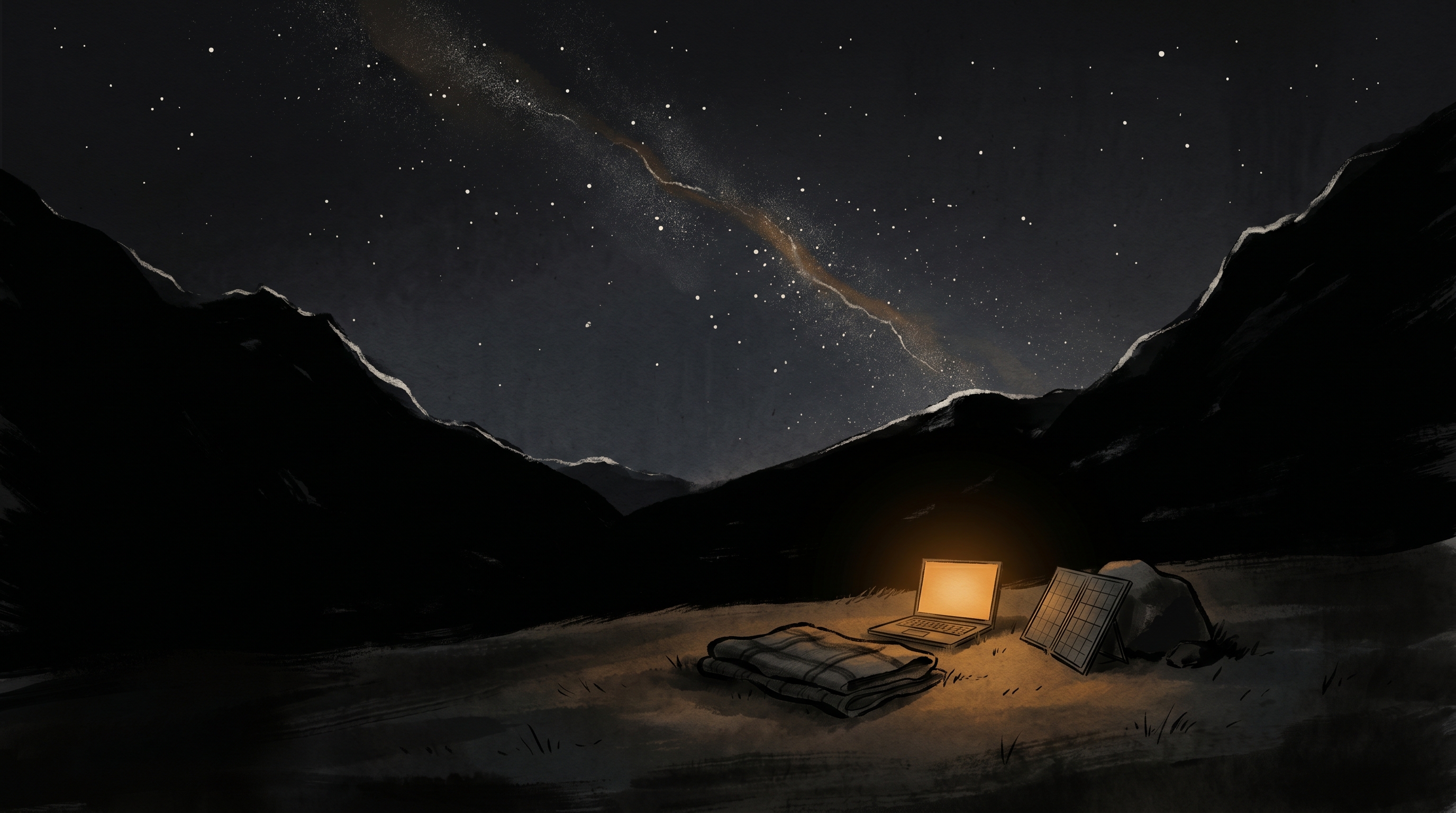
In the middle of a dark mountainside, a laptop unfolds beside a small solar panel. A tool that works even where everything is cut off is the self-instrument that humans of the next age must hold in their hands.
The Way We Receive — Not Detox but an Inflection Point
There must be a way to receive. So we are creating a new form we call "callsign."
On June 27th and 28th, we will hold a small two-day event on the mountainside of Yeongyang County. Its name is Off-Grid AI Camp Yeongyang. Thirty participants, twenty-two hours without cloud or WiFi, each person bringing a laptop and installing AI directly on it themselves.
It is not a digital detox.
More precisely, the place where we now stand is not detox but an inflection point. As we enter the age of AI, the very definition of humanity is being rewritten, and the list of tools essential for living as human is being composed anew. The human of the past hundred years and the human of the next hundred years may not be the same human.
Sometimes I imagine this:
If you fell on an uninhabited island, what would you take? You might take several days' worth of food and water. But if I am honest, I think I would take instead a small solar panel and a single laptop. But that laptop would need to have installed on it an AI that works smoothly even without internet, one that carries relatively current information right up to the moment before the shipwreck.
This imagining is not mere play.
The list of conditions necessary for living as human really is changing like this. A tool that works in your hands even without the cloud, a tool with which you can converse about humanity's knowledge up to yesterday without external signals—there lies the list of things the human of the next age must hold in their hands.
Our ancestors thought deeply through disconnection. We too need once to cut everything away. But cutting alone is not enough. We must carry together both the cutting and the essential tool we must keep in hand in the place where everything is cut off.
We build that tool together in the space of the callsign. The AI installed in the laptop, the small network we ourselves tie together, the shared drive and chatroom and bulletin board we build with our own hands. Living a full day for twenty-two hours without once calling upon the cloud, and writing a reflection right there in that place. This is the promise of one night and two days.
There is a picture this place shows society:
What must a person living in the age of AI hold in their hands? Not a person who works well only in places where everything is connected, but a person who can function even in places where everything is cut off—that is the self-instrument that the human of the next age must hold.
In the place where scholar Galaim Yi Hyeon-il tied a scholarly knot in the mountains of Ibam-myeon four hundred years ago, we are now tying the tools of the next hundred years. Disconnection was an asset then, and it is an asset now.
When evening comes, we gather by a bonfire. Perhaps a cup of makgeolli from Yeongyang Fermentation Workshop 1991 called "The Milky Way" finds its way into our hands. On the label is a single line:
"Brewed with the heart of counting stars, a milky way."
The first day I saw this label, I stayed there for a long time. And so for the callsign's hero copy I have chosen to place this line beside me:
While gazing at the stars and sipping a cup of milky way makgeolli, let us draw the future.
Not a promotional slogan, but a proposal for how to live.
Whether the wind Pokgant raised becomes a typhoon or scatters as a brief breeze is not decided by Pokgant's video. It is decided by Yeongyang. How Yeongyang receives that wind determines the shape of the next move.
From slowest Yeongyang, we are trying once to receive. Waiting for those who will gather with us on June 27th, so that we may receive well.
We transmit the callsign.
— Yeongyang County AI Association · SF://
From slowest Yeongyang. / Filed from the slowest village, Yeongyang.
Original video (Pokgant Channel) ↗ https://youtu.be/BDpjr2oY6ko
Callsign page ↗ yyaia.org/callsign-1
The images in this piece were created with an AI image-generation model (Gemini 3 Pro Image) and reviewed editorially.
Reference
- Yeongyang's Literary Lineage and Three Writers — Travel Eye
- Jusil Village, Cho Ji-hun's Birthplace — Gyeongbuk Daily
- Duedul Village and Yi Mun-yeol — Yeongyang Office of Education
- Galaim Yi Hyeon-il — Korean Ethnic and Cultural Encyclopedia
- Yeongnam School — Our History Net
- Cal Newport, Deep Work
- Kamiyama Village Regional Revitalization — Danbi News
- Kamiyama Digital Nomad Village — Mobinside
- Pokgant Channel — YouTube

This article was produced with the deep-thinking engine
Simthink Engine (深 Think) of Myeongseong Simjae.