
JTBC weekend drama · Written by Park Hae-young / Directed by Cha Young-hoon
Starring Koo Kyo-hwan and Go Yoon-jung · 12 episodes · First aired 18 April 2026
JTBC official page → · © JTBC

It was a few days after the lecture had ended. There is a particular kind of dawn that arrives once a large piece of work has been closed — when the shoulders quietly drop and a strange emptiness settles into the place where they had been holding tension. The lecture had meant something, I knew that, but the shape of its result didn't quite match what I had expected. On that dawn I was watching a drama: 《모두가 자신의 무가치함과 싸우고 있다》 (Everyone Is Battling Their Own Worthlessness), the JTBC series by writer Park Hae-young and director Cha Young-hoon. Two characters — Hwang Dong-man and Byeon Eun-ah, whose particular shapes of lack mirrored each other — meet for the first time in the language of the heart. Above the single word "Help me," they hold each other still. I'll confess: I cried.
I told myself I was identifying too much. The mind had already drifted in that direction. What is the heaviest thing one carries? Perhaps it is the suspicion that I myself amount to nothing — that the work I have spent years teaching, the small banner of mission I carry, weighs nothing at all. Hwang Dong-man speaks loudly, almost compulsively, so as not to disappear. I recognized in him a particular afternoon in my own classroom, where I had spoken louder, stood straighter, performed surer than I felt. That was why I cried, I think.
But over the following days, sitting with that ache, I began to see something about the dry soil I had named. The words gap, exclusion — at least in this place — usually do not name a deliberate act of discrimination. They name something quieter. They name what is more honestly called voluntary distance. To someone who watches the world's amplitude shift every day, the change looks enormous. To someone living the same routine, in the same chair, by the same window, it arrives as one thousandth of that amplitude — a tremor too small to hear. It took me longer than I'd like to admit to accept this.

So many promises were made. So many promises were quietly let go. I'm busy. Something came up. Next time, I'll listen. The line that runs underneath all of it is: not enough, not yet. To take in something new costs energy. And the energy required, for now, is not yet warranted — that is the silent verdict. On certain dawns the verdict travels back into the teacher's mind and translates itself: what you teach is not enough; and deeper still, you yourself, in this place, are not enough. Speaking louder, standing straighter — this is, if I'm honest, the desperate work of refusing that translation.
But time itself is precise. The amount of time it takes for a domain expert to fold AI into their own way of working was, not long ago, called a month. Soon it became a week. Now there are reports of three or four days. An American automotive marketplace rebuilt its inspection workflow into a multi-agent system in four days, compressing what had been a two-day process into under thirty minutes (Cox Automotive, CES 2026). This time decays as if on a half-life curve. And lowered thresholds carry with them the protection those thresholds once provided. The walls people believed safe — when looked at closely — turn out to be made of paper, and that fact will not stay hidden much longer.
So in this last lecture I scaled back the showy demonstrations — what we sometimes call click-bang, the kind of dazzling AI trick that fills the room with applause and very little else. I held instead to two slow, awkward lines: why should we bring AI into our work, and how might each person move that work into their own version of it. Only a handful of people came, but their gaze was serious. It was less curiosity than the look of someone who had set down their hesitation, just for a moment, and decided to listen once. Even they — I suspect — already knew that without something tried on a Tuesday afternoon the week after, the day-to-day would not change. Half of teaching, then, takes place outside the room where teaching is done.
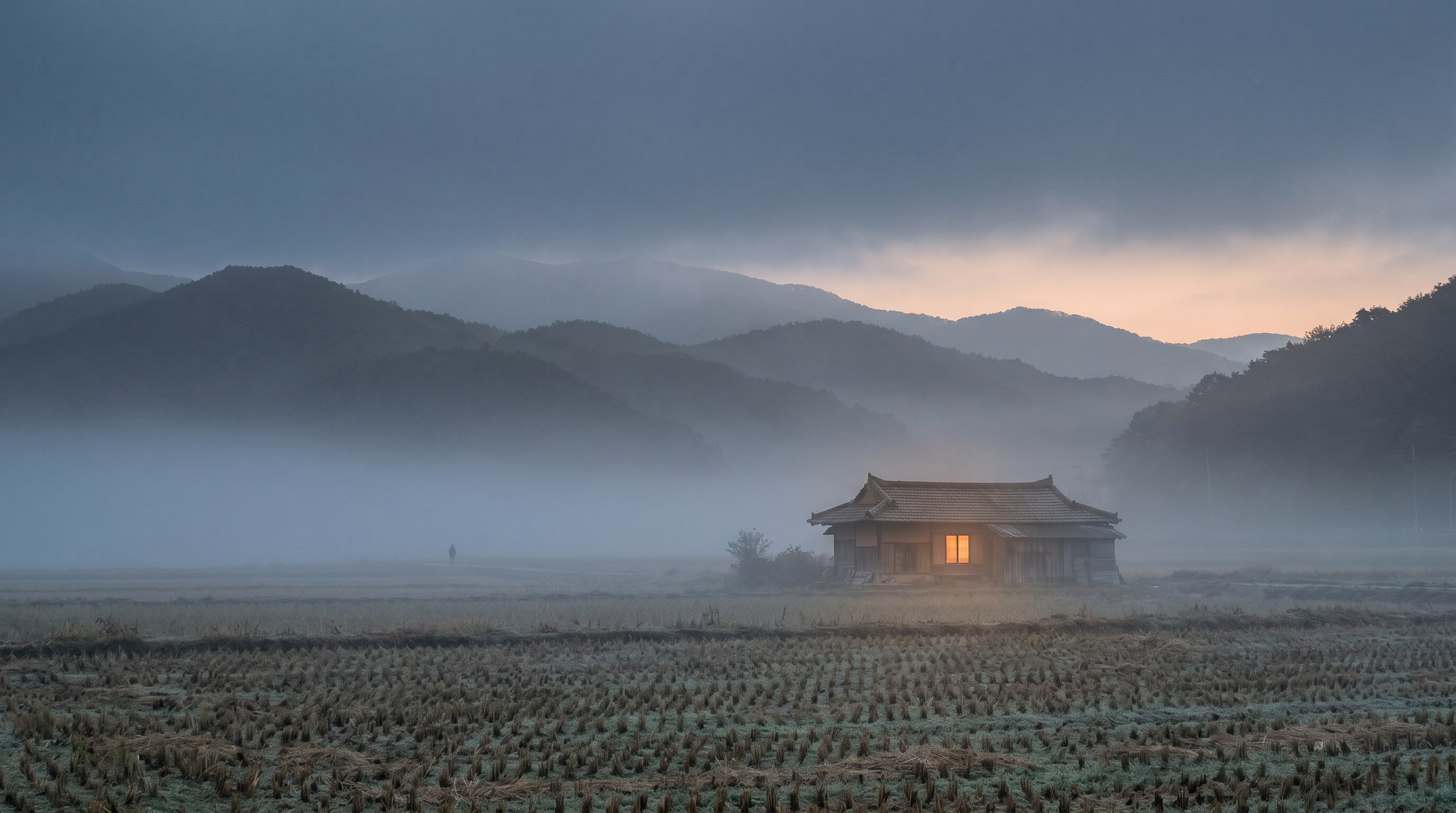
So the conclusion grows simple. Don't try to prove worth or weightlessness in front of others. The thing whose weight matters here is not me but the change I have been describing. The shorter the half-life becomes, the faster — its inverse — the weight of what one says about that change grows. By that time, people will look elsewhere for someone, or work their own way through. A teacher is no messiah. The work is plainer: to picture the shape of this place three or five years from now, and to set down, in advance, the small handful of tools and the small handful of words it will need — a line at dawn, a line at noon, a paragraph during the lecture's hour. To quietly maintain a small fortress in Yeongyang, yes — but not only Yeongyang. In every technological hinterland the wave reaches late, so that someone, when the time comes, can still hold the perimeter of their own life.
The most honest way of refusing to disappear, it turns out, is not speaking louder in front of others, but quietly preparing the place where they will eventually arrive. And so, once more, I gather a little courage and sit at the dawn desk. Not with a pen — but in conversation, again, with the assistant who never sleeps. To take the change I have been recommending in classrooms and place myself, daily, inside it. To write the future down a line at a time. To not leave the chair. Because the act of placing a single seed in dry soil happens, in the end, only at the hands of the person who refuses to leave the ground. That, this dawn, has quietly taught me again.

This article was produced with the deep-thinking engine
Simthink Engine (深 Think) of Myeongseong Simjae.